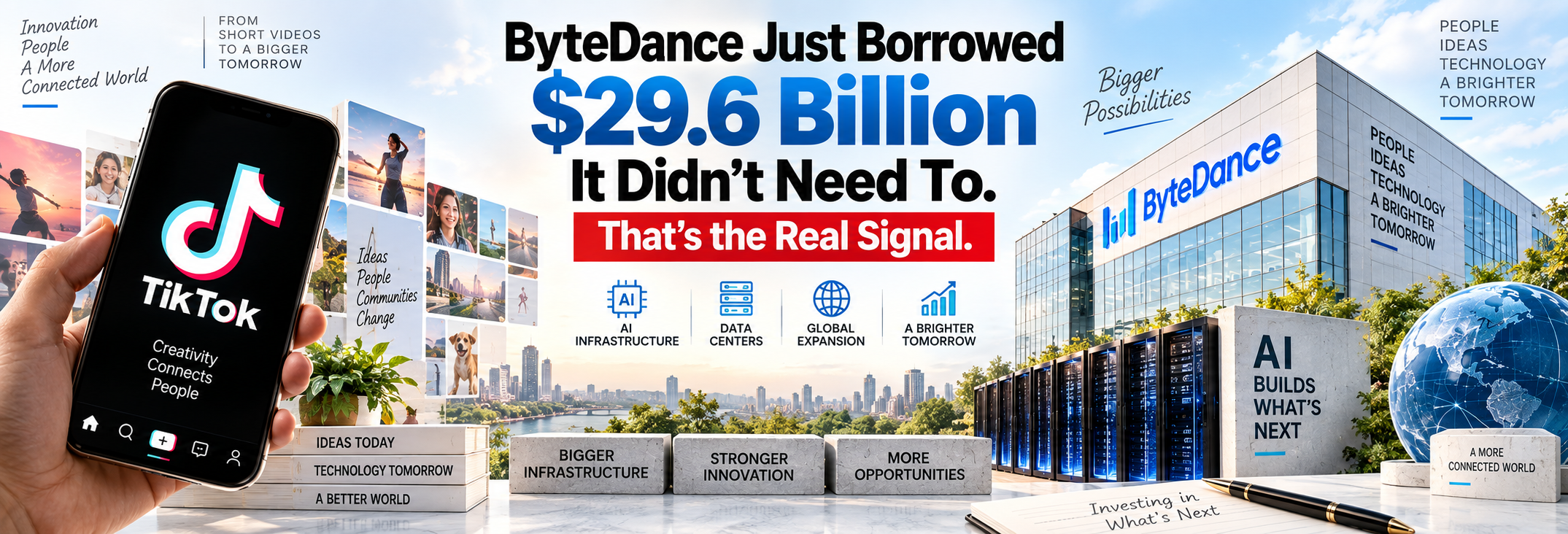
ByteDance Just Borrowed $29.6 Billion It Didn't Need To. That's the Real Signal.
What actually happened
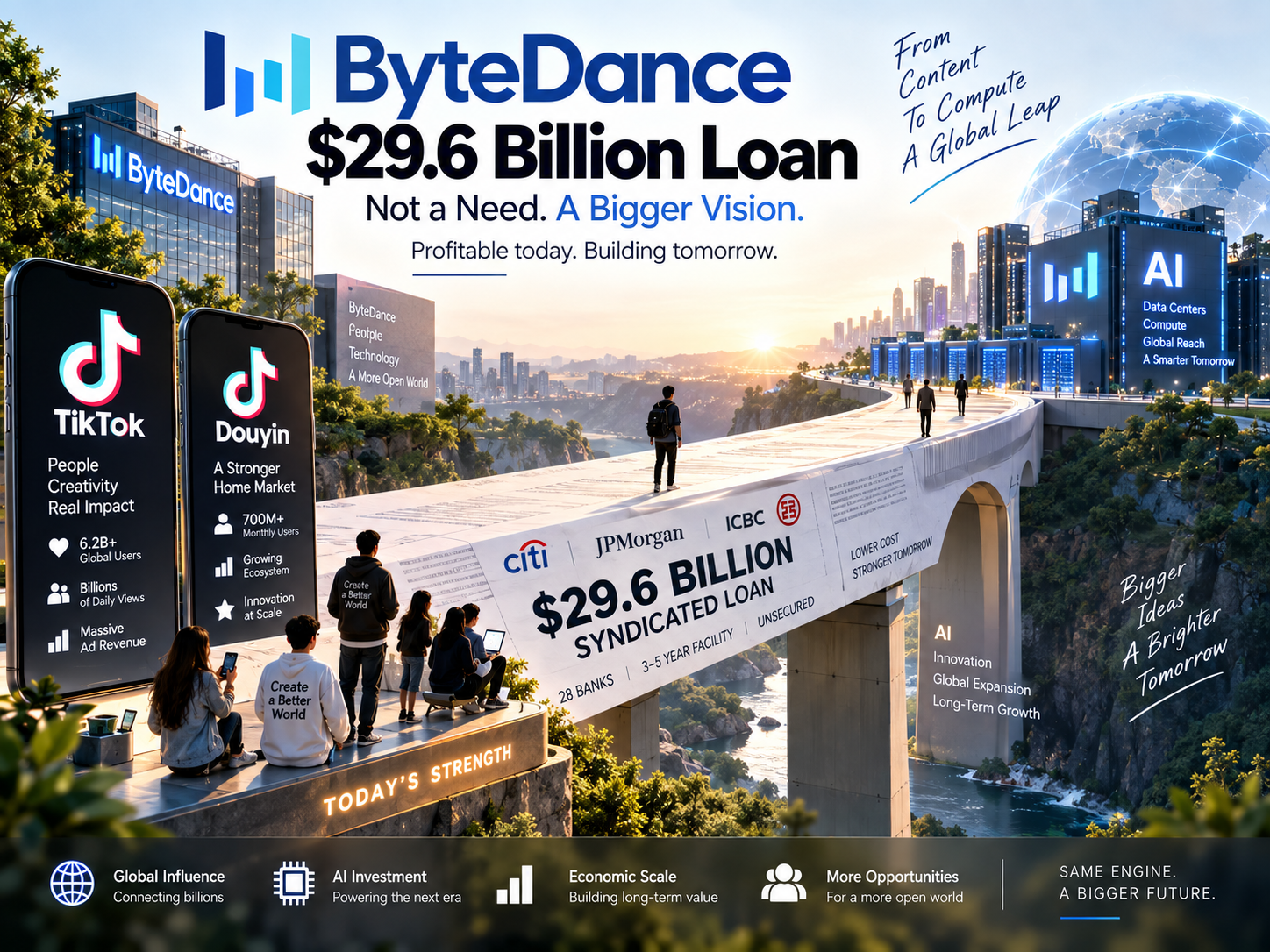
ByteDance signed a $29.6 billion syndicated loan with 28 banks in mid-September, after originally approaching lenders for just $20 billion and getting flooded with more than $30 billion in orders before the deal even closed. The three-year facility, extendable to five, is Asia's second-largest dollar-denominated loan this year, behind only SoftBank's $40 billion bridge loan for its OpenAI stake.
Fifteen Chinese state-backed banks committed a combined $18.9 billion — 64% of the total — while ICBC, Bank of China, HSBC, and roughly two dozen other Chinese, American, European, and Singaporean lenders filled out the rest, coordinated by Citigroup and JPMorgan. Officially, the money is earmarked for "general corporate purposes"; multiple people with direct knowledge of the deal say it will mainly fund AI infrastructure and data centers outside China. Bloomberg Decrypt
Why now
ByteDance is reportedly weighing capital spending as high as $70 billion this year on AI data centers and compute, with that figure potentially climbing toward $100 billion next year if demand holds — more than double what it spent in 2025. That kind of number is why even a company sitting on some of the most reliable ad revenue in tech is turning to debt markets rather than funding the buildout purely from profit.
The pricing detail matters as much as the headline size. ByteDance borrowed at 68 basis points over SOFR — tighter than the 85 basis points it paid on its 2024 loan — even as Asia's broader syndicated loan market just had its weakest first half in 16 years. Locking in cheaper debt now, while the AI infrastructure race only accelerates, gives it a real financial edge over waiting and borrowing later at worse terms.
Startup Fortune Tech Startups
The part that's actually unusual: no collateral required
This wasn't a secured loan against assets or a stock portfolio — SoftBank's $40 billion facility, by comparison, was borrowed against its securities holdings. Banks extended ByteDance nearly $30 billion essentially on the strength of its name and its cash-generating business alone, which multiple sources described as genuinely rare at this scale. Getting nearly 30 banks comfortable enough to lend that kind of money unsecured required something ByteDance almost never does: opening its books. The company is notoriously private about its financials — but it reportedly gave lenders detailed financial access as part of the underwriting process, a meaningful crack in the opacity of a company used by well over a billion people worldwide.
TechTimes Tech Startups
Why it matters
The real signal isn't that ByteDance needed $29.6 billion — it's that a company profitable enough to self-fund chose leverage instead, and chose it on unsecured terms that only a handful of companies globally could access. Debt keeps ByteDance private and avoids the scrutiny and dilution an IPO or equity raise would bring, while still giving it several years of runway to compete in a capex race where training models, securing chips, and reserving data center capacity all require billions spent well before any return is guaranteed.
It also lands at a specific moment in ByteDance's story: TikTok's US business was spun into a separate, US-controlled joint venture earlier this year, with ByteDance retaining a 19.9% stake — meaning the same cash-generating engine now underwriting this loan is partly reshaped by a deal that was, until recently, an open political question in Washington. Two of the biggest AI infrastructure bets of the year — SoftBank's $40 billion and ByteDance's $29.6 billion — are now both funded almost entirely by debt rather than equity, a pattern that says as much about how expensive the AI race has become as it does about either company individually.
CoinCentral
FAQ
How much did ByteDance borrow, and from whom?
$29.6 billion from 28 banks, including ICBC, Bank of China, HSBC, and roughly two dozen other Chinese, American, European, and Singaporean lenders, coordinated by Citigroup and JPMorgan. Chinese state-backed banks provided 64% of the total.
What is the loan actually for?
Officially "general corporate purposes." Multiple sources with direct knowledge say it's primarily meant to fund AI infrastructure and data center expansion outside China.
Is this loan secured against ByteDance's assets?
No — it's unsecured, relying on ByteDance's business and cash flows rather than collateral, which sources describe as unusually rare for a loan this size.
How does this compare to SoftBank's $40 billion loan?
SoftBank's loan was secured against its securities holdings to fund its OpenAI stake. ByteDance's loan is backed by its own operating cash flows from TikTok and Douyin, without pledging specific collateral.
How much is ByteDance planning to spend on AI infrastructure overall?
Reports point to as much as $70 billion in 2026, potentially rising toward $100 billion in 2027 if business conditions support it.

Tarun Punde
B.Tech AIADS@ Shri Balaji Institute of Technology & Management
I write at Metaplugs — breaking down the latest in tech, economics, and business into simple, impactful stories for everyday readers. Passionate about software testing and global finance.