Back to News
News AlertWorld AI Tech
Google Put AI Chips in Space — But the "Space Naturally Cools Servers" Idea Is Backwards
S
Author
Saumya Dawande
Published
October 3, 2026
Reading Time
4 MIN READ
Spread the Word
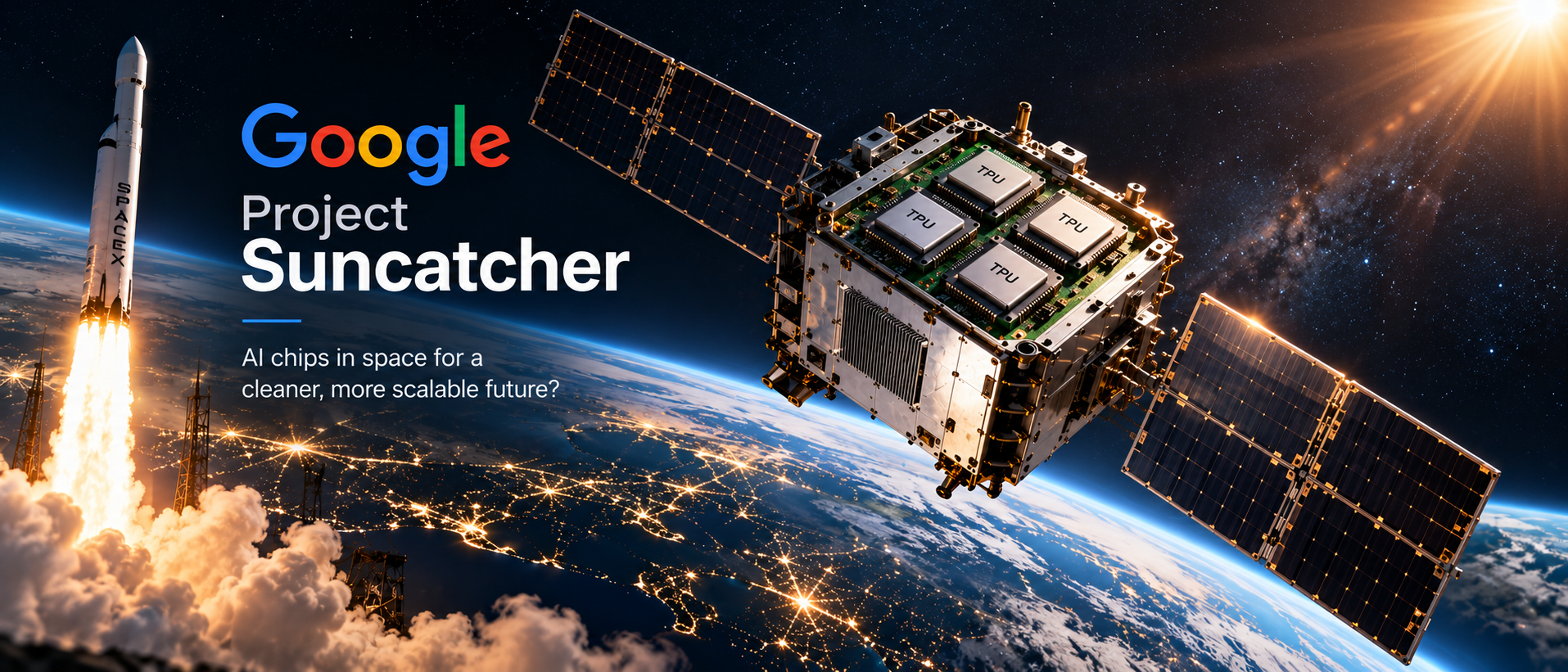
Google just launched AI chips into orbit to test space-based data centers. The twist: space doesn't cool servers easily — it's actually the hardest part of the plan
On October 1, a SpaceX rocket carrying a refrigerator-sized satellite lifted off with four of Google's Tensor Processing Units on board — the custom chips Google uses to train and run its AI models. It's the first real-world test for Project Suncatcher, Google's "moonshot" effort, first revealed last November, to find out whether AI computing can eventually run on solar-powered satellite constellations instead of power-hungry data centers on the ground. CNBC, NPR
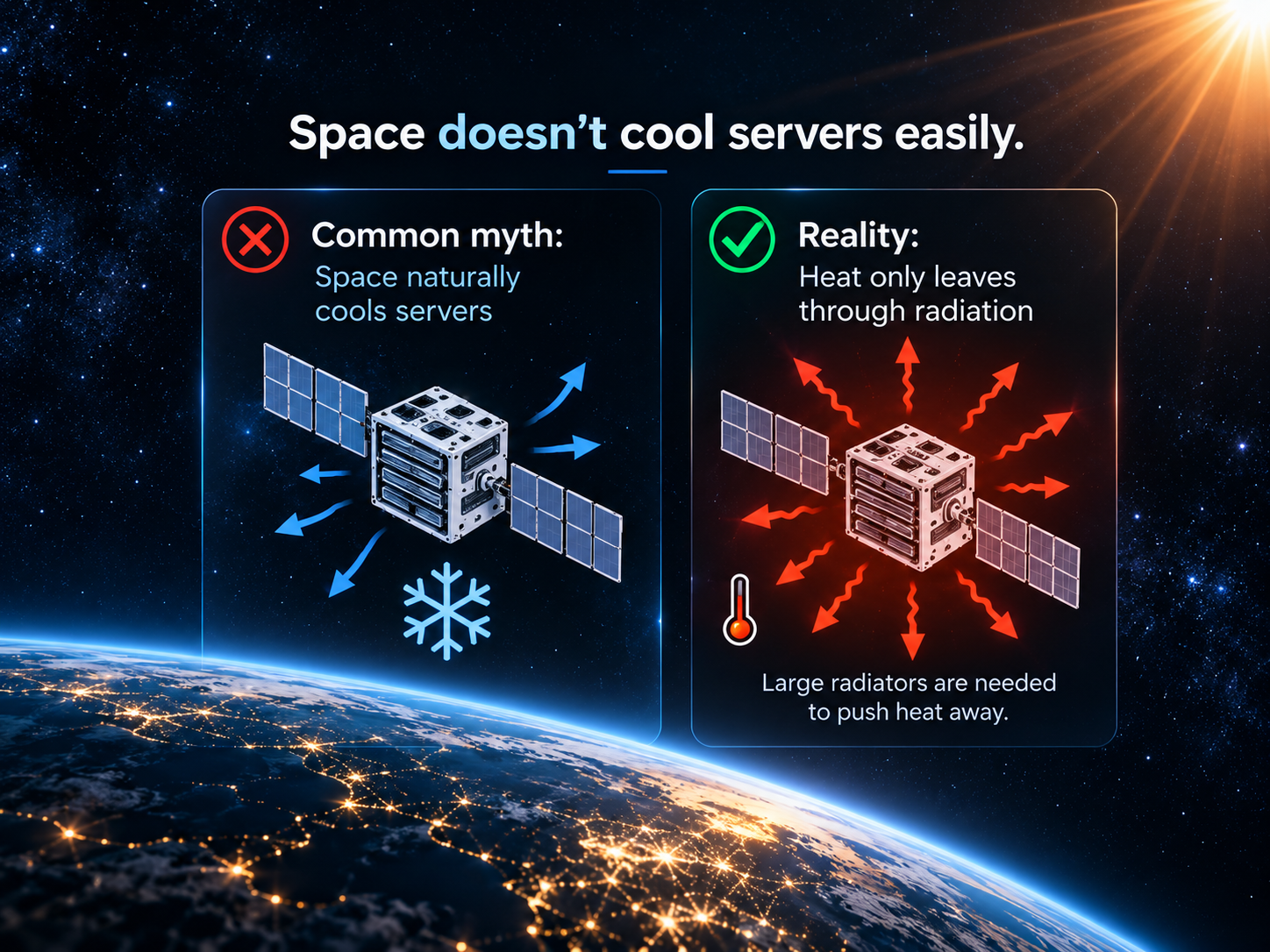
Here's the part worth correcting before it spreads: space is not an easy place to cool a server. It's a common misconception that the cold vacuum of space naturally pulls heat away from hot electronics — in reality, a vacuum has no air to carry heat off through convection, the way fans and air conditioning do on Earth. The only way to shed heat in orbit is through radiation, which means satellites built for AI computing will likely need large physical radiators to push heat away from their chips, not fewer cooling systems than a data center on the ground. An earlier Project Suncatcher prototype test reportedly found that Google's TPUs could run in space for only about 15 minutes before needing a shutdown to cool down — a sharp limit that illustrates exactly why this is a genuinely hard engineering problem, not a free win from being in orbit. KPBS, Tech Insider , Light Reading
What the mission is actually testing is narrower than "space data center," too. This single satellite carries only four TPUs — roughly the computing power of one server, not a data center — and the goal is to see whether the chips survive the stress of launch and the radiation and thermal extremes of orbit at all. Google is deliberately placing it in a sun-synchronous orbit, where its solar panels are almost never in shadow, which removes the need for heavy backup batteries. Next year, Google plans to launch two more satellites specifically to test how such satellites would communicate with each other using lasers — the networking piece a real constellation would eventually need. KPBS , CNN
The real-world pitch behind all this is the one your draft had right: AI is projected to account for nearly 12% of U.S. electricity consumption by 2030, and training and running large models on the ground consumes huge amounts of water for cooling along with that power. Because a satellite built for AI compute would be too heavy and expensive to launch as one giant unit, Google's longer-term vision is a cluster of roughly 81 smaller satellites working together as a single distributed data center, drawing directly on solar power that's roughly eight times stronger in orbit than at Earth's surface, with no atmosphere or night cycle interrupting it. Yahoo Tech
Google isn't alone in this race, and the competition shows how differently companies are approaching the same bet. A startup called Starcloud already launched a satellite carrying an Nvidia H100 chip last November and ran a version of Google's own Gemini AI from orbit. Nvidia is reportedly preparing its own test satellite. SpaceX has gone furthest in ambition on paper, saying it expects to begin deploying "orbital AI compute satellites" by 2028 and describing plans for a constellation of up to 1 million AI-computing satellites — a scale Google hasn't matched in its own public statements. KPBS , CNN
None of this is close to solved, and Google is being unusually direct about that itself — Project Suncatcher's lead, Travis Beals, called this launch "about seeing what works, identifying points of failure," not a finished product. Beyond the cooling problem, a real constellation would have to survive space debris and radiation over years of operation, and astronomers have already raised objections that large satellite clusters add to light pollution that's making it harder to observe the night sky. The launch economics are unresolved too: getting hardware into orbit, keeping it radiation-hardened, and eventually replacing failed satellites all cost money that a ground-based server replacement doesn't. Scientific American , CNN
The open question isn't whether AI's power and water demands are a real problem — that part is well documented. It's whether orbital computing actually solves it, or whether "the cold vacuum of space" turns out to be the hardest unsolved part of the plan rather than the convenient fix it sounds like in a headline.

Saumya Dawande
B.Tech AIML @ oriental institute of science technology bhopal
Engineering and tech journalist. I love exploring the impact of emerging technologies on global defense, sovereignty, and everyday life. Always looking for the real story behind the headlines.