Microsoft Just Built a Laptop That Wants AI to Stop Calling the Cloud
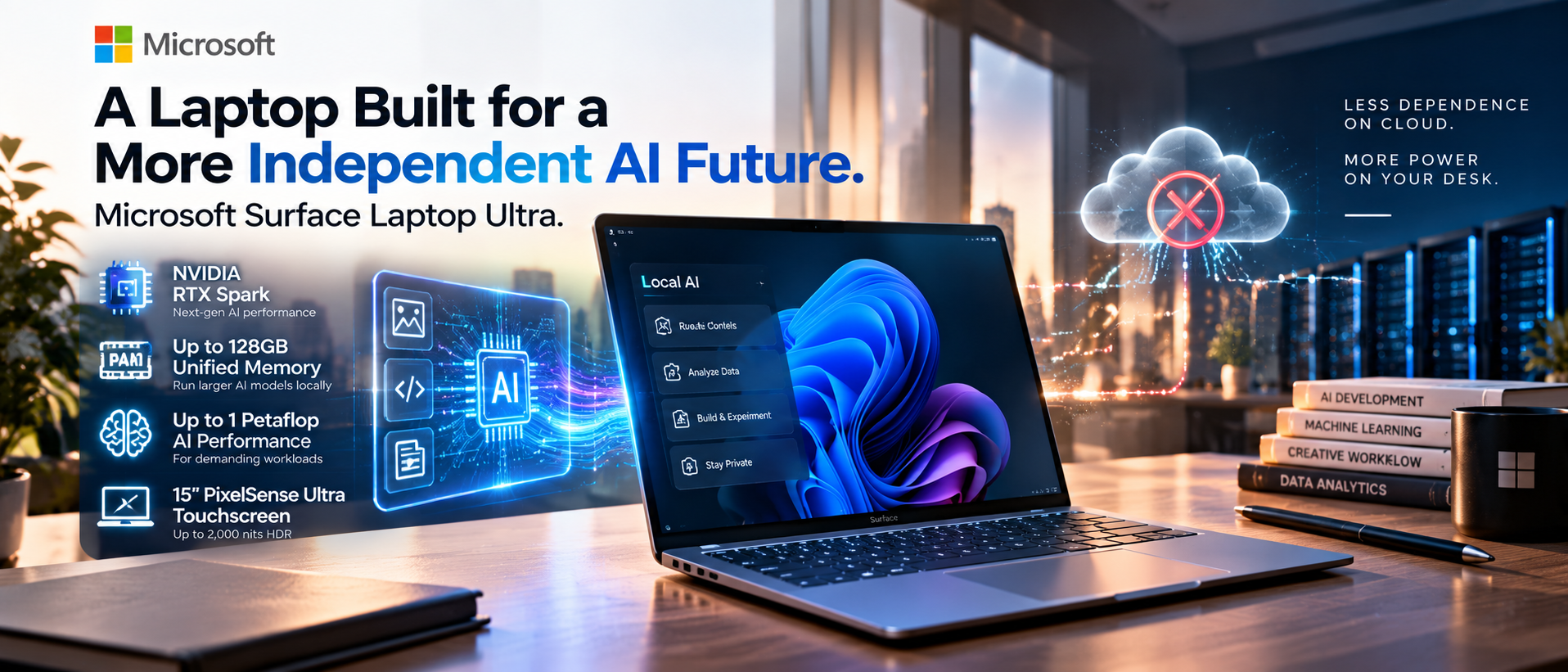
Microsoft’s new Surface Laptop Ultra brings NVIDIA RTX Spark, up to 128GB unified memory and powerful local AI capabilities to Windows, starting at $2,599.
Microsoft Surface Laptop Ultra, Surface Laptop Ultra 2026, Microsoft AI laptop, Surface Laptop Ultra price, Surface Laptop Ultra specs, NVIDIA RTX Spark, local AI laptop, AI PC 2026, Microsoft Surface
Microsoft has just introduced what could become one of its most important
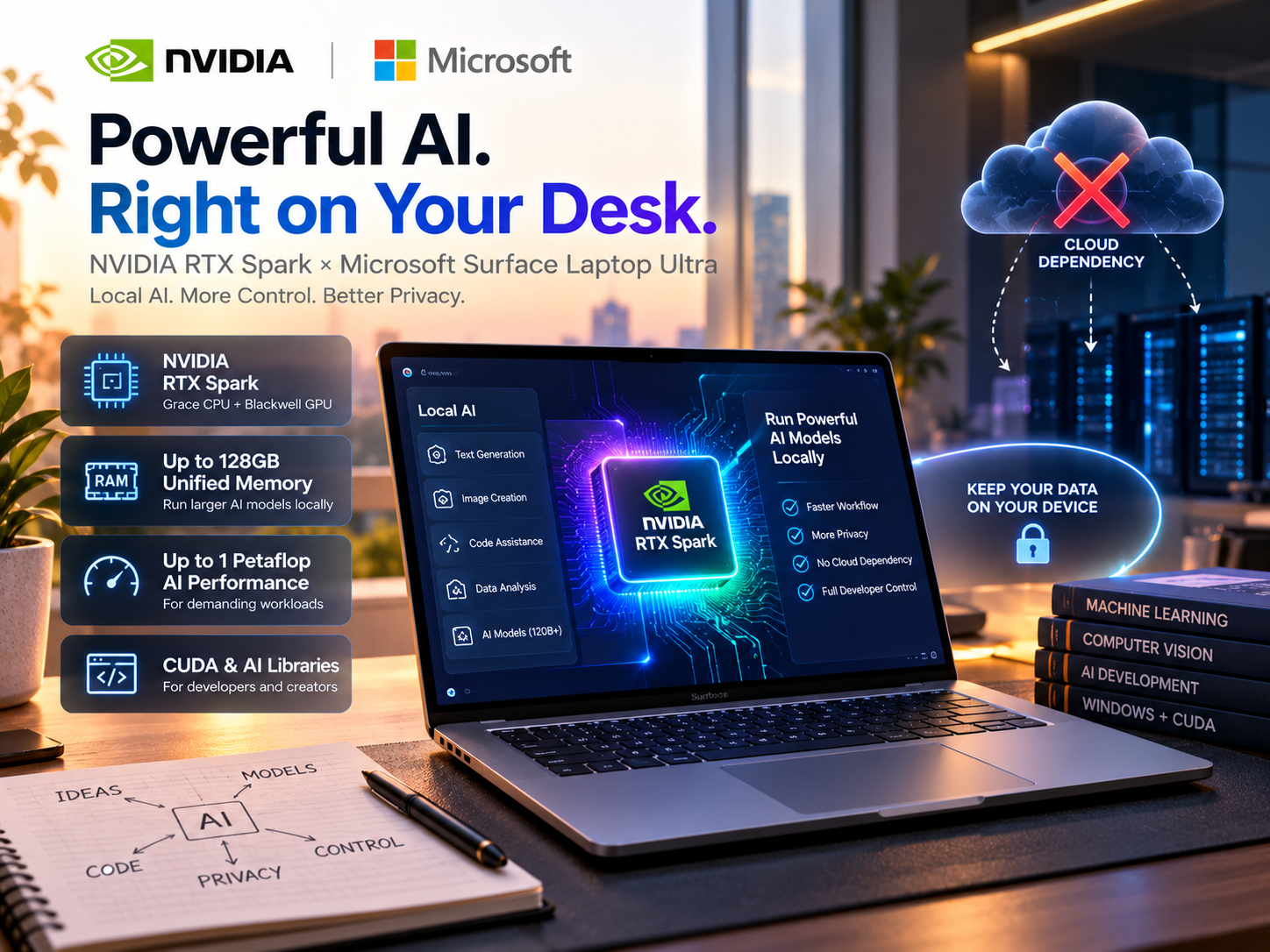
Surface devices in years: the Surface Laptop Ultra. But calling it simply a new premium laptop would miss the bigger story. Microsoft is positioning this machine as a powerful local AI computer capable of handling workloads that traditionally depended on cloud infrastructure. Starting at $2,599, the Surface Laptop Ultra combines NVIDIA's RTX Spark platform, up to 128GB of unified memory and powerful AI acceleration, making it clear that Microsoft believes the next generation of AI computing will not happen entirely inside massive data centers.
Microsoft Surface Laptop Ultra: What Makes It Different?
The biggest difference between the Surface Laptop Ultra and Microsoft's traditional Surface lineup is the level of computing power being packed inside the machine. The laptop uses NVIDIA's RTX Spark platform, combining a powerful NVIDIA Grace CPU with Blackwell-based RTX graphics and high-bandwidth unified memory. Microsoft says the system can be configured with up to 128GB of unified memory, allowing it to handle significantly larger AI models and professional workloads locally. For developers and AI researchers, this is particularly important because memory capacity can become one of the biggest limitations when attempting to run large language models directly on a personal computer.
The Surface Laptop Ultra is also designed around the growing idea of local AI, where computation happens directly on the device rather than constantly relying on remote cloud servers. Microsoft says the system can run AI models exceeding 120 billion parameters locally, while delivering up to 1 petaflop of AI performance under certain workloads. That does not mean a laptop suddenly replaces an entire AI data center, but it does show how quickly high-performance AI hardware is moving toward consumer and professional devices. For developers, this could mean faster experimentation, lower latency and greater control over sensitive data. Microsoft
Surface Laptop Ultra Price and Specifications
Microsoft has positioned the Surface Laptop Ultra firmly in the professional market, with a starting price of $2,599.99. The higher-end configurations can include up to 128GB of unified memory and up to 2TB of removable SSD storage, making the device more comparable to a mobile workstation than a conventional productivity laptop. The machine also includes a 15-inch PixelSense Ultra touchscreen with a high refresh rate and up to 2,000 nits of peak HDR brightness. Microsoft is clearly targeting developers, creators, researchers and other professionals who need serious computing power without moving entirely to a desktop workstation.
Connectivity has also received attention, with the Surface Laptop Ultra offering multiple USB-C ports, HDMI, USB-A, an SD card reader and a 3.5mm headphone jack. Microsoft is also introducing its Magnetic Connect charging system, which provides a magnetic USB-C connection while retaining the flexibility of USB-C. This approach is particularly useful for professional users who regularly connect external displays, storage devices, cameras and other peripherals. Rather than chasing an ultra-minimal design at the expense of connectivity, Microsoft appears to be treating the Surface Laptop Ultra as a machine that needs to work in a real professional environment.
Why NVIDIA RTX Spark Matters
The partnership with NVIDIA may ultimately be more important than the Surface branding itself. NVIDIA's RTX ecosystem gives developers access to CUDA, accelerated AI libraries and a mature software stack used across machine learning, computer vision, scientific computing and professional graphics. Combining that ecosystem with Windows creates a particularly interesting proposition for AI developers who want to experiment with models locally. Instead of repeatedly sending workloads to cloud APIs, developers can potentially run more of their experimentation, inference and development directly on their own hardware.
This also changes the conversation around AI privacy. Local AI means sensitive documents, source code and other information can potentially remain on the user's machine instead of being sent to external servers for every operation. Microsoft is simultaneously working on security mechanisms for AI agents, including technologies designed to restrict what autonomous software can access and execute. As AI moves from simple chatbots toward agents that can interact with files and applications, controlling those permissions will become just as important as increasing raw computing performance. Nvidia
Microsoft Is Betting on the AI PC
The Surface Laptop Ultra represents a much larger shift in Microsoft's PC strategy. For years, the standard computing model was straightforward: users interacted with applications on their computers while demanding AI workloads were processed remotely in the cloud. The emergence of powerful AI chips is changing that model. Microsoft's new approach increasingly looks like a hybrid system where everyday AI tasks can happen locally, while larger workloads can still be sent to cloud infrastructure when necessary. This could reduce latency, improve privacy and allow AI features to remain useful even when internet connectivity is limited.
The real competition therefore isn't simply between the Surface Laptop Ultra and another Windows laptop. Microsoft is effectively challenging the idea that serious AI work must happen in a data center. Apple has already pushed powerful custom silicon into MacBooks, while NVIDIA has spent years building the accelerated computing ecosystem that powers modern AI. Microsoft is now combining Windows, Surface hardware and NVIDIA technology into a single device designed specifically for this new computing era. The question is whether consumers and professionals are ready to pay workstation-level prices for that capability. Microsoft
The Bigger Picture
At $2,599, the Surface Laptop Ultra is certainly not designed for everyone, and its price could remain one of its biggest limitations. Most students and everyday laptop users simply do not need 128GB of unified memory or the ability to run extremely large AI models locally. But that may not be the point. Microsoft is targeting the developers, creators and AI professionals who are likely to define what personal computing looks like over the next several years. If local AI continues becoming more capable, today's expensive hardware could eventually become the foundation for tomorrow's mainstream computers.
The Surface Laptop Ultra therefore matters less because it is another powerful Surface device and more because of what it represents. Microsoft is betting that the next computer will not simply be a machine where people run applications; it will increasingly be a local AI workstation capable of understanding data, running models and executing intelligent tasks directly on the device. The cloud is not disappearing, but the balance between cloud computing and personal computing is beginning to change. And with the Surface Laptop Ultra, Microsoft is making a very clear statement about where it thinks that future is heading.

Vishal Sable
B.Tech AD @ shri balaji institute of technology and management
Engineering and tech journalist. I love exploring the impact of emerging technologies on global defense, sovereignty, and everyday life. Always looking for the real story behind the headlines.