LATEST NEWS
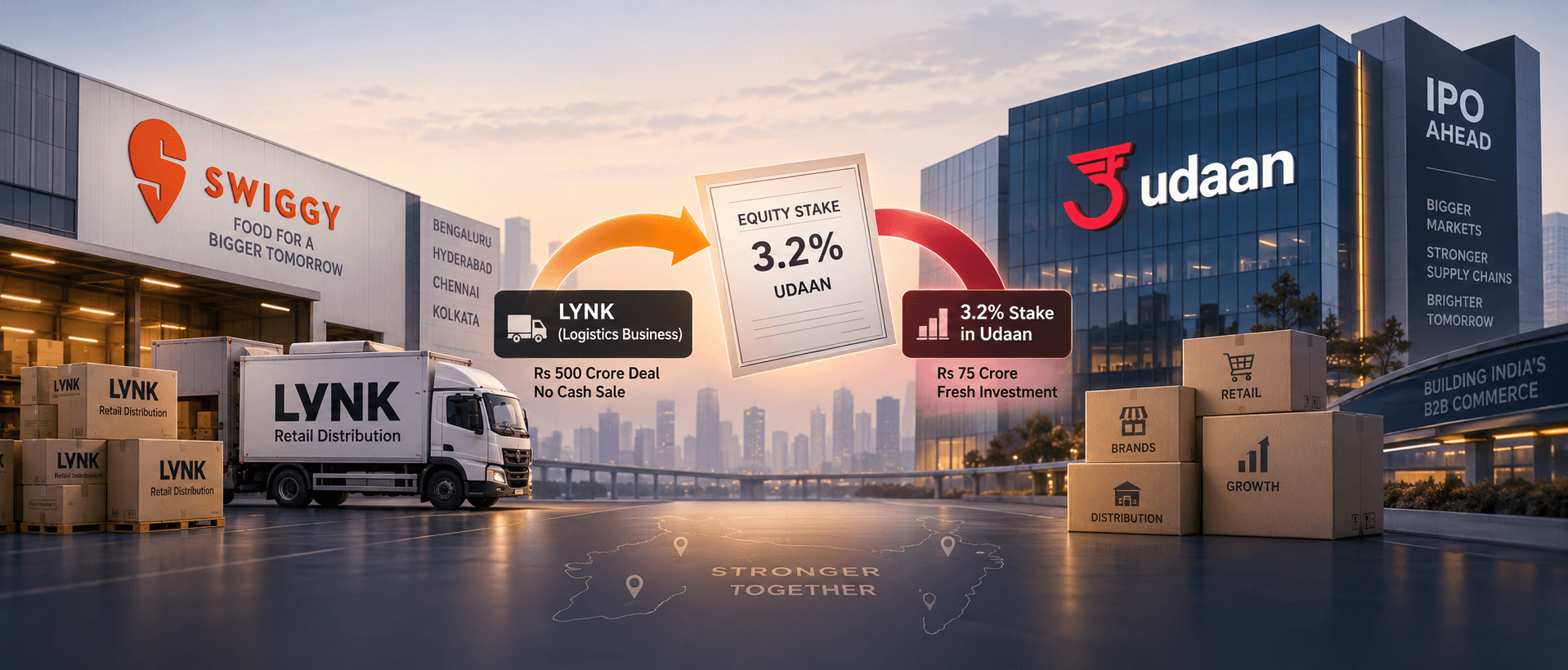
Swiggy Didn't Sell Its B2B Arm for Cash — It Bought Into the Company Buying It
September 9, 2026 5M
Back to News
News AlertWorld of Startup’s
The Great Pivot: Why 33% Early-Stage Growth Is Reshaping India's Startup Engine
V
Author
Vishal Sable
Published
April 9, 2026
Reading Time
12 MIN READ
Spread the Word

India Startup Funding FY26: $11.7B, 33% Early-Stage Surge & Profitable AI. Tracxn report: India raises $11.7B in FY26, early-stage funding jumps 33%. Fintech & SaaS lead as founders pivot to profitable AI solutions. Inside the reset.
The $11.7 Billion Reset – Why India's Startup Engine Is Healthier Than It Looks
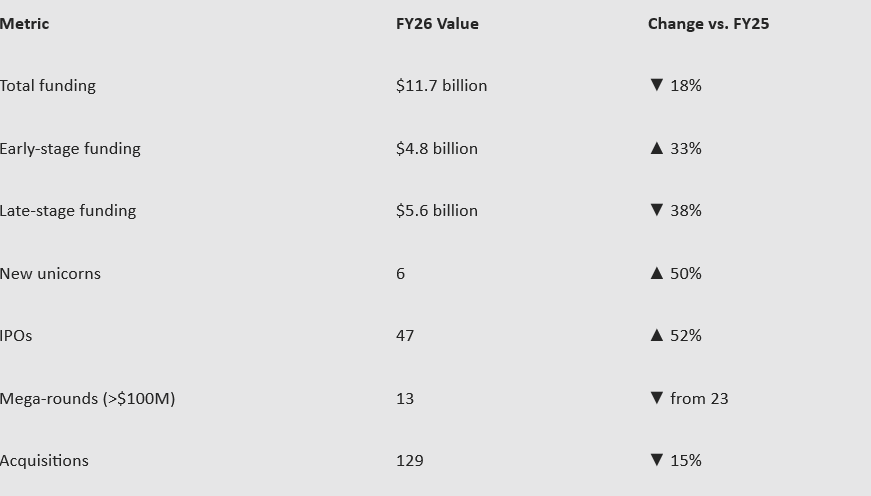
On the surface, the numbers tell a story of contraction. According to market intelligence firm Tracxn, Indian technology startups raised $11.7 billion in the fiscal year ended March 31, 2026—an 18% decline from the $14.3 billion raised in FY25. The country ranked fourth globally, behind the US, the UK, and China.
But the headline decline masks a far more important structural shift. While late-stage funding cratered by 38%—falling to $5.6 billion from $9.2 billion—early-stage funding surged by 33% to $4.8 billion. The seed stage held steady at $1.3 billion.
This is not a slowdown. It is a reset—and the early-stage engine is firing on all cylinders.
The Big Picture – India’s Fourth-Place Global Ranking and What It Means
India's tech ecosystem raised $11.7 billion in FY26, marking an 18% decline from FY25 but a 20% increase compared to the $9.7 billion raised in FY24. The funding figures come from Tracxn's India Tech Annual Funding Report 2026, released on April 8, 2026, offering a comprehensive snapshot of the country's startup landscape.
Bengaluru continues to dominate, accounting for 33% of total funding ($3.9 billion), followed by Mumbai at 21% ($2.4 billion). The city's deep tech talent pool and leadership in SaaS, AI, and fintech ensure it outpaces other hubs by a significant margin.
The year also saw six new unicorns created—a 50% increase from the four in FY25—and 47 IPOs, marking a 52% rise from 31 in the previous fiscal year. Major public listings included Lenskart, Groww, and Meesho.
Early-Stage Surge – Why Investors Are Betting on the Builders
The headline number of the Tracxn report is the 33% surge in early-stage funding to $4.8 billion—up from $3.6 billion in FY25 and $3.5 billion in FY24. Neha Singh, Co-Founder of Tracxn, explained the shift: "While overall funding saw moderation, the strong momentum in early-stage investments highlights continued investor confidence in start-ups building differentiated and scalable solutions."
The data supports this thesis.
Seed-stage funding declined 15% to $1.3 billion, reflecting a natural cooling after the post-pandemic boom.
Early-stage funding (post-seed through Series B) showed the strongest momentum, with investors placing high-conviction bets on companies with visible product-market fit and early revenue traction.
Late-stage funding saw the steepest decline, dropping 38% to $5.6 billion, as global VCs pulled back from large, capital-intensive rounds in favor of more disciplined, fundamentals-driven investing.
The number of mega-rounds exceeding $100 million fell from 23 in FY25 to just 13 in FY26. Yet large deals remained concentrated in Enterprise Infrastructure, Enterprise Applications, and Fintech, including Nxtra's $710 million PE round and Neysa's $600 million Series B.

Sector Spotlight – Fintech and Enterprise Applications Lead the Charge
Two sectors stood out as the top-performing categories in FY26: Fintech and Enterprise Applications.
Fintech: $2.4 Billion and Growing
Fintech firms secured $2.4 billion in funding, marking a 14% increase from $2.1 billion in FY25 and a 27% rise compared to FY24. The sector continues to benefit from India's deep digital public infrastructure (UPI, Aadhaar, Account Aggregator) and a massive underpenetrated market. Recent early-stage deals include Efficient Capital Labs' $7 million pre-Series A round and KreditBee's unicorn entry with a $280 million pre-IPO round at a $1.5 billion valuation.
Enterprise Applications (SaaS): $3.6 Billion Holding Strong
Enterprise Applications received $3.6 billion in funding, flat compared to FY25 but up 23% from $2.9 billion in FY24. India's SaaS ecosystem has matured into a global powerhouse, with companies like Cheerio AI raising seed capital for enterprise workflow automation and Emergent securing a $70 million Series B led by SoftBank and Khosla Ventures.
Retail: A Sector in Transition
Retail startups saw funding decline 32% to $2.4 billion, as investors recalibrated expectations after the post-pandemic e-commerce surge.
The AI Factor
Artificial intelligence is now embedded across all sectors. According to SenseAI Ventures' State of AI Report 2026, global AI investment reached $800 billion in 2025, with venture funding nearly doubling to $226 billion. In India, 75% of AI startups are building at the application layer, and nearly 80% of funding flows into this segment. A majority of these startups are reaching revenue stage early, positioning India as a key hub for AI applications.
Building for Profit – The Shift from Valuation to Value
Perhaps the most significant development in the FY26 data is the shift in founder mindset. The era of "growth at all costs" is over. Indian entrepreneurs are now focused on building profitable, real-world AI solutions rather than chasing high valuations.
The numbers tell the story:
60% of Indian AI startups are post-revenue at seed stage.
Enterprise AI contracts grew from $39,000 to $530,000 in just two years.
AI-native companies are scaling faster with leaner teams and higher revenue efficiency.
This focus on fundamentals is reflected in the increased IPO activity and unicorn creation, which indicate "improving maturity within the ecosystem, with companies demonstrating stronger fundamentals, capital efficiency, and clearer paths to profitability," as Singh noted.
One example of this trend is Sarvam AI, a Bengaluru-based AI startup in advanced talks to raise $300–350 million at a valuation of around $1.5 billion, with participation from Bessemer Venture Partners and Nvidia. The company is building sovereign AI models tailored to Indian languages and "agentic" AI systems capable of carrying out tasks such as coding and scheduling with limited human intervention.
Raja Gopalakrishnan, general partner at SenseAI Ventures, captured the moment: "The advantage in AI is shifting from those who build the most powerful models to those who deploy them effectively at scale. Indian startups, with their focus on capital efficiency and enterprise use cases, are well positioned for this transition."

Conclusion: The Engine Is Stronger Than Ever
The Tracxn India Tech Annual Funding Report 2026 reveals a startup ecosystem that has matured significantly. The 33% surge in early-stage funding signals that investors are placing high-conviction bets on the next generation of Indian entrepreneurs—those building differentiated, scalable, and fundamentally profitable solutions.
For investors, the message is clear: the reset has created opportunity. Late-stage deals may be harder to come by, but the early-stage pipeline has never been stronger. For founders, the playbook has shifted: focus on profitability, solve real-world problems, and build for the long term.
The "hype" around big late-stage deals has cooled—but the engine of new ideas is running hotter than ever.

Vishal Sable
B.Tech AD @ shri balaji institute of technology and management
Engineering and tech journalist. I love exploring the impact of emerging technologies on global defense, sovereignty, and everyday life. Always looking for the real story behind the headlines.