Back to News
News AlertWorld AI Tech
The Reasoning Revolution: Why OpenAI’s New "o1" Models Just Changed How Machines Think
S
Author
Saumya Dawande
Published
October 8, 2026
Reading Time
3 MIN READ
Spread the Word
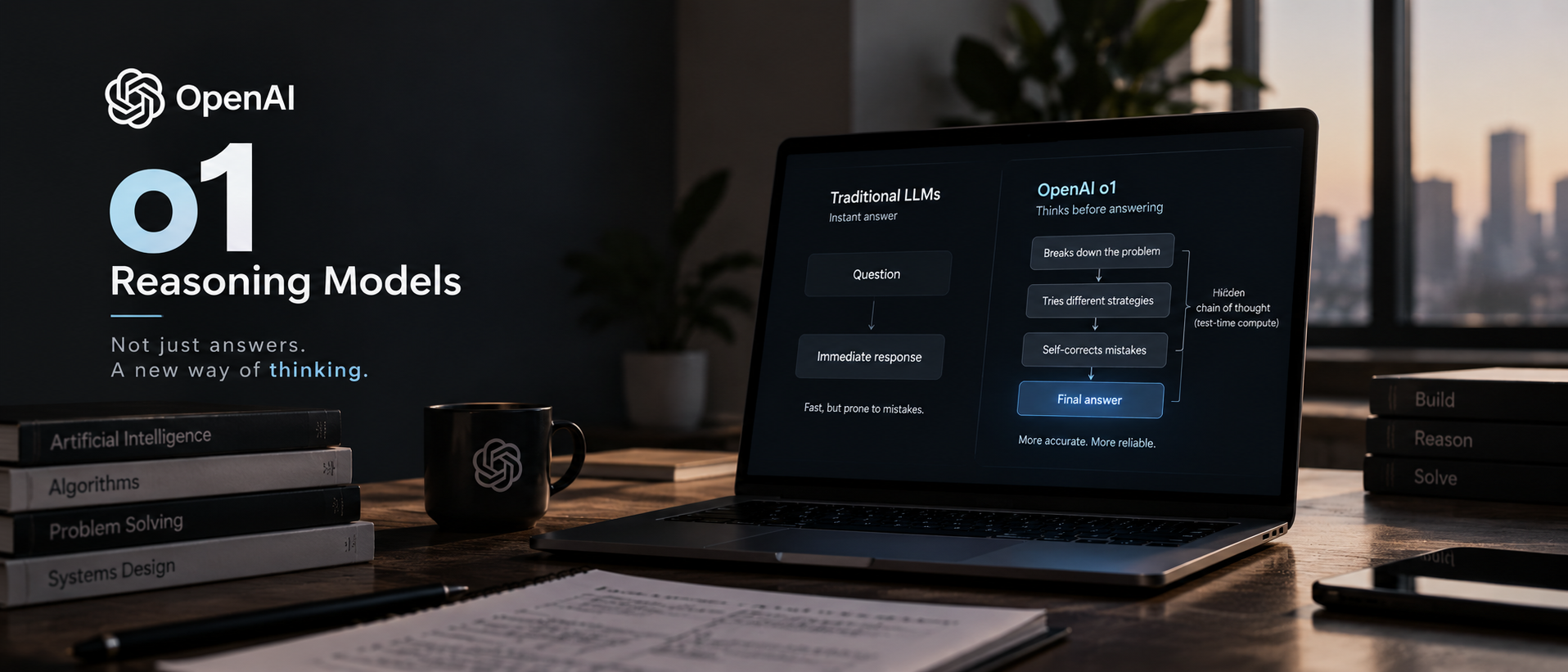
OpenAI’s o1 models replace instant word prediction with multi-step chain-of-thought reasoning, transforming how AI tackles complex coding and enterprise logistics.
For years, artificial intelligence has operated like a hyper-confident, fast-talking student—blurting out the first answer that comes to mind without a second of hesitation. But OpenAI’s latest release, the "o1" reasoning model series, fundamentally rewrites the rules of artificial intelligence by doing something entirely unprecedented: it forces the AI to stop, think, and second-guess its own logic before speaking. OpenAI
The tech industry has spent the last two years locked in a race to build bigger, faster conversational models. In late 2024, OpenAI introduced a structural pivot with the global rollout of the o1-preview and its highly efficient counterpart, o1-mini. Unlike previous models that rely on predicting the next most likely word almost instantly, the o1 series operates on a completely new optimization algorithm driven by reinforcement learning. OpenAI o1 - Wikipedia
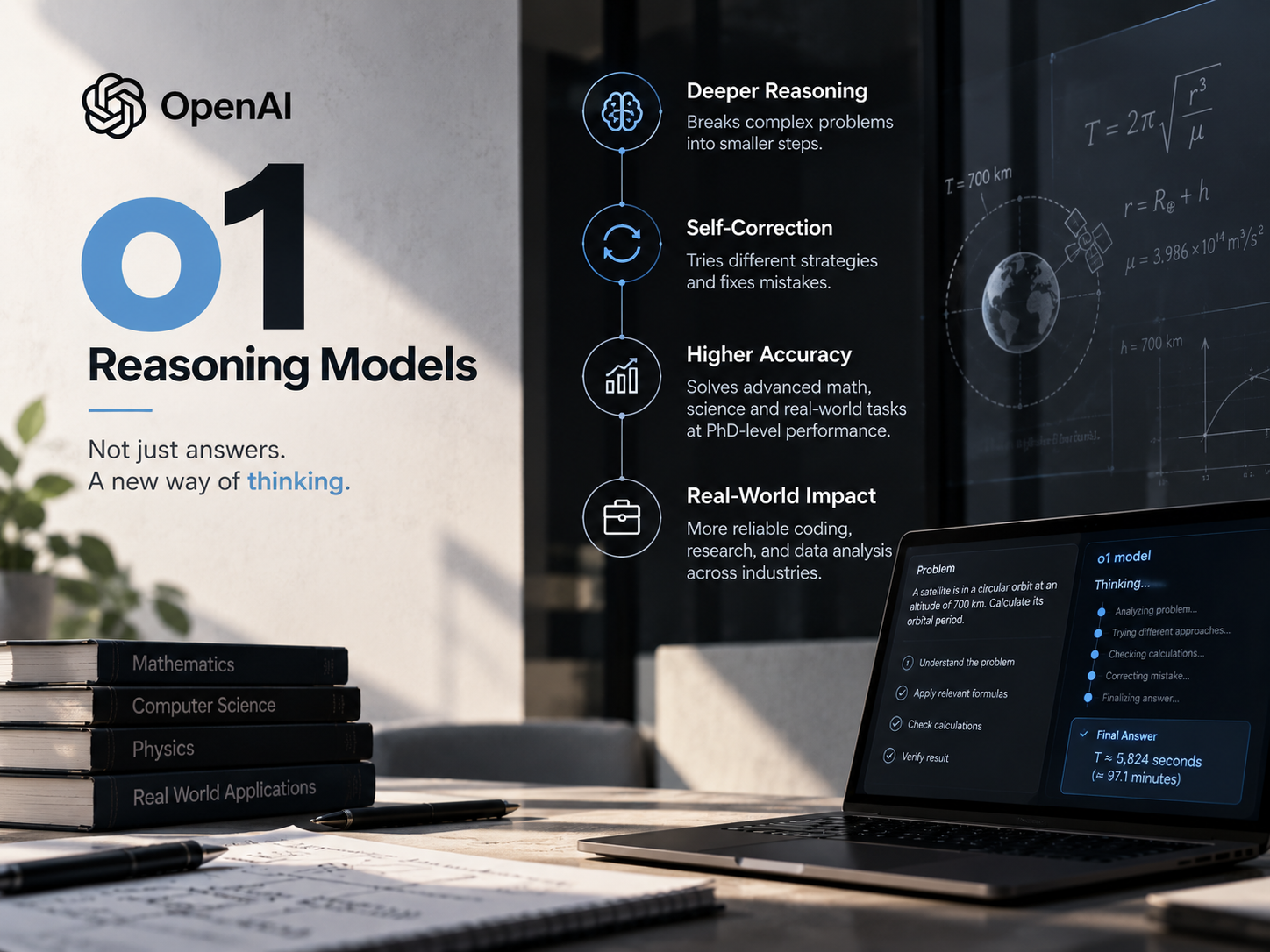
The o1 architecture was engineered to shatter this barrier by trading immediate response times for deep, deliberate reasoning. During rigorous scientific testing, OpenAI revealed that the o1 model crossed a massive threshold: it exceeded human PhD-level accuracy on the GPQA benchmark, a notoriously difficult test covering advanced physics, biology, and chemistry. MindStudio.
When an AI can actually reason through a problem rather than just regurgitating pattern-matched text, its utility in the modern workforce shifts overnight. For software architecture, this is an industry-altering shift. Instead of spitting out basic code snippets that crash half the time, reasoning models can trace logic loops, run virtual error-checking in their internal "thought" phase, and write complex software applications that actually compile on the first try. Developers are no longer just writing repetitive syntax; they are acting as high-level system architects, delegating complex backend debugging directly to the AI. OpenAI o1 - Wikipedia
For India’s massive $250 billion IT services and outsourcing sector, this transition acts as a seismic event. Companies that built entire business models around manual data processing, basic coding, and quality assurance testing are facing an immediate inflection point. When an AI can reason through contradictory datasets or debug enterprise architecture autonomously, the demand for entry-level programming tasks drops rapidly. The value shifts entirely to engineers who can manage and orchestrate these reasoning models to solve high-level tasks.
In fields like finance, legal research, and enterprise logistics, the operational impact is equally massive. Professionals no longer have to spend hours formatting perfect data. They can hand o1 chaotic, contradictory datasets—like conflicting tax codes or decades of unstructured financial records—and trust the model to methodically break down the contradictions rather than taking a surface-level shortcut. This capability bridges the gap between theoretical AI parlor tricks and practical, enterprise-grade reliability.
As tech giants rush to integrate these "thinking" models into their software ecosystems, the transition brings a massive shift in how humanity interacts with digital intelligence. We are no longer just retrieving information; we are outsourcing our cognition. But as models like o1 prove they can pause, reason through PhD-level science, and self-correct their logic autonomously, a critical tension emerges: if AI is now capable of deep reasoning and strategic planning, how long until we stop treating it as a software tool and start trusting it to run entire enterprise systems completely on its own?

Saumya Dawande
B.Tech AIML @ oriental institute of science technology bhopal
Engineering and tech journalist. I love exploring the impact of emerging technologies on global defense, sovereignty, and everyday life. Always looking for the real story behind the headlines.