Back to News
News AlertWorld Money
Trump Renames AI “Super Intelligence”: What It Means
T
Author
Tushar Shrivas
Published
September 30, 2026
Reading Time
5 MIN READ
Spread the Word
Trump has ordered US agencies to replace “AI” with “Super Intelligence.” Here’s what the change means for technology, markets and the global AI race.
Super Intelligence 2026, Trump AI executive order, AI renamed SI, US AI strategy, global AI race, AI economy, AI safety, artificial intelligence 2026
Trump Renames AI “Super Intelligence”: What It Means for the Global Tech Economy
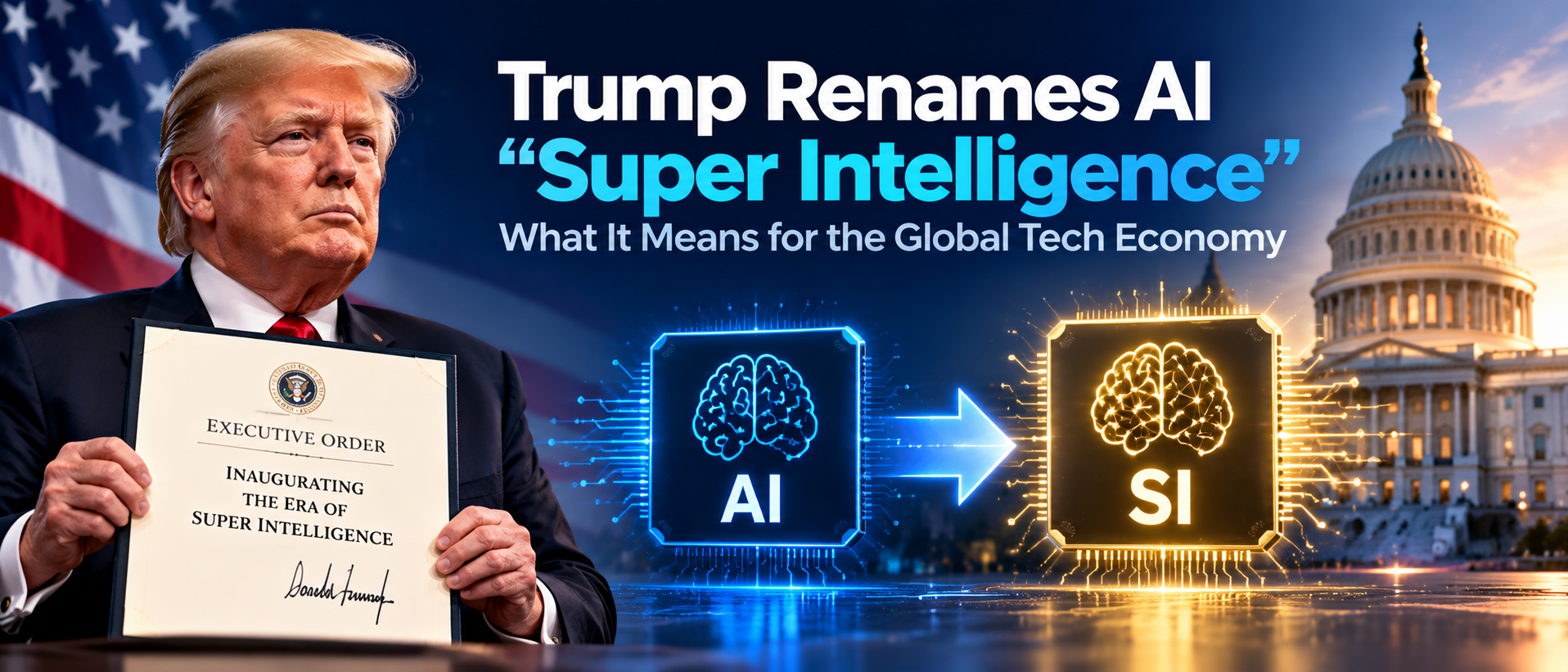
President Donald Trump has signed an executive order directing the U.S. federal government to replace the terms “Artificial Intelligence” and “AI” with “Super Intelligence” and “SI” in official government communications. The order, titled “Inaugurating the Era of Super Intelligence,” was signed on September 29, 2026, and is one of the most unusual developments yet in the rapidly evolving AI race.
It Is a Government Rebranding, Not a Global Renaming
The most important clarification is that Trump has not legally renamed the technology worldwide. The order applies to the U.S. executive branch. Federal departments and agencies are instructed to use “Super Intelligence” and “SI” in correspondence, websites, reports, public communications and other non-statutory documents, while existing regulations, contracts and historical records do not have to be rewritten. Hindustan Times
The administration argues that the traditional term “artificial intelligence” no longer adequately describes the capabilities of modern frontier systems. The executive order says today's systems can go beyond simply imitating or automating individual aspects of human intelligence, instead amplifying human creativity and capabilities across areas such as science and medicine. Forbes
Why Trump Wants the New Name
Trump has increasingly framed advanced AI as a strategic technology that could determine America's economic and national-security position relative to China. During the White House event, he described the technology as potentially larger than the internet and argued that the United States should continue pushing development rather than slowing technological progress. Roll Call
That makes the terminology change more than a branding exercise. It comes as Washington is trying to balance two competing priorities: maintaining U.S. leadership in advanced AI while addressing concerns about safety, cybersecurity and uncontrolled deployment. The same White House gathering brought major technology executives together for discussions around the future of AI and responsible development. Reuters
AI Safety Is Still Part of the Story
Interestingly, the renaming happened alongside a separate voluntary agreement involving major technology companies. Executives from companies including OpenAI, Anthropic, Meta, Google and Nvidia agreed to strengthen internal controls and work with independent auditors to assess whether their AI systems operate as intended and avoid unauthorized access. The agreement shows that the push for faster AI development is happening alongside increasing pressure for stronger safeguards. Reuters
The timing is significant for financial markets as well. AI is no longer simply a software-sector story. It is increasingly connected to data centres, semiconductor demand, electricity consumption, cloud infrastructure, cybersecurity and productivity. A stronger U.S. push toward advanced AI could therefore influence investment across several industries, while also increasing demand for the infrastructure required to operate increasingly powerful models. Moneycontrol
What Does “Super Intelligence” Actually Mean?
There is an important distinction between Trump's political terminology and the technical meaning of superintelligence. In AI research, superintelligence generally refers to systems whose cognitive capabilities greatly exceed those of humans across a broad range of areas. The term has been used in AI literature for years and is not simply another name for today's AI systems. Axios
Under Trump's order, however, “Super Intelligence” is temporarily defined using the existing statutory definition of artificial intelligence under U.S. law. The order also gives the Assistant to the President for Science and Technology 60 days to propose legislation that could establish a new federal definition of “Super Intelligence” and determine whether existing laws need corresponding changes. Times of India
image
What It Means for World Money
For the global economy, the bigger story is not whether governments start writing “SI” instead of “AI.” The real question is how quickly advanced AI becomes embedded in financial services, manufacturing, healthcare, defence and business operations. If increasingly capable AI systems deliver meaningful productivity gains, countries that control computing infrastructure, chips, energy and AI talent could gain a significant economic advantage.
Financial institutions are already watching this transformation closely because AI can affect everything from fraud detection and customer service to trading, risk management and financial research. At the same time, the technology creates new cybersecurity and operational risks, making the development of trustworthy AI systems increasingly important for the financial sector. AP News
The Trump administration's decision therefore sends a broader message: the United States wants to frame advanced AI as a strategic national capability, not simply another technology category. Whether the term “Super Intelligence” becomes widely adopted outside the U.S. government is uncertain. But the economic race surrounding increasingly powerful AI systems is already global—and that race could shape where capital, talent and infrastructure flow for years to come.
FAQ
Has Trump officially renamed AI worldwide?
No. The executive order directs U.S. executive-branch agencies to use “Super Intelligence” and “SI” instead of “Artificial Intelligence” and “AI” in applicable official communications. It does not rename the technology globally.
Does “Super Intelligence” mean today's AI is actually superintelligent?
No. In technical AI research, superintelligence generally describes hypothetical or future systems that substantially exceed human cognitive performance across many domains. Trump's order uses the term as the U.S. government's preferred terminology for AI.
Why is this important for investors?
The significance goes beyond terminology. The U.S. push is occurring alongside major investment in AI models, semiconductors, data centres, cloud computing and energy infrastructure. Those industries could all be affected as AI becomes a larger part of economic activity.
Did major AI companies also agree to new safety measures?
Yes. Major technology companies participated in a voluntary AI accord announced at the White House, including commitments around internal controls and independent auditing.

Tushar Shrivas
B.Tech CS@ Shri Balaji Institute of Technology & Management
I write at Metaplugs — breaking down the latest in tech, economics, and business into simple, impactful stories for everyday readers. Passionate about software testing and global finance.