Back to News
News AlertWorld Money
Trump's $90 Medicare Payment: Who Gets It, Who Doesn't
T
Author
Tushar Shrivas
Published
October 8, 2026
Reading Time
5 MIN READ
Spread the Word
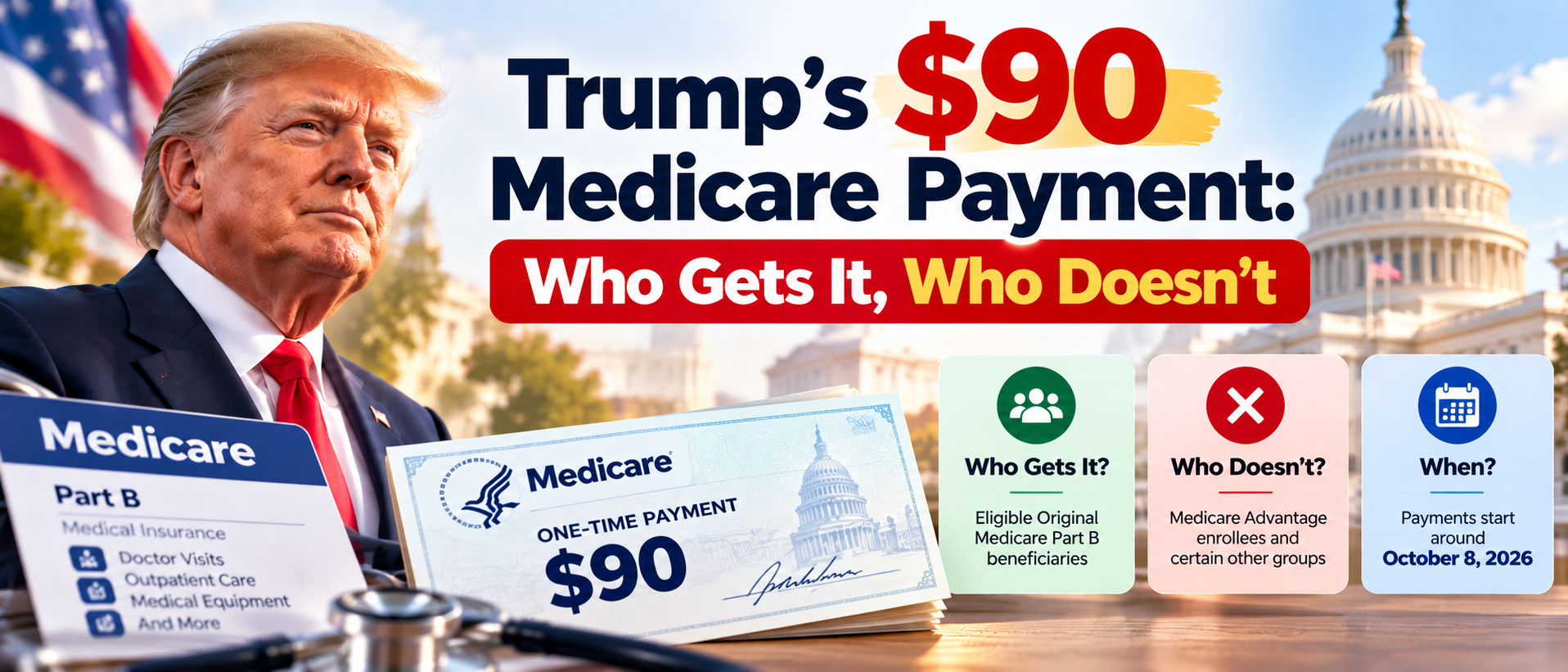
Trump's $90 Medicare rebate is rolling out in October 2026. Here's who qualifies, who is excluded, when payments arrive and what the money covers.
Medicare Part B 2026, Trump Medicare payment October 2026, $90 Medicare rebate, Medicare Advantage excluded, Medicare Improvement Fund
The $90 Medicare Payment Is Now Rolling Out
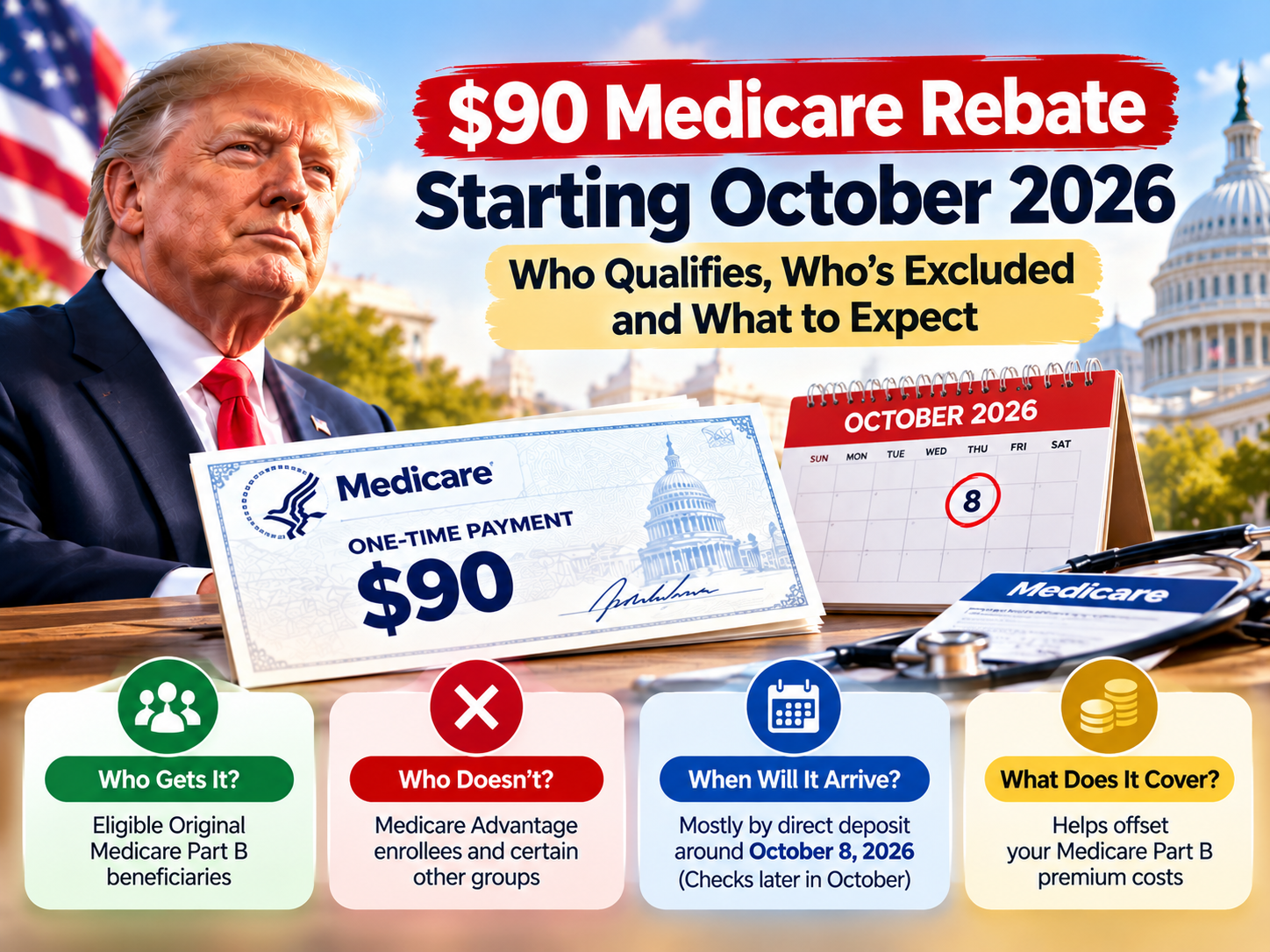
The $90 Medicare payment announced by President Donald Trump is now rolling out to eligible Americans, with most qualifying beneficiaries scheduled to receive the money by direct deposit on or around October 8. Beneficiaries without direct deposit will receive a paper check from the U.S. Treasury later in October. The one-time rebate is designed to help offset Medicare Part B premium costs, but the eligibility rules mean millions of Medicare beneficiaries will not receive it. CMS
The administration says 20.8 million Americans in Original Medicare Part B qualify for the rebate. The program will distribute approximately $2 billion in total and is being financed through the Medicare Improvement Fund, a federal fund created in 2008 for improvements to the Medicare fee-for-service program. AP News
Who Actually Gets the $90?
The eligibility rules are narrower than the headline suggests. The rebate is available to 20.8 million people enrolled in Original Medicare Part B who live in the United States, provided they are not receiving premium assistance from Medicaid and are not paying an income-related monthly adjustment amount, known as IRMAA. Eligible beneficiaries do not need to submit a separate application.
That immediately leaves out a large portion of the Medicare population. Medicare Advantage beneficiaries are not eligible, while millions of low-income beneficiaries receiving premium assistance and people paying IRMAA are also excluded. AP reports that roughly 35 million Medicare Advantage enrollees will not receive the payment.
Why Medicare Advantage Gets Nothing
The Medicare Advantage exclusion is particularly significant because the private-plan program now covers 55% of eligible Medicare beneficiaries, or about 35.2 million people, according to the Kaiser Family Foundation's 2026 enrollment analysis. That means more than half of the eligible Medicare population is outside the $90 rebate program. KFF
The distinction matters because Original Medicare and Medicare Advantage operate differently. The new rebate is specifically structured around Original Medicare Part B premiums, rather than being a general payment available to everyone enrolled in Medicare. As a result, switching between coverage types does not automatically create eligibility for the $90 payment.
What Is $90 Worth Against Medicare Costs?
The standard Medicare Part B premium is $202.90 per month in 2026, according to CMS. That means the $90 payment is equivalent to about 44.4% of one standard month's premium. It provides short-term relief, but it does not permanently reduce the Part B premium or change the underlying cost structure of Medicare.
Part B covers medically necessary services including doctors' services, outpatient hospital services, certain home health services, durable medical equipment and other medical services. The $90 payment is specifically intended to offset Part B premium costs; it is not a new Social Security benefit or a permanent increase in Medicare benefits. Medicare
Where Does the Money Come From?
The money comes from the Medicare Improvement Fund, which Congress created in 2008 to make improvements to the original Medicare fee-for-service program. CMS says the fund has been used in the past for other purposes, including congressional transfers that helped offset spending, so this is not the first time money has been taken from the fund. The current administration says this is the first time it has been used to make direct payments to Medicare beneficiaries.
The important point for beneficiaries is that the $90 rebate is a one-time October 2026 payment, not a recurring monthly benefit. CMS says eligible recipients will receive one payment, with most payments arriving around October 8 and paper checks following later in the month.
The Bottom Line
Trump's $90 Medicare payment is real and is now being distributed, but the headline hides a much narrower program. Only 20.8 million people in Original Medicare Part B qualify, while Medicare Advantage beneficiaries and several other groups are excluded. For those who receive it, $90 represents nearly half of one standard month's $202.90 Part B premium, but it remains a one-time rebate rather than a structural solution to rising healthcare costs. CMS
For millions of Americans, the immediate question is simple: Will the $90 arrive in their account? For the broader Medicare system, the bigger question is whether one-time financial relief can meaningfully help beneficiaries as healthcare and living costs continue to rise. Associated Press
Frequently Asked Questions
When will the $90 Medicare payment arrive?
Most eligible beneficiaries are scheduled to receive the payment by direct deposit on or around October 8, 2026. Those without direct deposit will receive a paper check later in October.
Who qualifies for the $90 Medicare payment?
People enrolled in Original Medicare Part B, living in the United States, who are not receiving premium assistance from Medicaid and are not paying IRMAA qualify under the CMS rules.
Are Medicare Advantage beneficiaries eligible?
No. Medicare Advantage beneficiaries are excluded from the one-time $90 rebate.
How much is Medicare Part B in 2026?
The standard Medicare Part B premium is $202.90 per month in 2026.
Do beneficiaries need to apply?
No. CMS says the payment is automatic for eligible beneficiaries.
Is the $90 payment permanent?
No. It is a one-time October 2026 rebate.
Is this a Social Security benefit?
No. It is a Medicare Part B premium rebate. Most eligible beneficiaries receive the money through the payment system used for their federal benefits, but it is not a new Social Security benefit.
No. It is a Medicare Part B premium rebate. Most eligible beneficiaries receive the money through the payment system used for their federal benefits, but it is not a new Social Security benefit.

Tushar Shrivas
B.Tech CS@ Shri Balaji Institute of Technology & Management
I write at Metaplugs — breaking down the latest in tech, economics, and business into simple, impactful stories for everyday readers. Passionate about software testing and global finance.