Back to News
News AlertWorld Unicorn
AI Landlords and Agentic FinTechs Are Quietly Redrawing the Unicorn Leaderboard
V
Author
Vishal Sable
Published
August 26, 2026
Reading Time
8 MIN READ
Spread the Word
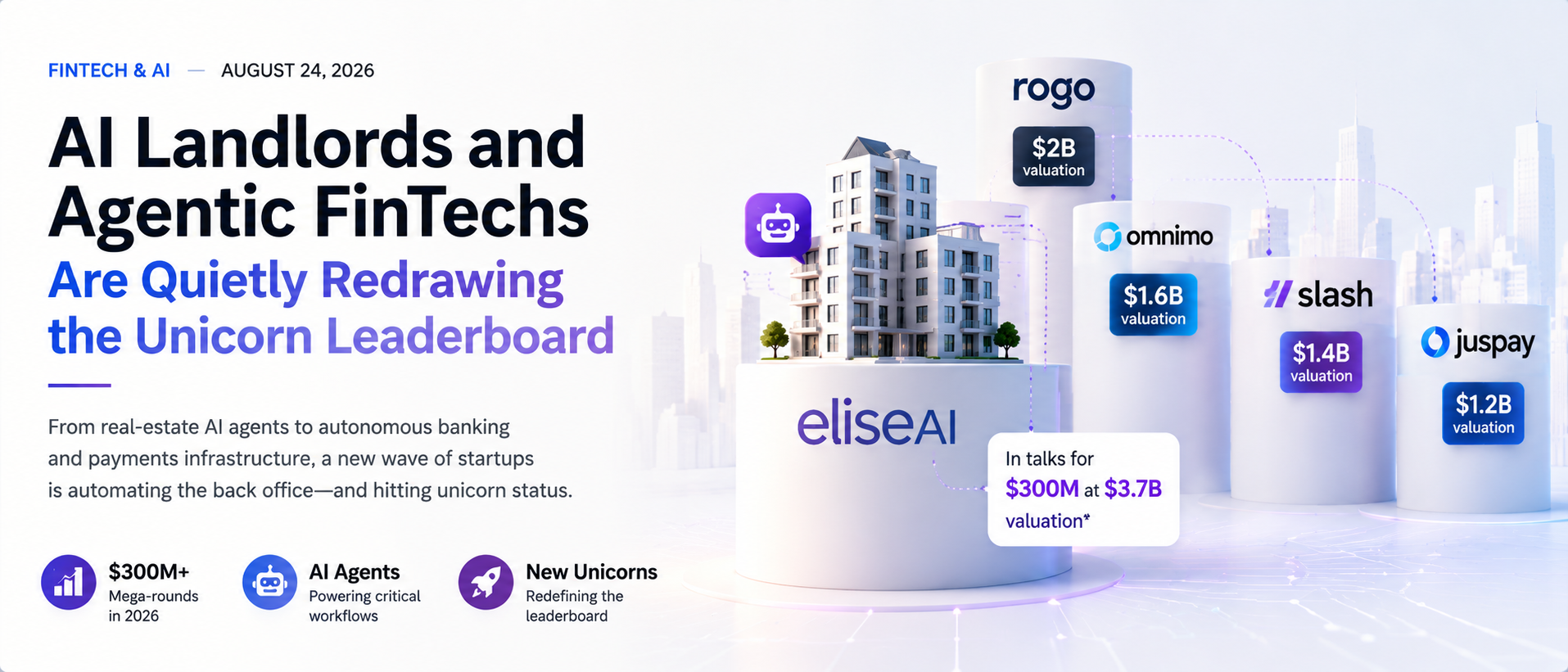
Property-management AI startup EliseAI is in talks to raise $300 million at a $3.7 billion valuation — up from $2.2 billion just a year ago — in a round being discussed with a16z and Bessemer, according to Business Insider. Nothing is signed yet. But EliseAI's trajectory sits alongside a wider pattern: the newest wave of unicorns, including Rogo, Ominimo, Slash, and Juspay, isn't chasing consumer attention. It's automating the back office of housing, banking, insurance, and payments — and investors are paying premium multiples for it.
Updated August 2026
Key Takeaways-
Key Takeaways-
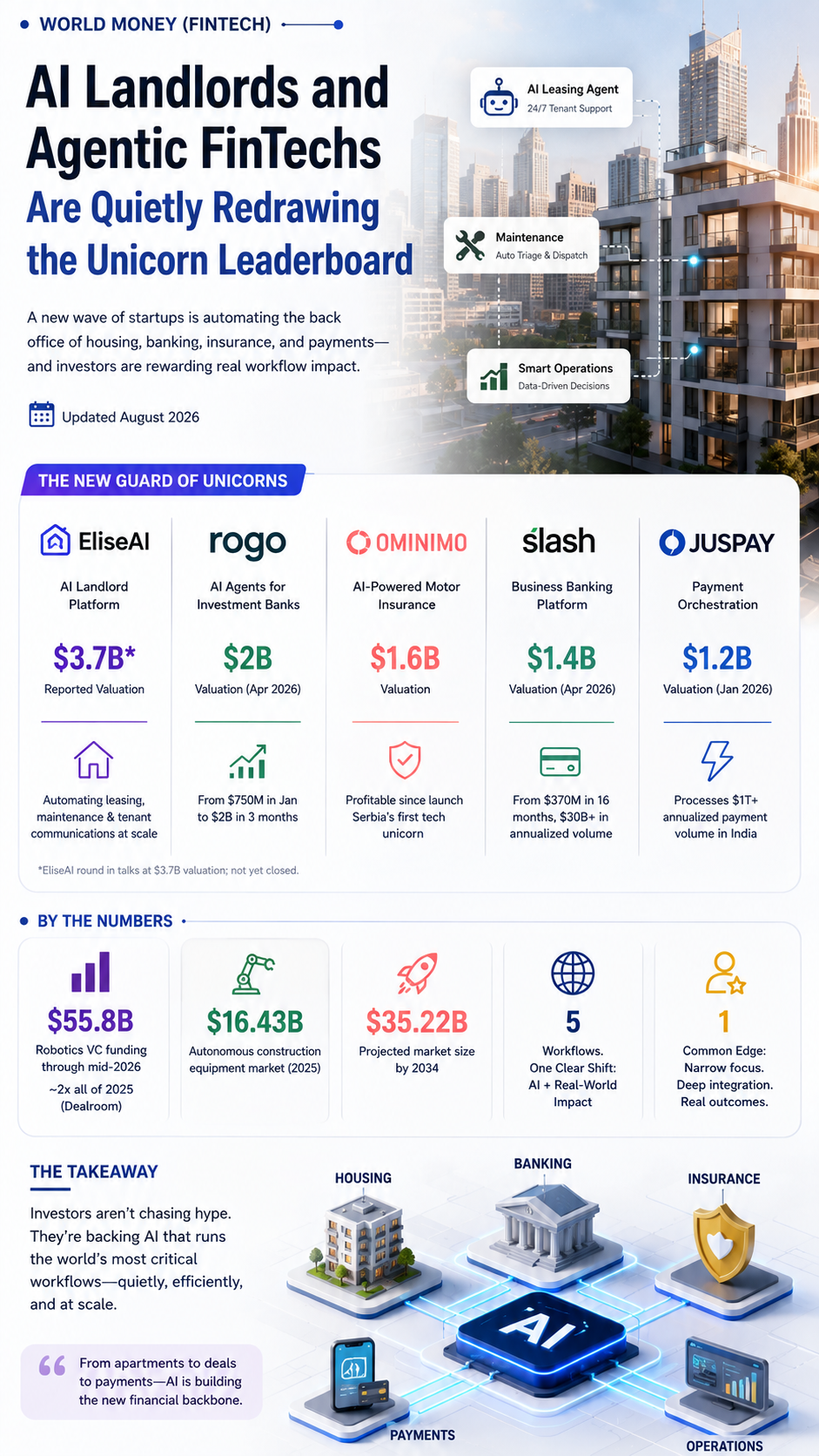
EliseAI is reportedly in talks for $300M at $3.7B — not yet closed — up from $2.2B a year earlier
Rogo, an AI agent platform for investment banks, went from a $750M valuation in January 2026 to $2B by April 2026 in the space of three months
Ominimo hit $1.6B and unicorn status roughly two years after launch, becoming Serbia's first tech unicorn — while staying profitable
Slash Financial reached $1.4B, up from $370M just 16 months earlier
Juspay became India's first unicorn of 2026 at $1.2B, on the back of processing $1 trillion+ in annualized payment volume
The common thread across all five: narrow, workflow-specific AI agents, not general-purpose consumer products
The Big Move: EliseAI's Reported $3.7B Valuation
The Big Move: EliseAI's Reported $3.7B Valuation
EliseAI, the New York-based company behind AI agents that handle apartment leasing, maintenance requests, and tenant communications, is reportedly in talks to raise $300 million at a $3.7 billion valuation, with a16z and Bessemer discussing the lead role — first reported by Business Insider's Katie Roof. Business Insider / The Next Web
It's worth being precise about what's actually confirmed here: the round has not closed, terms "are not settled," and EliseAI, a16z, and Bessemer all declined to comment when asked. The Next Web What we do know is the trajectory that got the company here:
August 2024: $75M Series D led by Sapphire Ventures — first unicorn valuation, at $1B
August 2025: $250M Series E led by a16z, with Bessemer joining — $2.2B valuation
August 2026 (reported, unconfirmed): $300M at $3.7B
If the round closes at the reported terms, EliseAI's valuation will have grown roughly 3.7x in two years — while, according to the company, it crossed $100 million in annual recurring revenue in early 2025 and grew headcount from around 150 to more than 300. Tech Funding News.
Watch : EliseAI’s CEO explains how AI agents are transforming property management
Watch : EliseAI’s CEO explains how AI agents are transforming property management
Why "AI Landlord" Is the Right Label
EliseAI's product isn't a chatbot bolted onto a leasing office — it's positioned to handle the repetitive, high-volume interactions that used to require a human leasing agent: tour scheduling, maintenance triage, and tenant Q&A, at a scale a16z has said covers roughly 10% of the U.S. apartment market. EliseAI That distinction — real operational throughput, not a demo — is what separates this generation of "vertical AI agents" from the chatbot wave of 2023-24.
The Leaderboard Shift: Four Unicorns Built on Narrow, High-Stakes Workflows
None of the four companies below are betting on consumer engagement. They're betting on being embedded in a workflow a business cannot function without — payments, underwriting, deal execution, or claims.
Rogo: From $750M to $2B in Three Months
Rogo builds an AI agent called Felix for investment banks, private equity firms, and hedge funds — handling deal screening, CIM generation, buyer outreach, and data-room diligence. PR Newswire
The valuation jump is the striking part: Rogo closed a $75M Series C in January 2026 at a $750M valuation led by Sequoia, then closed a $160M Series D in April 2026 — barely three months later — led by Kleiner Perkins at a $2B valuation. Fintech.Global The company says it now serves 250+ institutions, including Rothschild, Jefferies, Lazard, and Moelis, with 35,000+ professionals using Felix. AI Automation Global
Ominimo: A Profitable Insurtech Unicorn in Two Years
Ominimo, a Budapest-based motor insurance startup founded in 2024, raised a Series B led by the venture arm of the European Bank for Reconstruction and Development at a $1.6 billion valuation — up from roughly $230M at its Series A in May 2025. EU-Startups
Two things distinguish this deal from typical insurtech stories. First, Ominimo says it has been profitable since its Hungarian launch — a deliberate contrast to WeFox, once Europe's best-funded insurtech at a $4.5B valuation before it moved into divestments and emergency financing. BeInsure Second, the check size was small relative to the valuation jump: just $22.5 million unlocked a $1.6B mark, which one analysis attributed to investors pricing in Ominimo's unit economics rather than pure growth-stage burn. Value Add VC
Slash Financial: Business Banking Built for AI-Native Operations
Slash, a business banking platform founded by college dropouts Victor Cardenas and Kevin Bai in 2021, hit unicorn status at $1.4 billion in April 2026 via a $100M Series C led by Ribbit Capital — up from a $370M valuation just 16 months earlier. Finextra
Slash says it grew from $10 million to $250 million in annualized revenue in 24 months and now processes more than $30 billion in annualized payment volume for over 5,000 businesses. American Banker The round also introduced Twin, an AI financial agent designed to execute payments, generate invoices, and issue cards on a business's behalf rather than requiring manual logins. FinTech Futures
Juspay: India's First Unicorn of 2026
Juspay, a Bengaluru-based payment orchestration company founded in 2012, raised $50 million from WestBridge Capital in January 2026, reaching a $1.2 billion valuation and becoming India's first unicorn of the year. Inc42
Unlike most companies on this list, Juspay is a legacy player rather than a recent AI-native startup — it's been operating since 2012 and turned profitable in its most recent fiscal year, posting a net profit of ₹62.3 crore against a prior-year loss. Inc42 It processes more than 300 million transactions daily and over $1 trillion in annualized total payment volume for clients including Amazon, Flipkart, Google Pay, and HSBC. CIOL
Our Take: What This Leaderboard Actually Signals
Line these five deals up and a pattern emerges that's easy to miss if you look at each in isolation: every one of them monetizes a workflow that was previously done by a specific, expensive human role — a leasing agent, a junior banking analyst, an insurance underwriter, a bookkeeper, a payments engineer — rather than trying to be a general-purpose assistant.
That's a meaningfully different bet than the 2023-2024 AI wave, which was dominated by horizontal tools (chat interfaces, copilots) competing on model quality. These companies are competing on domain-specific data, compliance, and integration depth — Rogo's edge is being embedded in bank data warehouses; Juspay's edge is 14 years of India's UPI payments infrastructure; Ominimo's edge is proprietary underwriting models tuned to specific national insurance markets. That kind of moat is harder to copy than a better prompt, which is likely why investors are underwriting valuation jumps of 2-4x in under 18 months across the board.
The other pattern worth flagging: three of the five deals (Rogo, Ominimo, Slash) are still pre-IPO growth bets on companies under three years old, while Juspay is the outlier — a 14-year-old company only now crossing the unicorn line. That's a reminder that "AI unicorn" isn't a single category; it spans genuinely new AI-native businesses and older infrastructure companies whose valuations are catching up as their existing tech gets rebranded and re-rated through an AI lens.
One caveat worth repeating: the EliseAI figures anchoring this piece are still reported, not confirmed — worth watching whether the $3.7B round closes on the terms described, and at what final structure.
FAQ: AI Landlords and Agentic FinTech Unicorns in 2026
What is an "AI landlord" startup?
The term refers to companies like EliseAI that use AI agents to automate property-management functions traditionally handled by human staff — leasing, tour scheduling, maintenance coordination, and tenant communications — rather than replacing landlords themselves.
Is EliseAI's $3.7 billion valuation confirmed?
No. As of this writing, the round is reported by Business Insider as being in talks, with terms not yet finalized and no comment from EliseAI, a16z, or Bessemer.
What do Rogo, Ominimo, Slash, and Juspay have in common?
Each has built AI or automation tools around a single, high-value financial or operational workflow — investment banking research, motor insurance underwriting, business banking, and payment orchestration, respectively — rather than a general-purpose consumer product.
Which of these companies is profitable?
Ominimo and Juspay have both stated they are profitable. EliseAI, Rogo, and Slash have disclosed strong revenue growth but have not publicly confirmed profitability.
----
Sources: Business Insider/The Next Web, Tech Funding News, EliseAI, PR Newswire, Fintech.Global, AI Automation Global, EU-Startups, BeInsure, Value Add VC, Finextra, American Banker, FinTech Futures, Inc42, CIOL. Reporting current as of August 2026 — figures tied to in-progress funding rounds may change before close.

Vishal Sable
B.Tech AD @ shri balaji institute of technology and management
Engineering and tech journalist. I love exploring the impact of emerging technologies on global defense, sovereignty, and everyday life. Always looking for the real story behind the headlines.