LATEST NEWS
AI Landlords and Agentic FinTechs Are Quietly Redrawing the Unicorn Leaderboard
August 26, 2026 8M
Back to News
News AlertWorld Unicorn
Forget Consumer Apps: The World's Most Valuable Startups Now Build Robots and Chase Rent
V
Author
Vishal Sable
Published
August 28, 2026
Reading Time
4 MIN READ
Spread the Word
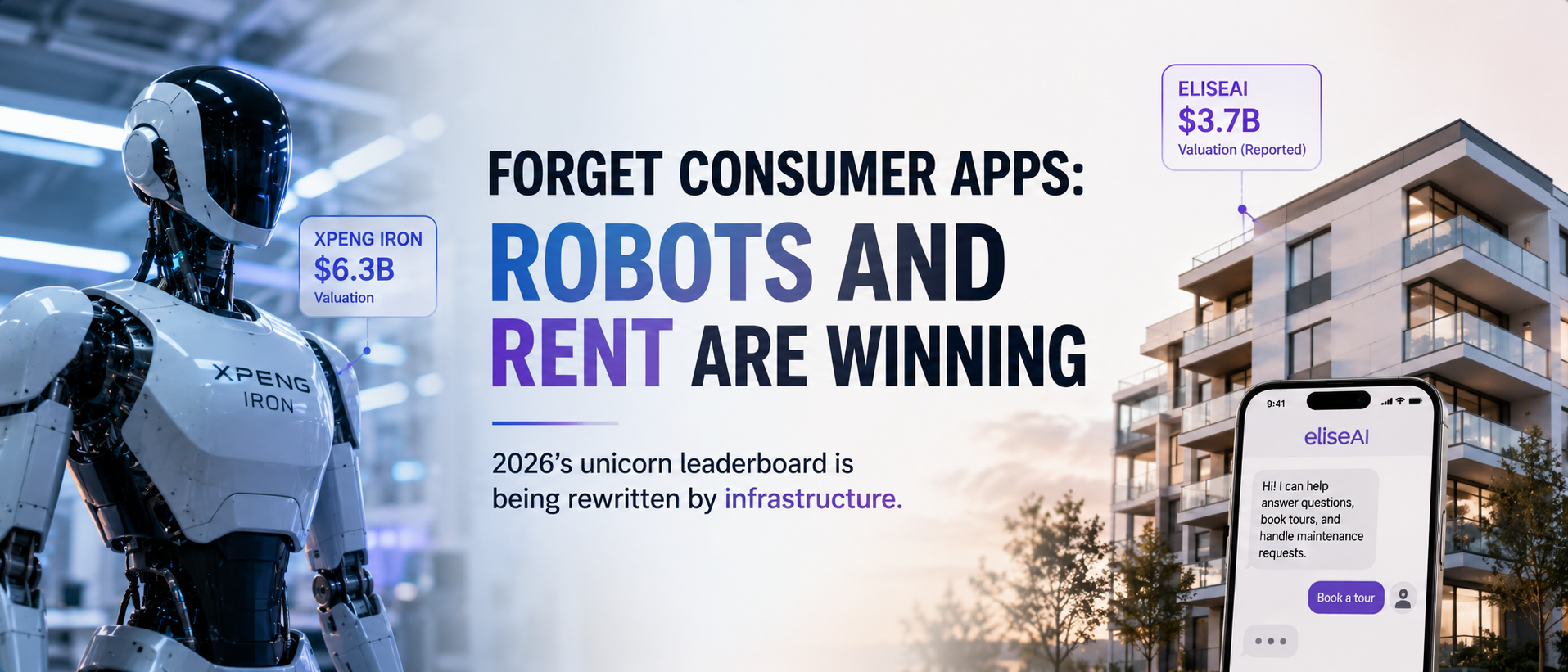
The 2026 unicorn leaderboard has shifted hard toward infrastructure: humanoid robots like XPENG IRON, and AI landlord EliseAI eyeing a $3.7B valuation. Here's what's really driving valuations now.
The leaderboard has a new type
The leaderboard has a new type
Scroll the biggest private funding rounds of the past week and a pattern jumps out: almost none of it is consumer software. It's things that move and workflows that used to require a person answering the phone.
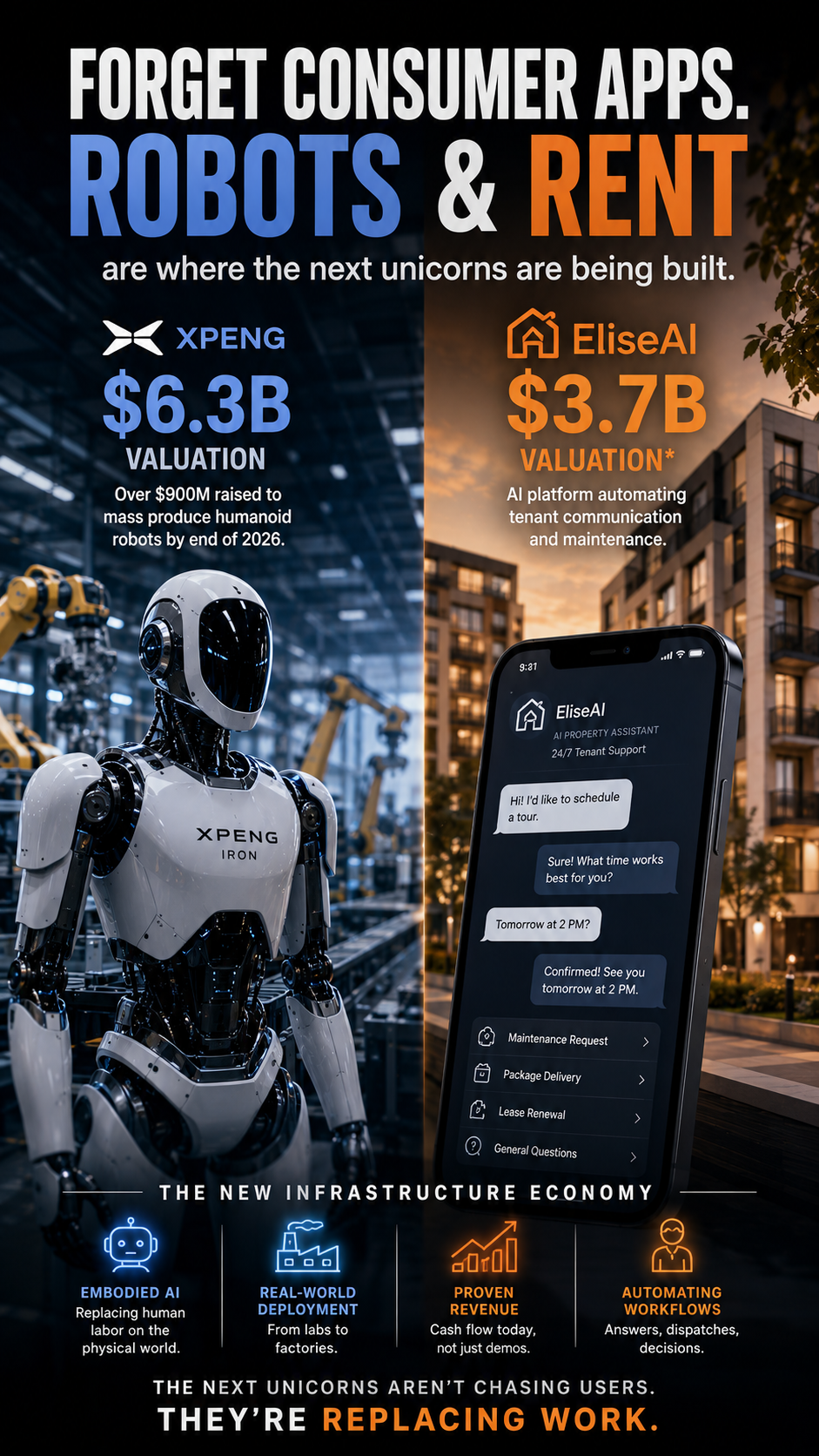
XPENG's robotics unit just raised over $900 million at a $6.3 billion valuation — the largest single private funding round in China's embodied AI sector to date — to push its IRON humanoid robot into mass production by the end of 2026. IDG Capital led, with Tencent and Alibaba both writing strategic checks. Fellow Chinese quadruped and humanoid maker DEEP Robotics is on a similar trajectory, already tutoring for an IPO at roughly $1.1 billion.
Meanwhile, in New York, EliseAI — an AI platform that automates tenant communication and maintenance dispatch for property managers — is reportedly finalizing a $300 million raise at a $3.7 billion valuation, up from $2.2 billion just twelve months ago. Andreessen Horowitz and Bessemer are said to be leading again.
A humanoid robot company and an AI leasing assistant don't look alike. But investors are backing them for the same underlying reason.
XPENG IRON: paying $6.3B for a robot that hasn't shipped
XPENG's number is striking because of what it isn't: IRON hasn't been sold to a single paying customer yet. Mass production is targeted for the end of 2026, with initial units deployed inside XPEng's own stores and campuses before wider commercial delivery in 2027. Investors aren't pricing a product — they're pricing XPEng's manufacturing track record, its in-house AI chips, and its bet that humanoid robots are moving from lab demos to actual factory lines faster than skeptics expect.
DEEP Robotics is playing a quieter version of the same bet: rather than chasing splashy demos, it's built a base of industrial clients like State Grid and pushed toward a mainland IPO — evidence that in China's embodied AI race, capital is now flowing toward companies that can show a path to revenue and public-market exit, not just impressive video clips.
EliseAI: the unglamorous unicorn
EliseAI's pitch has nothing to do with robots. It sells AI assistants that answer prospective tenants by text, phone, and email, book apartment tours, and triage maintenance tickets — the exact grind that eats a property manager's day. It's deliberately boring, and that's precisely why it's compounding so fast: the company passed $100 million in annual recurring revenue in early 2025 and has now roughly tripled its valuation in two years, climbing from a $1 billion unicorn mark in August 2024 to a possible $3.7 billion today.
That's not hype capital chasing a narrative. It's growth capital following a business that already has thousands of paying property operators as customers.
The real thread connecting all of it
Every company on this list shares one trait: immediate, high-margin cash flow potential in a market incumbents have left slow and inefficient. Robotics investors aren't funding "AI" in the abstract anymore — they're funding a specific, physical replacement for a specific, expensive human task: a tenant-services rep, a warehouse worker, a maintenance dispatcher. EliseAI, XPENG, and DEEP Robotics are all, in their own domains, selling the same underlying product: labor, automated, at scale.
That's the real story behind the leaderboard shift. Speculative consumer social apps chase attention. These companies chase margin — and right now, margin is what's winning the biggest checks in venture.
If the next wave of unicorns isn't chasing users but replacing headcount, what happens to venture valuations once "how many workers did you automate" becomes the pitch — instead of "how many users do you have"?
---
Sources: Electrek, TechNode, PR Newswire, Tech Funding News, The Real Deal, Caixin Global.

Vishal Sable
B.Tech AD @ shri balaji institute of technology and management
Engineering and tech journalist. I love exploring the impact of emerging technologies on global defense, sovereignty, and everyday life. Always looking for the real story behind the headlines.