Back to News
News AlertWorld Defence Tech
Beyond the Barrel: How Software-Defined Warfare Is Rewriting Global Defense in 2026
V
Author
Vishal Sable
Published
April 6, 2026
Reading Time
12 MIN READ
Spread the Word
Software-Defined Warfare 2026: AI Mesh & 3D-Printed Drones
Defense spending hits $2Tn as autonomous drones get 3D-printed in hours and AI mesh networks self-heal. Inside 2026’s software-defined battlefield.
Welcome to Software-Defined Warfare – Where Code Kills Faster Than Steel
Global defense spending has surpassed $2 trillion in 2026, but the more consequential shift is not how much is being spent—it’s how. The world’s militaries are no longer buying just tanks and jets. They are buying software-defined platforms, autonomous swarms, and self-healing networks.
In April 2026, the "Year of Truth" for defense tech has arrived: autonomous systems have moved from testing labs to active deployment. From 3D-printed drones assembled in shipping containers to AI mesh networks that reroute around destroyed nodes, the battlefield is being rewritten in real time.
Additive Manufacturing – Drones in Hours, Not Weeks
The single biggest bottleneck in modern warfare is no longer firepower—it’s manufacturing speed. Legacy production lines take months to spin up. Adversaries are learning to build drones in days.
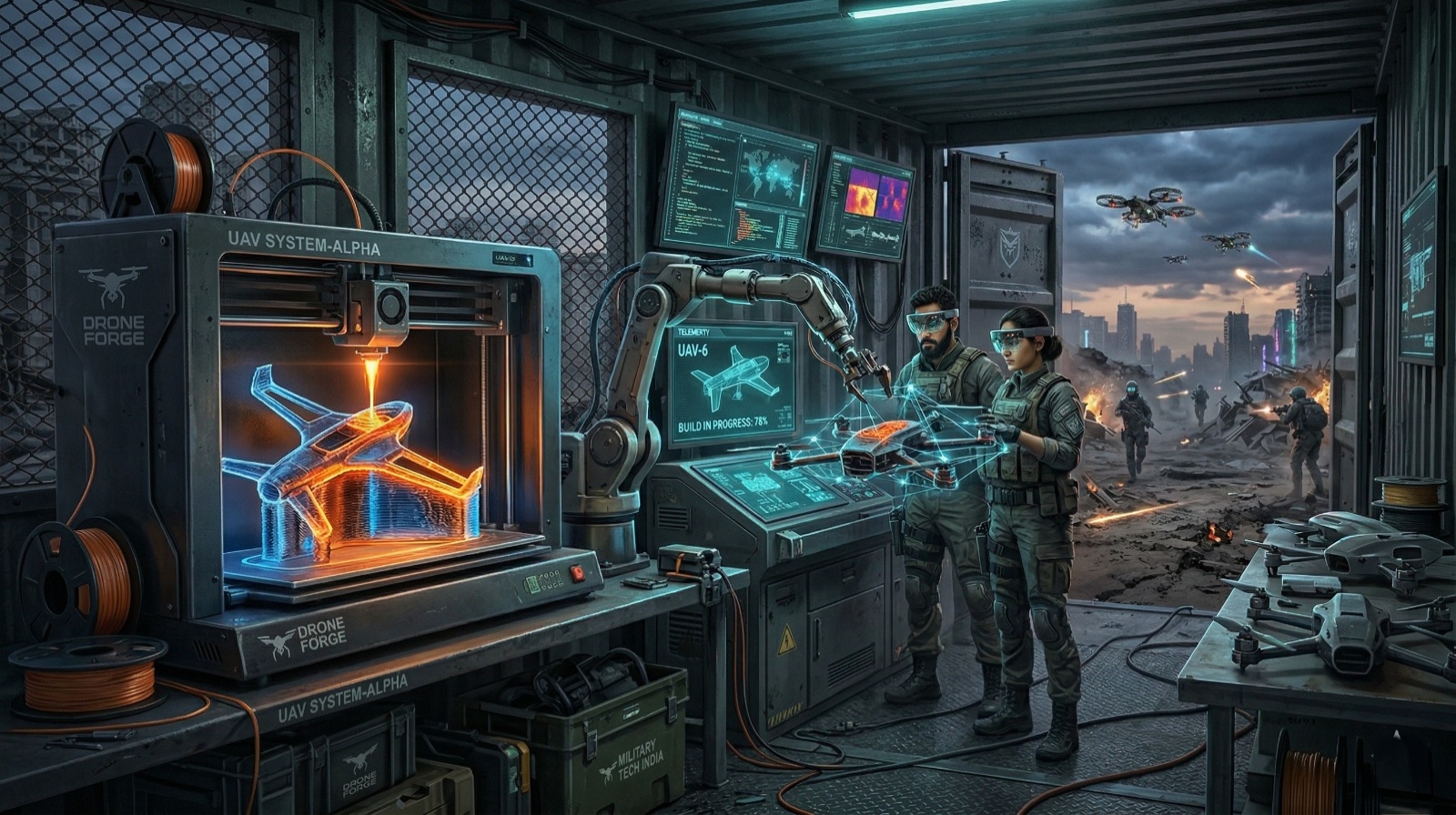
Enter additive manufacturing in the combat zone. In March 2026, Czech defense startup 3DFENSE unveiled a modular container-based factory capable of producing up to 1,600 attack drones per month directly at the front line. The system integrates 3D printing to churn out three types of VTOL and strike drones, with ranges from 70 km to 360 km, adapting payloads to real-time mission needs within hours.
Meanwhile, the U.S. Marine Corps has approved the HANX drone—a $700, NDAA-compliant 3D-printed UAV built from domestically sourced components by a sergeant who learned 3D printing in a LEGO robotics club. It represents a leap from 2017’s "Nibbler" to a combat-ready, supply-chain-secure asset.
But the crown jewel is Venom. Two California startups—Divergent Technologies and Mach Industries—designed, 3D-printed, and flew an autonomous strike aircraft in just 71 days from concept to first flight. Divergent printed entire wing and fuselage sections as single monolithic assemblies, eliminating traditional tooling and part-count complexity. The Pentagon’s "affordable mass" doctrine just got real.
The Command-and-Control Bottleneck – AI Mesh Networks Go Live
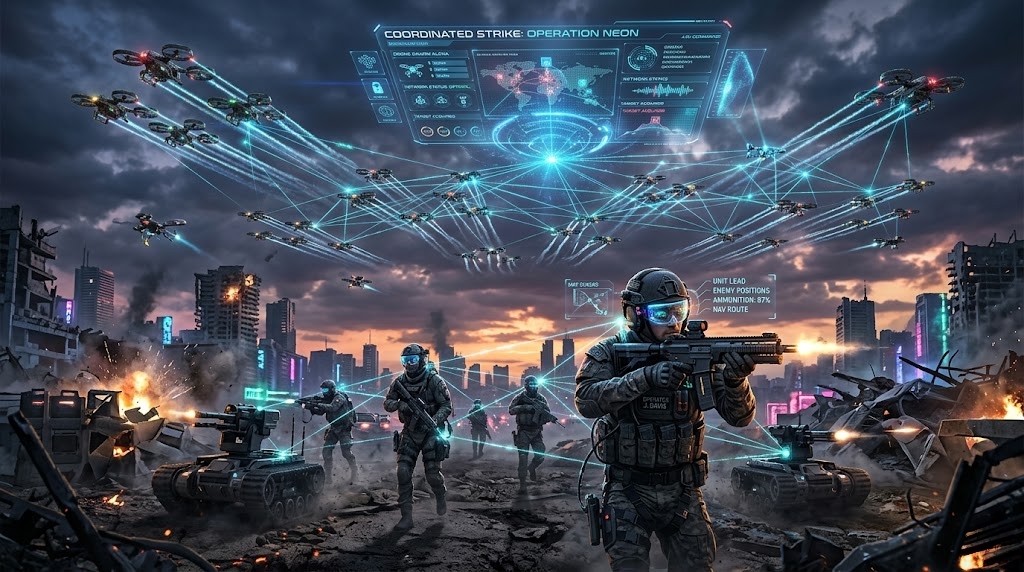
As drone swarms proliferate, the critical problem has shifted from building autonomous platforms to coordinating them. Bessemer Venture Partners’ 2026 defense roadmap notes that autonomous systems have moved "from concept to combat"—but orchestrating missions across different systems remains the Achilles‘ heel.
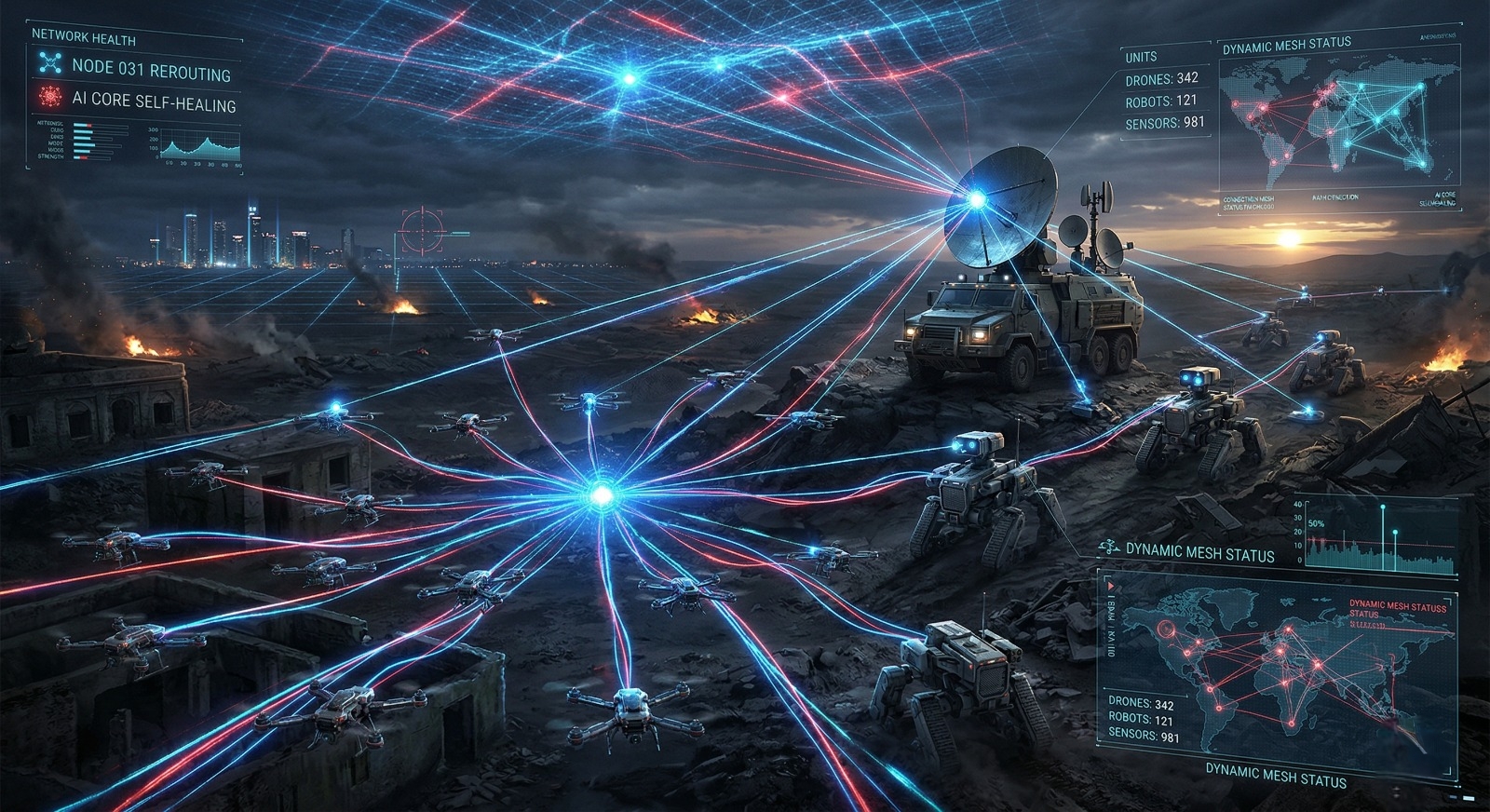
The solution? AI mesh networks that self-heal in real time. Rajant’s Kinetic Mesh technology enables drones, robotic platforms, sensors, and edge computing nodes to operate as a unified network that adapts as systems move and conditions change. Each node continuously evaluates available communication paths, ensuring connectivity persists even when links are disrupted. The result: soldiers stay connected in RF-congested or contested environments without relying on centralized infrastructure.
DTC’s MESH Solution takes it further: self-forming, self-healing communications allow voice, video, and data to hop across distributed nodes without fixed base stations. In urban operations where buildings block line-of-sight, the network finds its own path—"stepping stones across a river," as one executive put it.
NATO is betting big. The alliance’s DIANA 2026 Challenge Programme selected Neuron’s secure edge communication layer from over 3,600 applicants to enable resilient, infrastructure-independent coordination across autonomous agents, sensors, and drones in Degraded, Denied, Intermittent, and Limited (DDIL) environments. Field validation is underway.
Technology Capability Deployment Status
3DFENSE Mobile Factory 1,600 drones/month via 3D printing Field-ready (March 2026)
USMC HANX Drone $700 NDAA-compliant UAV Approved, entering service
Venom Strike Aircraft 71-day design-to-flight Prototype flown
Rajant Kinetic Mesh Self-healing battlefield network Operational
NATO DIANA Program Resilient edge AI coordination 2026 accelerator phase
H2: The $9.8 Billion Reality Check – Where the Money Is Going
Congress passed an $839 billion defense spending bill for fiscal 2026, with $9.8 billion directed explicitly toward autonomous and unmanned systems development across every service branch. The DoD‘s total IT budget reached $66 billion—a $1.8 billion increase from 2025—with the Navy alone adding $308 million in AI spending, a 22.7% year-over-year jump.
The market numbers validate the shift. The global military AI systems market is projected to grow from $14.49 billion in 2026 at a 12.0% CAGR through 2036, driven by autonomous platforms and AI-enabled defense modernization. Meanwhile, the counter-UAS market is exploding from $2.08 billion in 2025 to $19.06 billion by 2035 at a 22% CAGR.
Agentic Warfare – The U.S.-China Race for Decision Speed
The defining metric of 2026‘s military AI race is no longer raw compute—it’s speed to decision. The nation that first fully integrates agentic systems into its command-and-control architecture will observe, orient, decide, and act faster than any opponent.
The U.S. currently retains a fragile first-mover advantage in frontier models and the underlying technology stack. China, however, leads in rapid adoption and civil-military fusion, aggressively fielding autonomous hardware—hundreds-strong drone swarms, loyal wingman concepts, and experimental uncrewed surface vessels. The Pentagon’s new AI strategy, released in January 2026, explicitly treats adoption as an operational race where diffusion speed—moving capability from experiment to trusted field use—is the decisive variable.
Ukraine remains the world‘s live-fire AI laboratory. In March 2026, Kyiv opened access to its battlefield data for allied AI models—millions of annotated images from tens of thousands of combat flights—creating a unique training asset unmatched anywhere else. Russia responded days ago, unveiling the “Kuryer” unmanned mortar platform with an autoloader capable of sustained fire without exposing a crew to counter-battery strikes.
Conclusion
The Code That Wins Wars
In 2026, defense is no longer about the heaviest armor or the fastest jet. It’s about software-defined platforms that update overnight, additive manufacturing that prints mission-specific drones in hours, and AI mesh networks that refuse to die. The $2 trillion global defense budget is reallocating rapidly—toward autonomy, toward resilience, and toward the code that wins wars.
For defense contractors and investors, the signal is clear: the era of hardware-centric warfare is over. The era of software-defined warfare has begun.

Vishal Sable
B.Tech AD @ shri balaji institute of technology and management
Engineering and tech journalist. I love exploring the impact of emerging technologies on global defense, sovereignty, and everyday life. Always looking for the real story behind the headlines.