Back to News
News AlertWorld Money
Brent Oil Hits $110 as Hormuz Attacks Raise Supply Fears
T
Author
Tushar Shrivas
Published
October 17, 2026
Reading Time
7 MIN READ
Spread the Word
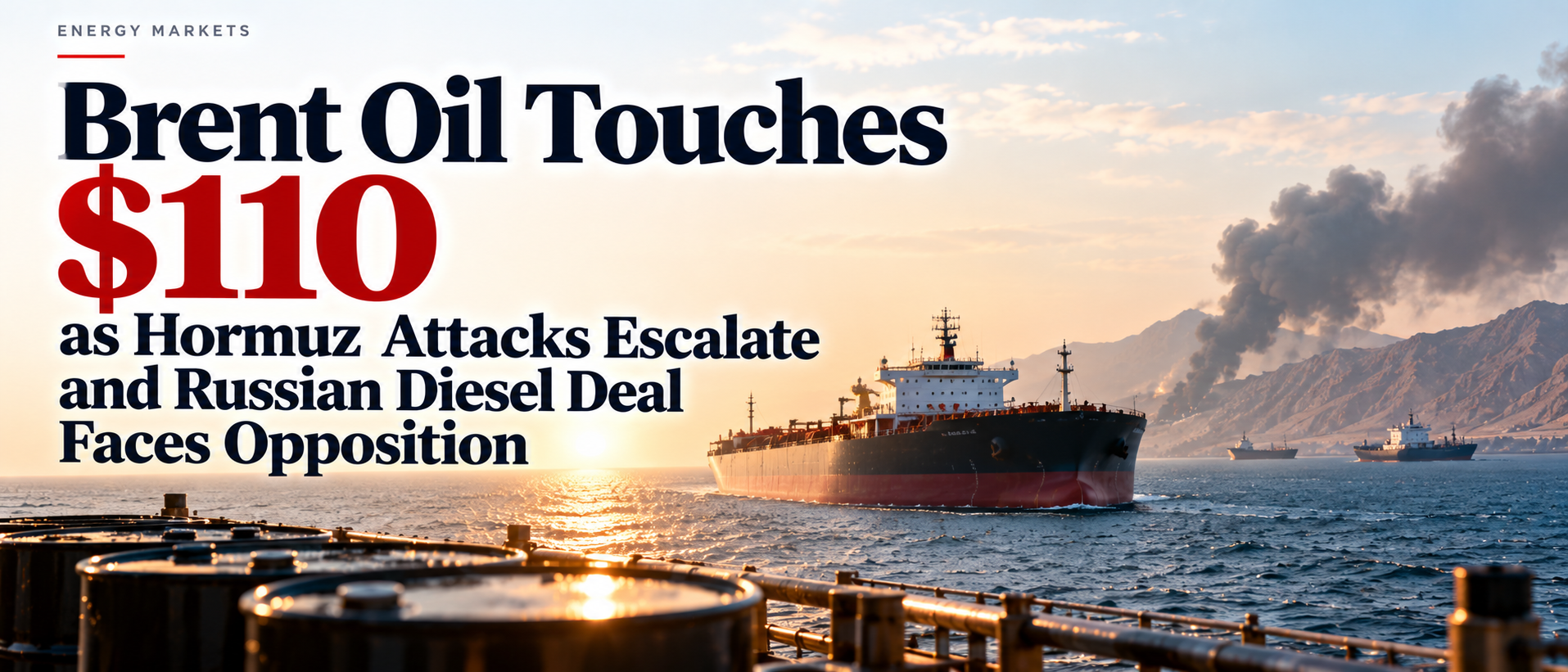
Brent crude touched $110 on October 16 as Middle East attacks threatened oil supplies. A controversial Russian diesel deal faces opposition in Washington.
Strait of Hormuz attacks 2026, Russian diesel deal, US diesel prices, WTI crude oil, Saudi oil infrastructure, Yanbu port, global oil supply risks
Brent Oil Touches $110 as Supply Risks Intensify
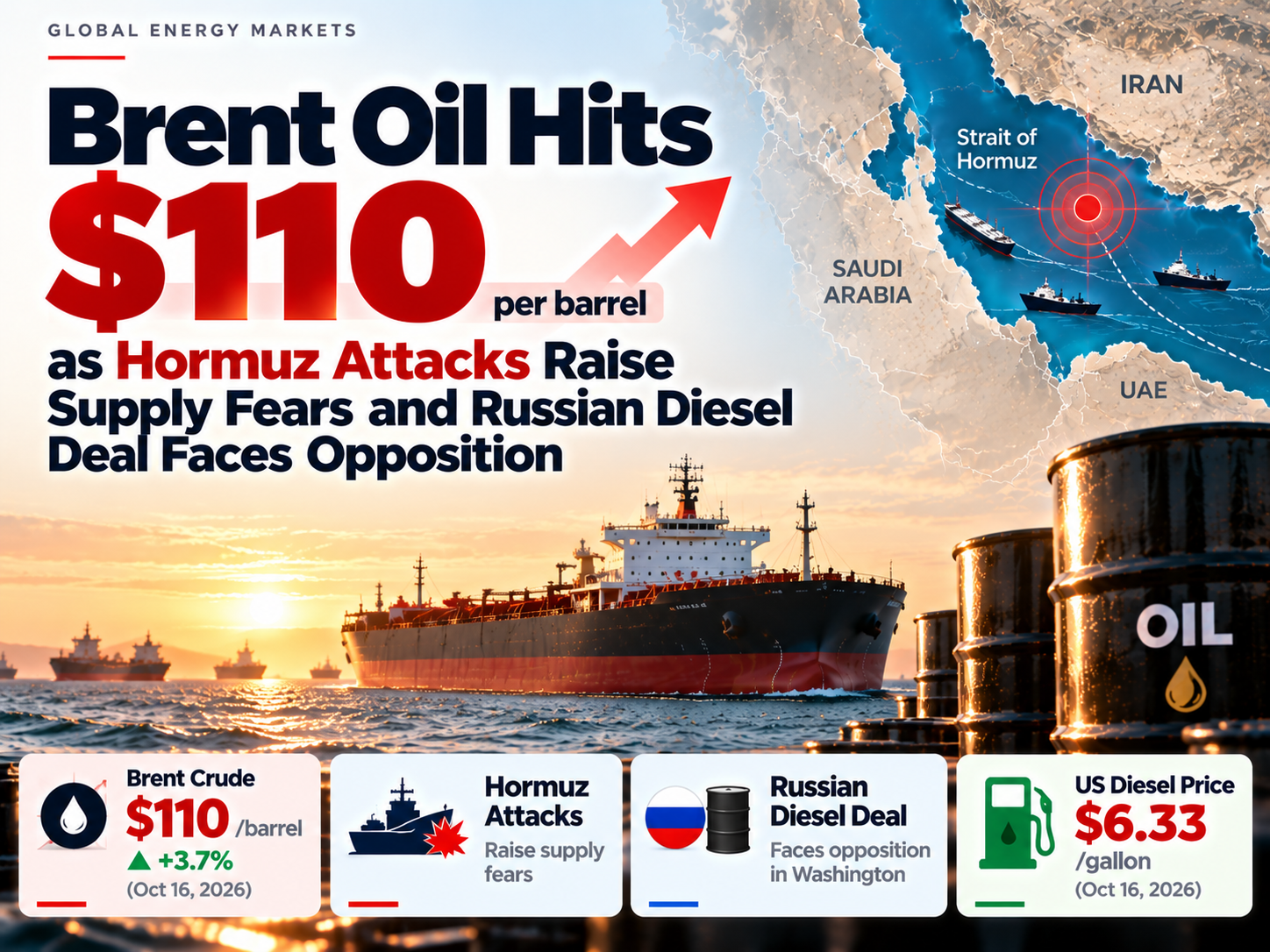
Brent crude briefly touched $110 a barrel on Friday, October 16, for the first time since May, before settling at $109.86, up 3.7% for the session. US West Texas Intermediate (WTI) crude also climbed, closing at $101.41, its highest level since mid-September. The rally reflects mounting concern that escalating geopolitical tensions could disrupt global oil supplies just as governments are trying to contain rising fuel costs.
The increase was driven by several overlapping risks, including attacks around the Middle East, concerns about shipping through the Strait of Hormuz and continued strikes on Russian energy infrastructure. These developments have strengthened the risk premium built into crude prices, although the market's next move will depend on whether supply disruptions worsen or transportation routes stabilize. Reuters
Strait of Hormuz: Why Shipping Security Matters
The Strait of Hormuz is one of the world's most important energy corridors, connecting major Gulf oil producers with international markets. Any threat to tanker movements through the waterway can raise shipping costs, insurance premiums and concerns about the reliability of future deliveries.
Recent attacks on vessels and escalating regional tensions have increased uncertainty around the route. However, estimates of current oil flows differ depending on the period and measurement used, so it would be misleading to describe traffic as either fully restored or completely halted. The more defensible conclusion is that the route remains strategically vulnerable and that markets are pricing in the possibility of further disruption.
Saudi Arabia's Yanbu port has also attracted attention after authorities reported intercepting a missile directed toward the strategically important area. Yanbu is significant because Saudi Arabia can use its Red Sea infrastructure to move some crude exports without relying entirely on Hormuz.
The Russian Diesel Deal Faces Political Opposition
The oil market is also watching a controversial US–Russia arrangement intended to increase diesel supplies to international markets. US President Donald Trump has announced a deal with Russian President Vladimir Putin to allow additional Russian diesel exports, with the stated aim of easing pressure on fuel prices.
The agreement has triggered criticism because additional energy revenue could benefit Russia while its war with Ukraine continues. Ukrainian President Volodymyr Zelenskyy publicly criticised the arrangement, arguing that it could provide financial support to Moscow and undermine efforts to pressure the Kremlin.
On October 16, US Representative Gregory Meeks introduced bipartisan legislation intended to block the deal and restrict sanctions relief for Russian energy. The bill's introduction is confirmed, but its introduction alone does not mean the agreement has been cancelled. Its eventual impact will depend on the legislative process and the administration's actions. foreignaffairs
Russian Refinery Strikes Add to Supply Uncertainty
The proposed diesel arrangement faces another challenge: Russia's ability to deliver additional fuel while its refining infrastructure is under pressure. Ukraine has continued strikes on Russian energy facilities, including the Ryazan refinery, adding uncertainty about how much refined fuel can be produced and exported.
Diesel is especially important because it powers freight transport, agricultural machinery and a wide range of industrial operations. A shortage can raise logistics and production costs even when crude oil remains available. Additional Russian exports could offer some relief, but analysts have questioned whether the proposed volumes would be large enough to offset the broader supply pressures.
The combination of refinery disruptions and geopolitical uncertainty means the market cannot assume that announcing a supply agreement will immediately translate into lower fuel prices.
US Diesel Prices Keep Pressure on Consumers
The pressure is already visible at the pump. According to the American Automobile Association (AAA), the US national average diesel price was approximately $6.33 per gallon on October 16, compared with around $3.65 a year earlier. That represents an increase of roughly 73% over the year.
Higher diesel prices can affect trucking, shipping, agriculture and manufacturing, potentially feeding into the cost of transporting goods. Airlines may also face pressure from elevated fuel costs, although jet fuel prices and airline surcharges do not move in perfect alignment with crude oil.
For households, businesses and policymakers, the important issue is whether high fuel costs persist long enough to spread more broadly through the economy. If crude prices remain elevated, transportation and production expenses could put additional pressure on inflation. AAA
What Higher Oil Prices Mean for Markets and Logistics
The latest rally highlights how geopolitical risks can affect more than crude futures. Shipping companies may face higher insurance costs and uncertain transit times, while import-dependent economies may have to pay more for energy. Businesses involved in cross-border logistics could need to revise fuel-cost assumptions, delivery schedules and risk buffers if disruptions continue.
However, these are potential consequences rather than confirmed changes across every freight corridor or settlement platform. The actual impact will vary according to shipping routes, contract terms, fuel hedging and the availability of alternative supplies.
The direction of oil prices will depend partly on whether tanker traffic becomes more reliable, additional supplies reach the market and the conflict eases. A sustained improvement in those areas could reduce the geopolitical premium. Continued attacks or fresh infrastructure damage could keep prices elevated or push them higher. Reuters
The Bottom Line
Brent crude's move to $110 highlights how quickly geopolitical developments can reshape energy markets. Attacks around the Middle East, uncertainty over Hormuz shipping and strikes on Russian refineries have increased concerns about the reliability of global oil and fuel supplies.
The proposed Russian diesel deal could add supply, but political opposition and questions about delivery volumes complicate the outlook. For consumers and businesses, the key indicators to watch are crude prices, diesel costs, shipping conditions and whether additional fuel actually reaches international markets.
Frequently Asked Questions
Did Brent crude close above $110?
No. Brent touched $110 during Friday's trading session on October 16 but settled at $109.86 per barrel.
Why are oil prices rising?
The rally reflects increased supply concerns related to Middle East tensions, risks to shipping around the Strait of Hormuz and attacks on Russian energy infrastructure.
What is the Russian diesel deal?
It is a proposed arrangement announced by the US and Russia to allow additional Russian diesel exports in an effort to ease fuel-price pressure. Its effectiveness depends on actual deliveries and the evolving sanctions and political situation.
Has the US Congress blocked the deal?
Not yet. Representative Gregory Meeks introduced legislation on October 16 to block the arrangement. Introducing a bill is not the same as enacting it into law.
How much is diesel in the United States?
AAA reported a national average of approximately $6.33 per gallon on October 16, 2026.
Could Brent fall below $100?
It is possible if shipping conditions improve, supply disruptions ease and the geopolitical risk premium declines. Continued attacks or further supply losses could instead keep prices elevated.

Tushar Shrivas
B.Tech CS@ Shri Balaji Institute of Technology & Management
I write at Metaplugs — breaking down the latest in tech, economics, and business into simple, impactful stories for everyday readers. Passionate about software testing and global finance.