Back to News
News AlertWorld Money
IMF-World Bank Bangkok 2026: $112B Private Capital, Only $3B for Poorest
V
Author
Vicky Galfat
Published
October 20, 2026
Reading Time
4 MIN READ
Spread the Word
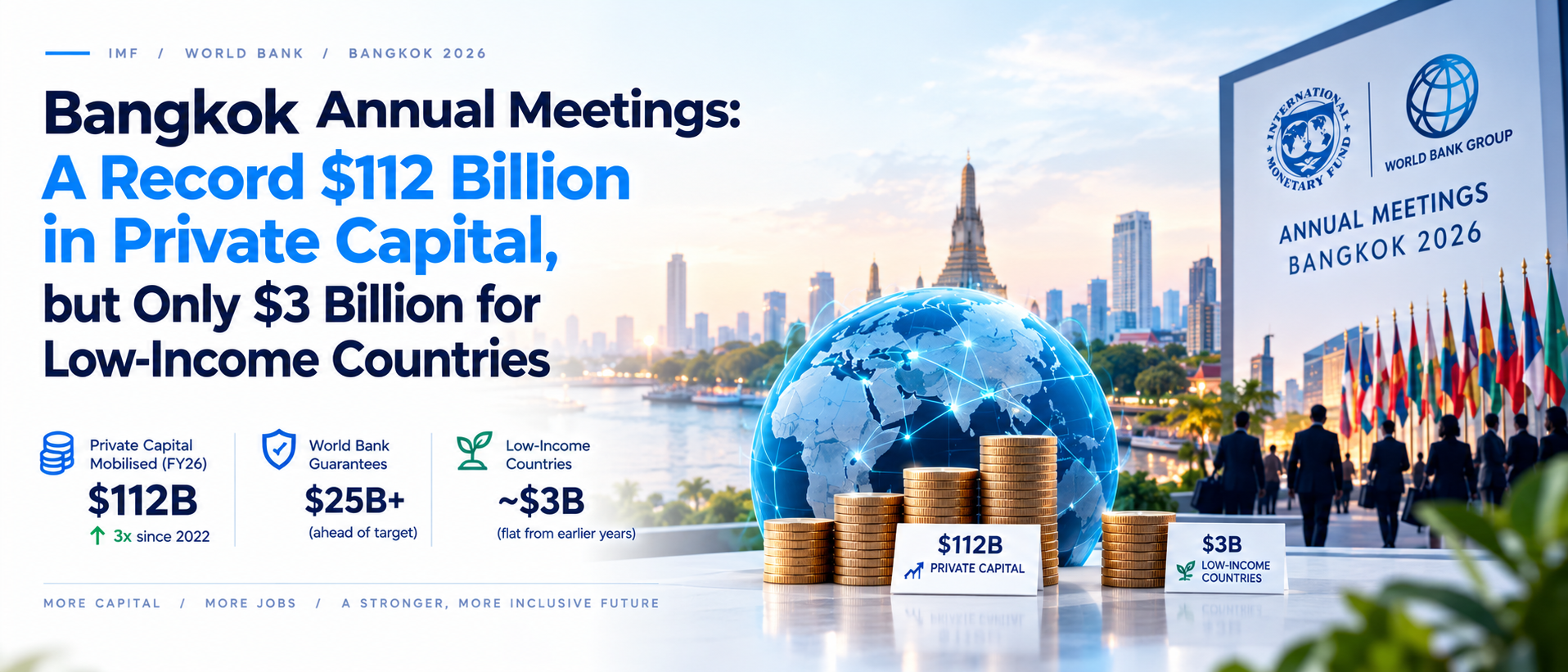
The World Bank mobilised a record $112B in private capital in FY26, but only about $3B reached low-income countries as debt costs and jobs gaps grow.
IMF World Bank Annual Meetings 2026, Bangkok Annual Meetings, World Bank private capital mobilization, Ajay Banga jobs gap, IMFC Chair's Statement, low-income country debt, World Bank guarantees, youth employment gap, developing economies debt service, IMF Georgieva.
IMF World Bank Annual Meetings 2026, Bangkok Annual Meetings, World Bank private capital mobilization, Ajay Banga jobs gap, IMFC Chair's Statement, low-income country debt, World Bank guarantees, youth employment gap, developing economies debt service, IMF Georgieva.
Bangkok Annual Meetings: A Record $112 Billion in Private Capital, but Only $3 Billion for Low-Income Countries
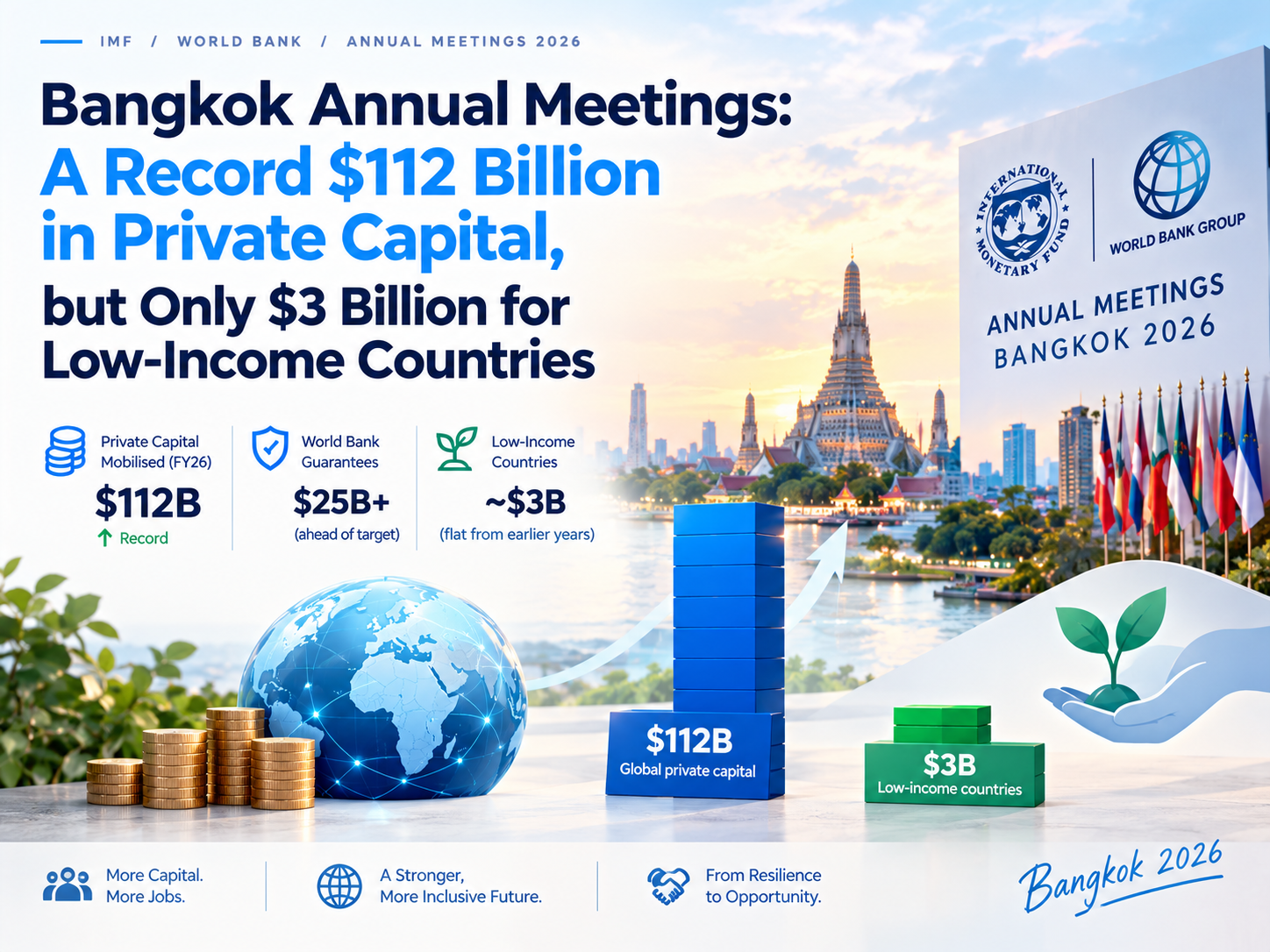
The World Bank Group's headline from the 2026 Annual Meetings in Bangkok is a record: $112 billion of private capital mobilised in fiscal 2026. The number that matters more for the world's poorest countries is buried beside it. Mobilisation in low-income countries stayed at about $3 billion.
New Times
New Times
What Banga Reported
At the plenary on 16 October, World Bank Group President Ajay Banga said private capital mobilised rose from $35 billion in fiscal 2022 to $112 billion in fiscal 2026, the most in the institution's history and more than a threefold increase. The Group also issued more than $25 billion in guarantees, beating its goal of $20 billion a year by 2030 four years early. About $22 billion of the mobilised capital went to Africa. According to the Bank, 55% of total financing, including mobilised capital, went to five job-rich sectors: infrastructure and energy, agribusiness, health, tourism and value-added manufacturing.
Six multilateral development banks are also working to standardise how investments are packaged and transferred, so institutional investors can buy into existing projects and free up development-bank capital for new ones. Blueprint
The Jobs Math Behind the Push
Banga framed the push for private money around employment. In developing economies, 1.2 billion young people will reach working age over the next 10 to 15 years, while only about 400 to 420 million jobs are projected to be created, leaving a shortfall of roughly 800 million. The Bank says the private sector creates nine out of every ten jobs in these economies, which is why it wants capital flowing to firms and infrastructure. Banga stressed that the gap is a projection, not a destiny. Morung Express
What the IMFC Agreed
The International Monetary and Financial Committee, which advises the IMF's governors, issued a Chair's Statement on 17 October rather than a joint communiqué. Chair Mohammed Al-Jadaan, Saudi Arabia's finance minister, said the statement reflects text agreed by all members. It says the global economy has weathered recent shocks better than expected but that buffers have eroded and resilience cannot be taken for granted. Members called for more support for countries facing short-term financing pressure from war spillovers and high energy prices, and welcomed a "Bangkok Blueprint" on digital finance safeguards, cyber resilience and digital fraud. Al-Jadaan said there was no room for complacency. Reuters also reported that delegates walked out during a Russian official's remarks, a sign of the divisions in the room. Reuters
The Debt Squeeze Behind the Statement
The debt numbers came mainly from IMF Managing Director Kristalina Georgieva, not from the statement itself. She said debt-service costs in low-income countries have risen from 6% of government revenue a decade ago to 14%. The IMF's World Economic Outlook identified low-income, oil-importing countries not exposed to the AI investment boom as the most vulnerable to the Iran-war energy shock. IMF deputy research director Petya Koeva Brooks told AFP that many of these countries have "no choice" but to cut spending or risk debt restructuring.
Relief looks unlikely. Reuters reported that, unlike the Covid-era suspension of debt-service payments for the poorest countries, G20 diplomats see little appetite for similar action now because of high debt levels and political pressures. The Bangkok meetings did not produce a new relief mechanism. New Straits Times
Where the Two Tracks Fail to Meet
Put the pieces side by side. The World Bank's jobs plan depends on private capital, and private capital reached record levels. But in low-income countries, where debt service is rising fastest and shocks are hitting hardest, mobilisation was flat at roughly $3 billion. The capital is moving where it is easiest to deploy, and the countries least able to attract it are the ones squeezed by interest costs.
The open question is whether guarantees, and the plan to repackage existing projects for institutional investors, can reach the poorest economies, or whether the jobs strategy will lean on money that keeps avoiding them. The next test comes at the IMFC's April 2027 meeting in Washington. IMF statement page

Vicky Galfat
University of Mumbai/BCA
Learning, building, and exploring the world of technology one project at a time.