Back to News
News AlertWorld Money
Nasdaq Rebounds 1% After Worst Week Since June: Tech Rallies
T
Author
Tushar Shrivas
Published
October 19, 2026
Reading Time
6 MIN READ
Spread the Word
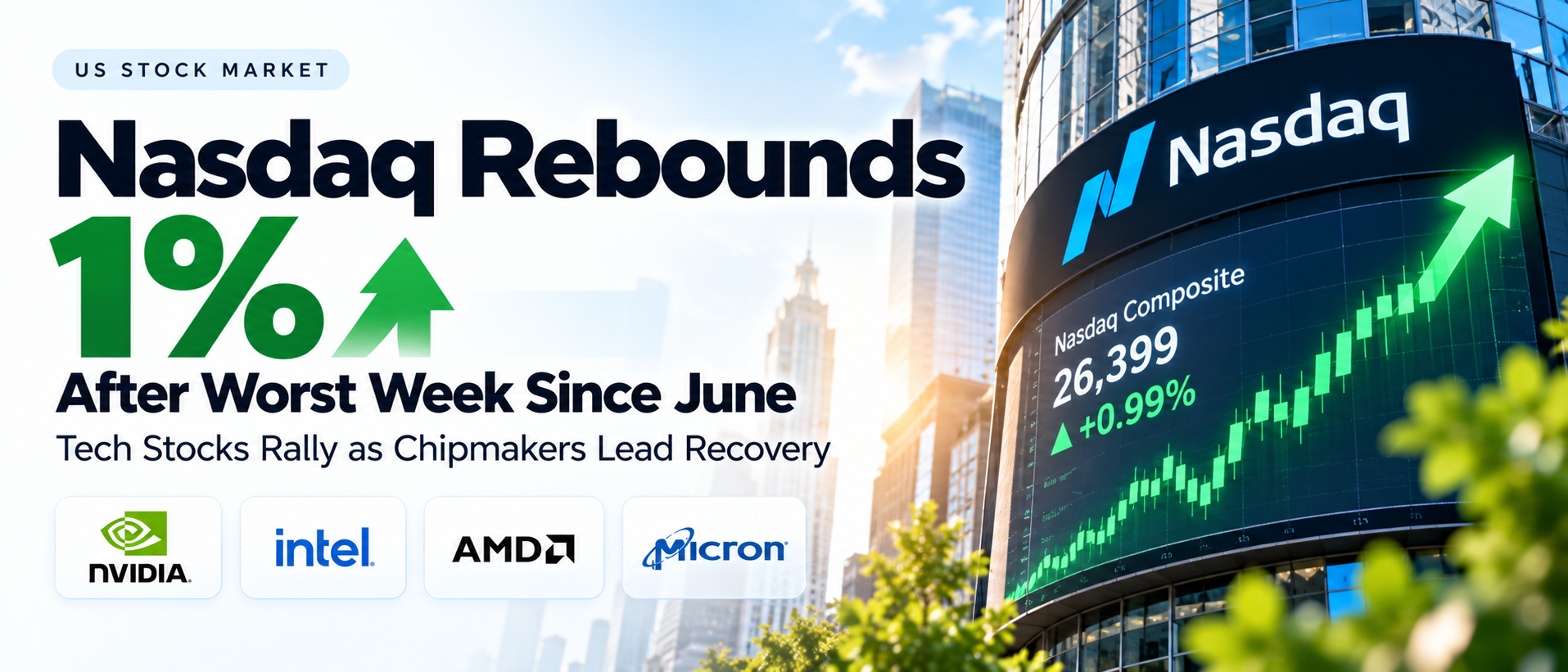
The Nasdaq Composite rose about 1% on October 19 after a 4.5% weekly drop. Chipmakers led the rebound as European stocks slipped on French unrest.
Nasdaq Composite worst week since June, chipmakers rally, Philadelphia Semiconductor Index, CoreWeave, AI stocks selloff October 2026, STOXX 600 France unrest, Treasury yield 5.08%
Nasdaq Rebounds 1% After Its Worst Week Since June as Chipmakers Lead the Recovery
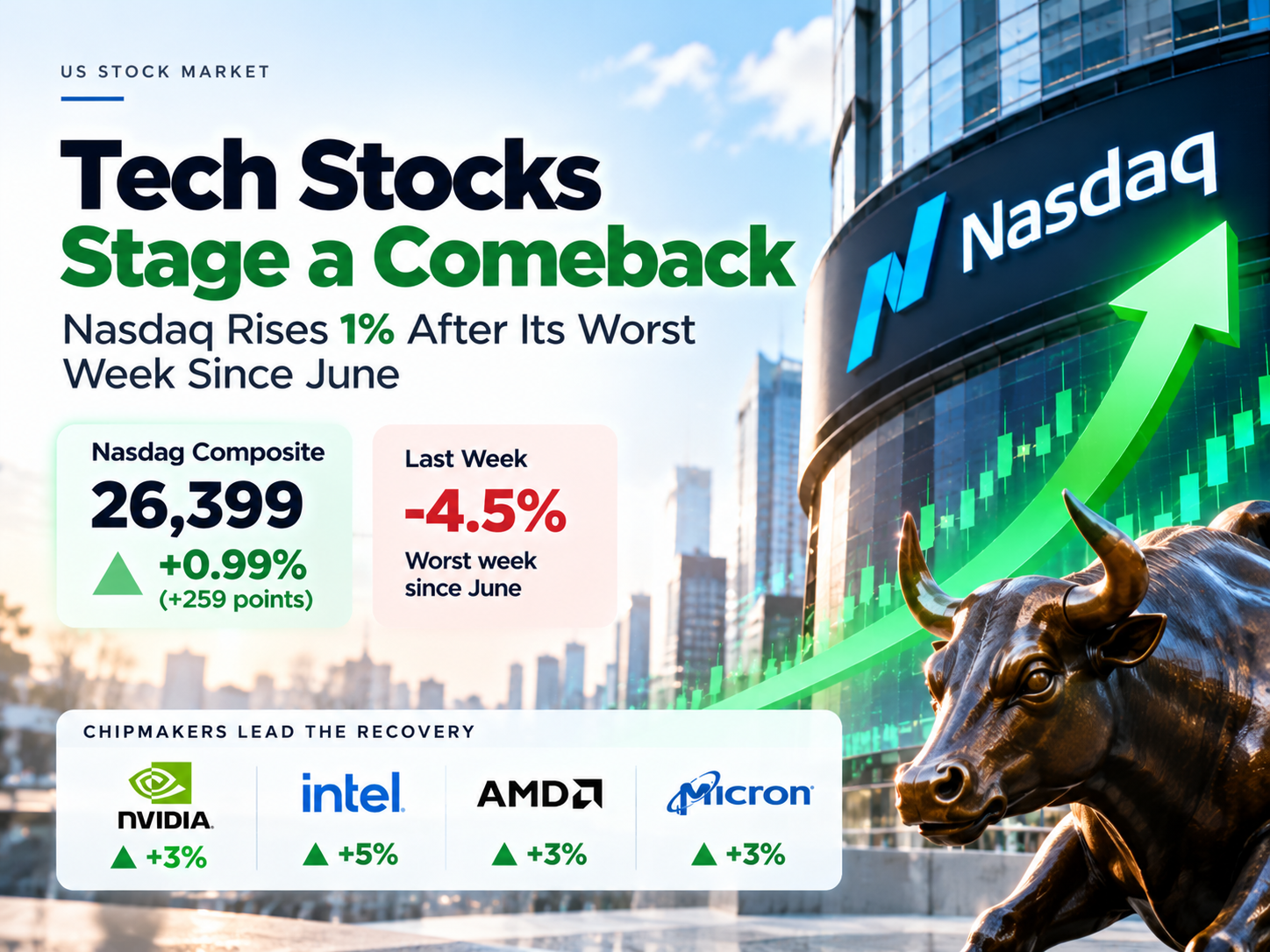
The Nasdaq Composite rose 259 points, or 0.99%, to 26,399 in early trading on Monday, October 19, 2026, after the index fell 4.5% the previous week. That drop was its worst weekly performance since June and ended a four-week winning streak. The rebound came as investors returned to technology and AI stocks that had been sold hard in the prior sessions. HDFC Sky
The brief described last week's drop as tech falling 4.5%. That figure is the Nasdaq Composite, not the technology sector. The information technology sector itself lost more than 6% in the week, its roughest stretch since April 2025, according to CNBC's reporting. The distinction matters because the Composite includes many non-tech names.
Chipmakers Did the Heavy Lifting
The Philadelphia Semiconductor Index rose 2.9% in morning trading, on track to snap an eight-day losing streak that was its longest in 18 years. Bloomberg reported the Nasdaq 100 had its worst week since the tariff turmoil of April 2025, which is a longer look-back than the Composite's "since June" comparison. Both framings are accurate for their indexes, but they should not be mixed in a single headline. Bloomberg
Why Tech Sold Off in the First Place
The selloff was driven by doubts about AI infrastructure financing rather than a single news event. Investors reacted to the withdrawn IPO of Firmus and to CoreWeave bond yields reaching about 15%, a level that signals stress in the debt that funds AI data centres. Concerns about how fast AI infrastructure spending can continue weighed on the sector. Capital Brief
On the rates side, the 10-year US Treasury yield eased to about 5.08% and Brent crude fell about 1.3%, both of which helped sentiment. The brief's "near 5.10%" is close; 5.08% is the more precise figure. Reuters reported that both major indexes had their biggest weekly drop since late June on Friday, as concerns that higher interest rates could curb AI infrastructure investment weighed on technology stocks, particularly data-centre operators. Easing oil prices gave some additional support on Monday. Yahoo Finance
Single-stock moves reflected that split. CoreWeave, the AI cloud operator, fell 25% in the prior week and recovered about 4% after Goldman Sachs raised its rating. Intel rose about 5% after JPMorgan upgraded it to neutral from underweight. Micron and AMD gained around 3% each. Quartz
Europe Fell, But Not as Much as the Brief Said
The brief said European benchmark indexes dropped over 1%. The data supports a smaller move for the broad benchmark. The STOXX 50 fell about 1%, while the STOXX 600 declined about 0.8% at the open, with travel, leisure, carmakers and banks leading losses. Trading Economics
The sharper falls were in France. The CAC 40 dropped more than 1%, while the STOXX 600 was down about 0.7% by mid-morning in Europe. The move is best described as a France-led decline rather than a region-wide slump of more than 1%. MarketScreener
The French Unrest and Its Market Impact
The weekend protests were among the most violent in France in years, with arrests, property damage and looting reported. Carrefour said 50 of its stores were targeted. The protests also strained French public finances: the gap between French and German 10-year bonds stood at 143.5 basis points, having topped 150 earlier in October, and ratings agency Moody's was reviewing France's Aa3 rating, which carries a negative outlook. Euronews
A Chinese Memory Chip Story Added to the Pressure
Breadth Was Narrow
A Chinese Memory Chip Story Added to the Pressure
Last week's weakness was also linked to competitive worries. Chinese memory chipmaker CXMT announced progress in developing advanced memory, which raised concerns about pricing power at major US and South Korean chipmakers. That concern is one reason semiconductor stocks fell so far, and it is not resolved by a single-day bounce. BigGo Finance
Breadth Was Narrow
The rebound was concentrated. On the Nasdaq, advancing issues outnumbered decliners, but the Nasdaq also recorded 120 new 52-week lows against 12 new highs. Most S&P 500 constituents posted losses even as the technology sector rose 1.2%. That is a rotation back into a handful of AI-linked names rather than a broad market recovery.
What the Algorithms Are Doing (Analysis, Not Reporting)
The brief suggested that high-frequency and quantitative models are shifting capital out of defensive sectors into high-beta tech. That is a reasonable description of how systematic strategies respond to a sharp semiconductor rebound, but I did not find reporting that measures algorithmic flows for this session. Treat it as a mechanism, not a documented fact.
With major earnings due this week, from Netflix on Tuesday and Tesla and Meta on Wednesday, the rebound is being tested almost immediately. The question for the next few sessions is whether it holds through those results or reverses.Dim Sum Daily
FAQ
How much did the Nasdaq rise?
About 1%, or roughly 259 points to 26,399 in early trading on October 19, 2026.
Did tech fall 4.5% last week?
The Nasdaq Composite fell 4.5% the prior week. The information technology sector fell more than 6%, its worst stretch since April 2025.
Did European indexes fall more than 1%?
Not broadly. The STOXX 50 fell about 1% and the STOXX 600 about 0.7–0.8%. The CAC 40 in France fell more than 1%.
What was the 10-year Treasury yield?
About 5.08% on Monday, retreating from recent levels. The brief's "near 5.10%" is close.
What caused last week's selloff?
Concerns about AI infrastructure financing, including high bond yields at CoreWeave, a withdrawn Firmus IPO, and worries that higher rates could slow AI infrastructure spending.
Is this rebound broad?
No. It was concentrated in chipmakers and AI-linked names. Most S&P 500 constituents posted losses and the Nasdaq recorded more new lows than highs.

Tushar Shrivas
B.Tech CS@ Shri Balaji Institute of Technology & Management
I write at Metaplugs — breaking down the latest in tech, economics, and business into simple, impactful stories for everyday readers. Passionate about software testing and global finance.