Back to News
News AlertWorld Money
Digital Literacy & "Trump Accounts" – Finance Gets Personal and Hyper-Concentrated
V
Author
Vishal Sable
Published
April 7, 2026
Reading Time
15 MIN READ
Spread the Word

Trump Accounts 2026: $1,000 Child Seed & FANG+ ETF Surge White House declares US "crypto capital" as 4M kids enroll in Trump Accounts. FANG+ ETFs see 50%+ concentration in 5 giants. Inside April 2026 finance.
April 2026 – The Month Finance Became Both Personal and Polarized
Finance in 2026 is caught between two powerful, seemingly opposite forces: extreme personalization and extreme concentration.
On one hand, April is National Financial Literacy Month in the United States—and this year, the White House has made it explicitly about blockchain, digital assets, and a new generation of child savings vehicles called "Trump Accounts." On the other hand, institutional investors are piling into FANG+ ETFs, where just five companies now control more than half of the portfolio.
This is not a contradiction. It is a convergence. The same technological forces—automation, AI-driven portfolio management, digital-first infrastructure—are making finance more accessible to individuals while simultaneously funneling institutional capital into a shrinking pool of mega-cap winners.
National Financial Literacy Month – Crypto, Blockchain, and the "Crypto Capital" Pledge
Today, April 7, 2026, the White House released a Presidential Message on National Financial Literacy Month with a striking declaration:
"Under my leadership, we are making the United States the crypto capital of the world—cultivating a pro-innovation environment that embraces blockchain and digital finance instead of prohibiting it."
The proclamation, issued via the Office of Science and Technology Policy, marks a significant policy shift. Where previous administrations approached digital assets with regulatory caution or outright hostility, the 2026 White House is embedding blockchain literacy directly into the national financial education agenda.
What This Means for Financial Literacy in 2026
The administration's message ties three threads together:
Trump Accounts as a flagship initiative: The proclamation highlights the new child savings accounts as "a historic initiative that provides $1,000 to every child born between January 1, 2025, and December 31, 2028, placed into a long-term savings account that grows as your child grows."
Digital finance as a core competency: Financial literacy is no longer just about budgeting and saving. It now includes understanding blockchain, cryptocurrencies, and digital asset management. As the Hedera Blockchain Foundation's Executive Director noted, "financial education should be considered incomplete if digital assets are omitted."
Government-backed education infrastructure: The Treasury Department, through Secretary Scott Bessent, is reaffirming its commitment to advancing financial literacy via programs like the FDIC's Money Smart initiative and the centralized portal at MyMoney.gov.
The timing is critical. According to 2026 financial literacy statistics, 90% of Gen Z uses finance apps, 34% learn about money from TikTok and YouTube, and nearly 46% struggle with crypto concepts that simply did not exist when previous generations learned personal finance.

Trump Accounts – 4 Million Children, $1,000 Each, and a July 4 Launch
The centerpiece of this year's Financial Literacy Month is the rapid rollout of Trump Accounts—tax-deferred savings and investment vehicles for children, created under the One Big Beautiful Bill Act (OBBBA) enacted on July 4, 2025.
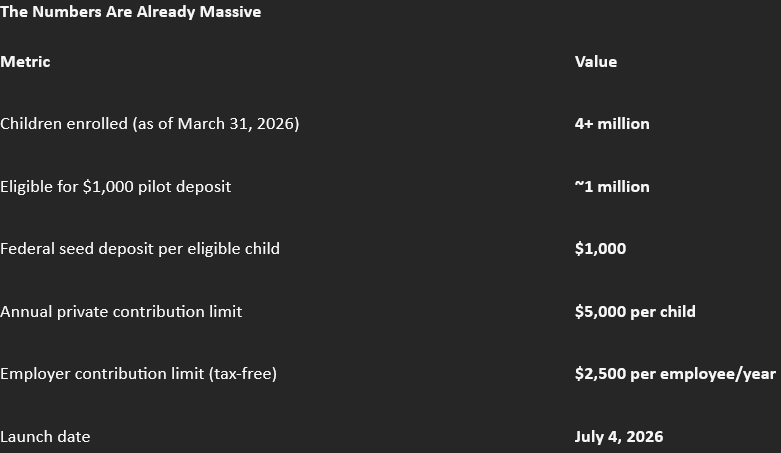
According to the IRS, more than 4 million children have already been signed up for Trump Accounts, with roughly one million qualifying for the Treasury's $1,000 pilot program contribution.
How They Work
Trump Accounts function similarly to tax-advantaged retirement accounts but are designed specifically for minors:
Eligibility: All children under 18 with a Social Security number can open an account. However, only U.S. citizens born between 2025 and 2028 qualify for the $1,000 federal seed deposit.
Contributions: Parents, relatives, employers, charities, and even governments can contribute. Annual private contributions are capped at $5,000 per child, with the government's $1,000 not counting against that limit.
Withdrawals: Funds generally remain locked until the child turns 18, at which point they can be used for higher education, a first home purchase, or starting a business.
Enrollment: Parents can enroll at TrumpAccounts.gov or via IRS Form 4547 with their 2025 tax return.
The BNY–Robinhood Partnership
On April 6, 2026, the Treasury Department announced that Bank of New York Mellon (BNY) will serve as the designated financial agent, with Robinhood building the dedicated Trump Accounts app. The platform is a custom, white-label product designed exclusively for Treasury—no BNY or Robinhood branding will appear on the finished interface.
BNY, which holds $60 trillion in assets for pension funds and institutions, brings institutional reliability. Robinhood brings modern fintech accessibility. Together, they represent the program's dual mandate: security and scale.
Within a year, families will be able to roll accounts over to other financial institutions, opening a new competitive front for advisors and broker-dealers nationwide.
The Dell Factor
Michael Dell and his wife, Susan Dell, have donated more than $6 billion to seed accounts for 25 million children living in ZIP codes where median household income is below $150,000—depositing $250 into each eligible child's account.
FANG+ ETFs – The Hyper-Concentration Trade
While retail investors focus on Trump Accounts, institutional capital is flowing into something entirely different: ultra-concentrated technology ETFs.
The NYSE FANG+ Index—which tracks 10 of the most dominant technology and tech-enabled companies—has become a battleground for investors betting on AI-driven growth. But the concentration is staggering.
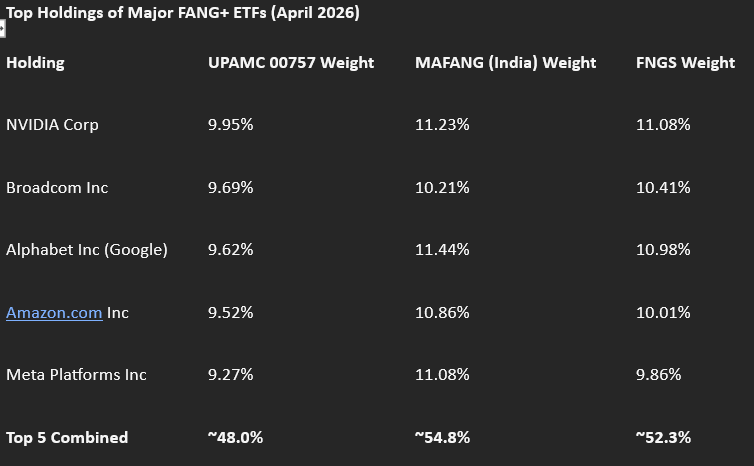
In the Mirae Asset NYSE FANG+ ETF (NSE:MAFANG), the top five holdings alone account for over 54% of the entire portfolio—meaning every dollar invested is more than half-exposed to just five companies.
Performance Reality Check
Despite the concentration, 2026 has been brutal for these highly leveraged tech plays. The MicroSectors FANG+ ETN (FNGS) posted a -15.08% return in Q1 2026, following a volatile 2025 that saw a -13.15% first quarter before rebounding.
The message is clear: hyper-concentration amplifies both upside and downside. When the AI trade works, these funds soar. When sentiment turns—as it has in early 2026—the losses are equally magnified.
Recent Index Changes
The FANG+ Index underwent a quarterly adjustment effective March 23, 2026, adding Micron Technology (MU) and removing CrowdStrike (CRWD). The move extends the index's AI exposure from compute and software into memory hardware—a bet on the physical infrastructure layer of the AI boom.

The Convergence – Why Personal and Polarized Finance Coexist
At first glance, National Financial Literacy Month's focus on blockchain education and child savings accounts seems worlds apart from institutional investors piling into FANG+ ETFs. But they share a common driver: the digitization of everything financial.
For individuals: Trump Accounts represent the first time the federal government is directly seeding investment accounts at birth, using fintech infrastructure (Robinhood) and institutional custody (BNY) to deliver a modern, app-first experience.
For institutions: FANG+ ETFs represent a bet that AI and digital infrastructure will continue concentrating economic value in a handful of mega-cap winners—NVIDIA for compute, Alphabet and Meta for AI models, Amazon and Broadcom for cloud and connectivity.
Both trends are accelerating. As Secretary Bessent put it: "Financial Literacy is what fuels the American Dream. Understanding how to make informed financial decisions unlocks opportunity for every American."
That now includes understanding blockchain. And understanding why five companies control half of your ETF.
Conclusion: April 2026 – A Month of Firsts
This April marks several firsts:
The first National Financial Literacy Month where a sitting president explicitly declares the US the "crypto capital of the world."
The first time 4 million children have been pre-enrolled in a federal savings program before it even launches.
The first time FANG+ ETFs have seen top-five concentration cross the 50% threshold.
For investors, the playbook is bifurcated. For retail participants, Trump Accounts offer a long-term, tax-advantaged entry point into market-based savings. For institutional players, FANG+ ETFs offer concentrated exposure to the AI winners—with commensurate volatility.
Finance in 2026 is more personal than ever. It is also more polarized than ever. Both statements are true. Both are happening right now.

Vishal Sable
B.Tech AD @ shri balaji institute of technology and management
Engineering and tech journalist. I love exploring the impact of emerging technologies on global defense, sovereignty, and everyday life. Always looking for the real story behind the headlines.