Back to News
News AlertWorld Money
The Great Financial Convergence: Why 2026 Is the Year Infrastructure Meets Humanity
V
Author
Vishal Sable
Published
April 6, 2026
Reading Time
13 MIN READ
Spread the Word
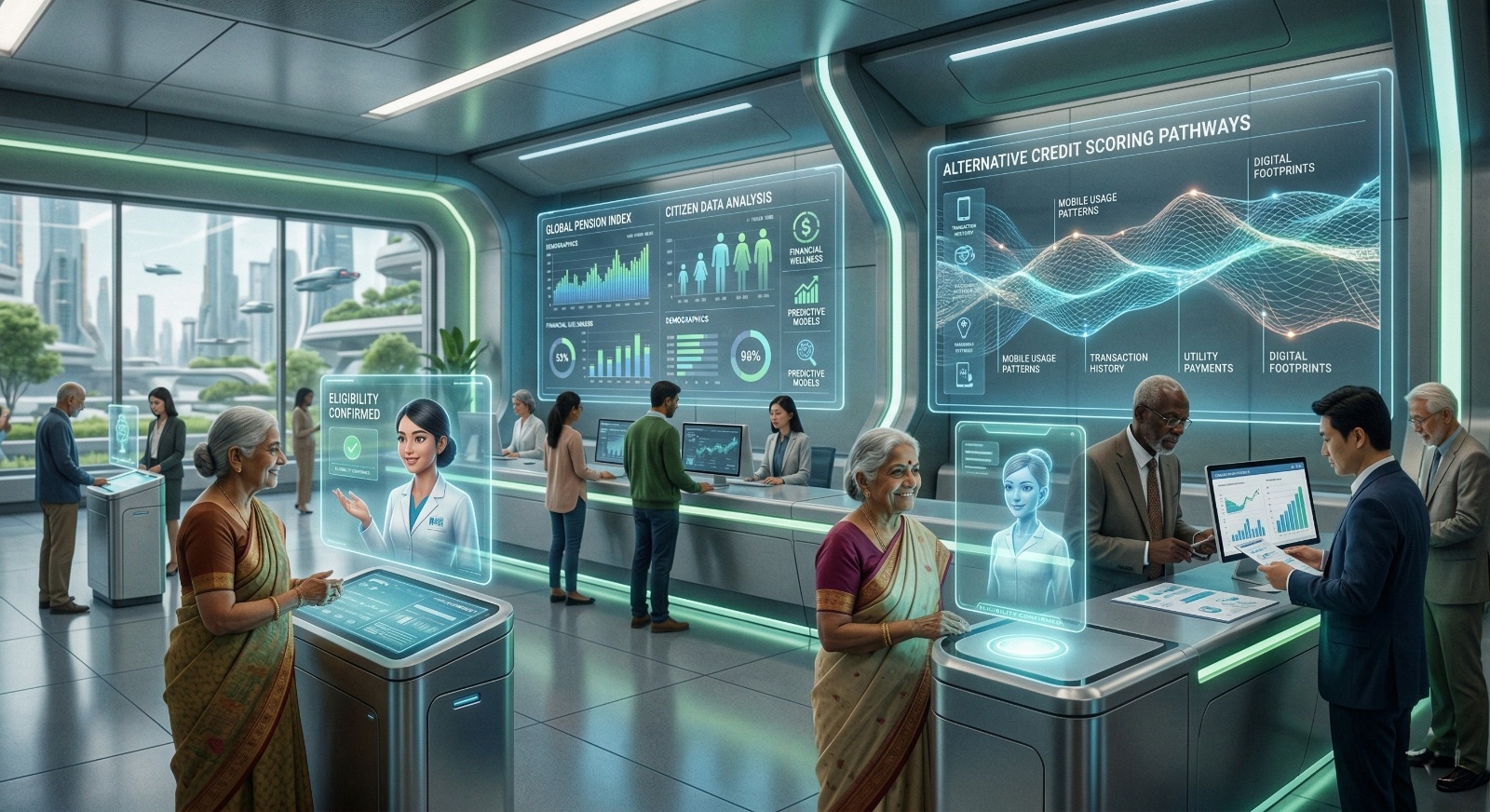
134 countries explore CBDCs as AI credit scoring enters national pensions. Inside 2026’s financial convergence at Money20/20 Asia.
2026 – The Year Finance Stopped Choosing Sides
The theme dominating every major financial forum this month—from Bangkok to Manila to Davos—is "From Infrastructure to Impact: Where Technology Meets Humanity." It’s the official theme of Money20/20 Asia (April 21–23, Bangkok), and it captures a singular truth: the walls between TradFi, DeFi, social security systems, and digital currencies are dissolving.
This is the Convergence Era. And three developments today prove the thesis is already operational.
AI in Social Security – Surfin Meta Brings Credit Scoring to National Pensions
The first convergence vector is humanitarian technology. Just today, Singapore‑based fintech Surfin Meta Digital Technology signed a Memorandum of Understanding with the Philippine Social Security System (SSS) to integrate AI credit scoring, big‑data modeling, and chatbot technology into national pension operations.
The agreement, finalized at the World Economic Forum in Davos (January 2026) and now moving into implementation, transforms how a government pension fund serves its members. Under the MOU, SSS and Surfin will explore:
AI‑driven loan administration and member servicing
Automated back‑end risk management
Explainable, auditable analytics for compliance
Personalized retirement‑planning tools via digital assistant.
The economic logic is relentless: traditional credit bureaus exclude billions because they lack formal history. Surfin’s proprietary credit‑scoring model, developed across over 600,000 features, evaluates borrowers using alternative data streams—smartphone usage, location patterns, even digital transaction trails.
“The Philippines remains a strategically important market,” said Surfin CEO Dr. Yanan Wu. “This collaboration reflects our continued efforts to leverage artificial intelligence and data‑driven technologies to support individuals and small businesses that face challenges within traditional financial infrastructure.”
The Philippine SSS, managing pensions for millions, sees AI not as a threat but as a governance enhancer. “AI can help strengthen governance and enable personalized member services, from retirement‑planning tools to interactive digital assistants,” said SSS President Robert Joseph M. de Claro.
India is moving in parallel. The Union government is actively weighing an AI‑based credit scoring framework to expand access for first‑time borrowers, women, and rural communities, using alternative data sets to assess repayment capacity where no formal credit history exists.
The Intersection Stage – TradFi and DeFi Finally Stop Fighting
The second convergence vector is structural. At Money20/20 Asia 2026, the brand‑new Intersection Stage is dedicated entirely to one question: what happens when traditional finance and decentralized finance stop competing and start collaborating?
The lineup is instructive. Speakers include Siddharth Gupta (Bank of America), Dhiraj Bajaj (Standard Chartered), Fangfang Jiang (International Finance Corporation), Ran Goldi (Fireblocks), and Kaushik Sthankiya (Kraken)—institutional incumbents and crypto natives on the same stage.
The consensus emerging from Bangkok is clear: convergence is no longer theoretical. According to Sumsub’s APAC Legal Director Siva Kumar, “The convergence of TradFi and DeFi can only succeed if trust, identity, and compliance evolve alongside technology. Asia is leading this shift by adopting regulatory models that enable innovation without compromising security.”
Key infrastructure drivers accelerating the convergence:
Real‑world asset (RWA) tokenization has surged past $26 billion, bringing traditional yield‑generating assets onto blockchain rails.
U.S. spot Bitcoin ETFs attracted over $1.4 billion in just five trading days in early 2026, signaling institutional capital moving in at scale.
Stablecoins are handling over $250 billion in daily transactions, with a total market cap of $300 billion—a parallel financial system that TradFi can no longer ignore.
Metric 2024 2026
Countries exploring CBDCs 114 134
Launched CBDCs 9 11
Stablecoin daily tx volume $180B $250B+
RWA tokenization $12B $26B+
U.S. spot Bitcoin ETF inflow (5 days) N/A $1.4B
The question at Money20/20 Asia is no longer if TradFi and DeFi converge—it’s how fast regulators can build the guardrails.

CBDCs Go Live for Daily Settlement – The Central Bank Digital Currency Era
The third convergence vector is operational. Central bank digital currencies have moved from pilot projects to daily settlement infrastructure.
As of early 2026, 134 countries are exploring CBDCs, and 11 have already launched them. But the real news is the shift toward tokenized wholesale CBDCs for real‑time, 24/7 settlement.
Project mBridge, a collaboration involving the BIS Innovation Hub, Thailand, China, the UAE, and Hong Kong, has created a shared blockchain platform for real‑time, cross‑border, and foreign exchange transactions. It enables direct, 24/7 settlement in central bank money, bypassing correspondent banks entirely to reduce costs and settlement risk. The MVP for the new payment scheme is expected in H1 2026, intended to support over 4 billion accounts.
The Bank of Japan has launched a blockchain‑based sandbox to test settlements using central bank reserves, with a decision on issuing a retail digital yen expected this year.
China has already begun paying interest on digital yuan balances held in user wallets, effective January 1, 2026—transforming the e‑CNY from a simple cash alternative into a programmable deposit currency with macroeconomic implications.
Hong Kong is advancing its e‑HKD Pilot Programme into Phase 2, developed with Deloitte and 11 industry partners, designed to enable faster digital transactions while preserving the same monetary value and government backing as physical currency.
Even SWIFT is upgrading its infrastructure to enable instant, 24/7 cross‑border payments, with 75% of transactions already reaching beneficiary banks within 10 minutes.
The Coexistence Question – CBDCs vs. Private Stablecoins
A critical sub‑plot of 2026 is the relationship between government‑issued CBDCs and private stablecoins (USDT, USDC). They are not necessarily competitors—they are complementary layers of a hybrid system.
Stablecoins offer pseudonymity, 24/7 settlement, and sub‑penny fees. CBDCs offer sovereign trust, regulatory compliance, and programmability. As one analyst noted, “In 2026, digital currency is evolving into a hybrid system where stablecoins and CBDCs coexist and interoperate, combining private sector innovation and speed with sovereign trust and regulatory compliance.”
The practical impact is already visible: cross‑border remittances using stablecoins bring fees from 6.5% to under 1%, saving an estimated $58.5 billion annually on global remittances, according to World Bank data.

Conclusion: Infrastructure to Impact – The Monetization Opportunity
The convergence of AI‑powered social security, TradFi‑DeFi integration, and CBDC settlement creates a unified thesis for 2026: the financial system is becoming programmable, inclusive, and real‑time.
For investors and enterprises, the monetization vectors are clear:
AI credit scoring unlocks unbanked populations previously invisible to lenders.
RWA tokenization bridges traditional yields with blockchain efficiency.
CBDC infrastructure provides the sovereign rails for daily settlement at scale.
The "Infrastructure to Impact" theme at Money20/20 Asia is not marketing copy. It is the operating manual for the next decade of global finance.

Vishal Sable
B.Tech AD @ shri balaji institute of technology and management
Engineering and tech journalist. I love exploring the impact of emerging technologies on global defense, sovereignty, and everyday life. Always looking for the real story behind the headlines.