Back to News
News AlertWorld AI Tech
Etched's $50B Bet Doesn't Escape the Chip Industry's Real Bottleneck
V
Author
Vicky Galfat
Published
October 6, 2026
Reading Time
4 MIN READ
Spread the Word
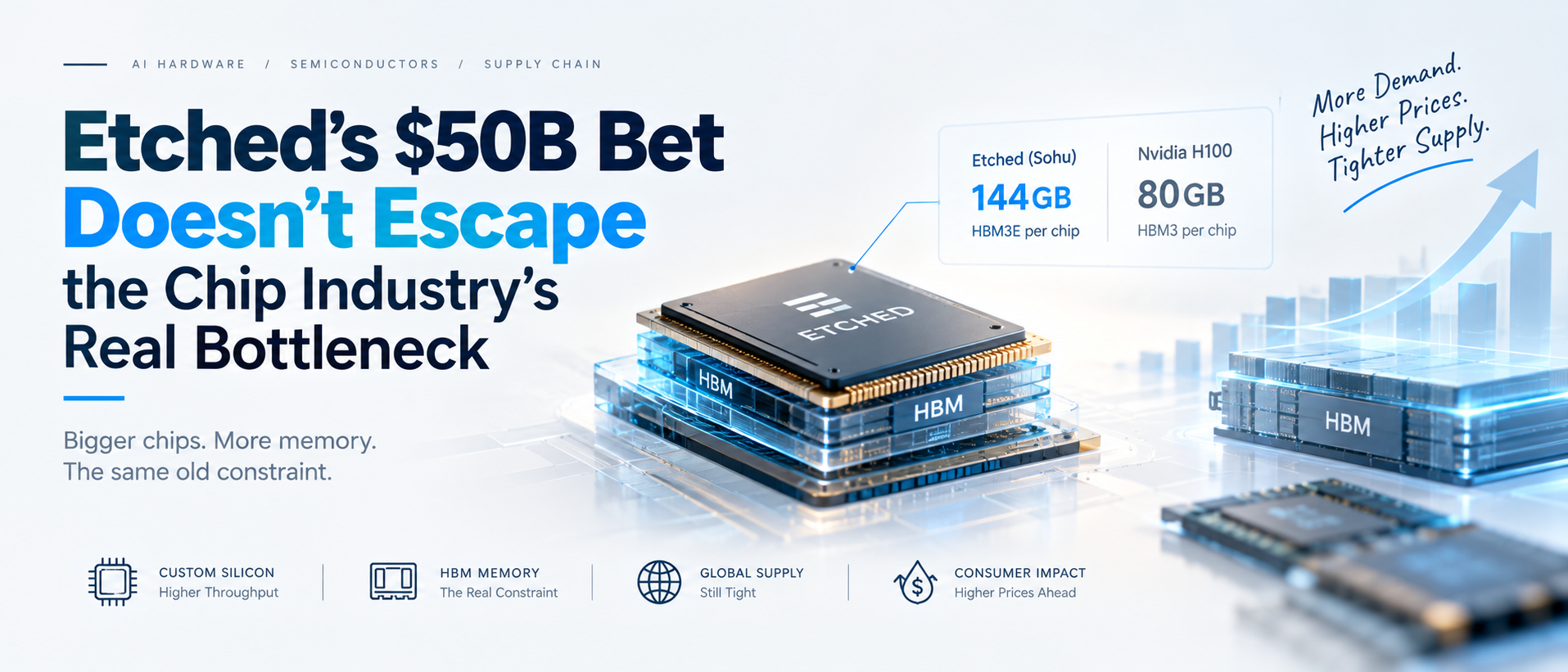
Etched's valuation may hit $50B, but its chip uses more HBM memory per unit than Nvidia's H100 — deepening, not solving, 2026's AI memory shortage.
Etched valuation 2026, Sohu transformer chip, HBM memory shortage, DRAM price increase 2026, AI chip startup funding, high bandwidth memory squeeze, inference chip Nvidia alternative, memory supercycle
Etched valuation 2026, Sohu transformer chip, HBM memory shortage, DRAM price increase 2026, AI chip startup funding, high bandwidth memory squeeze, inference chip Nvidia alternative, memory supercycle
Etched's $50 Billion Bet Doesn't Escape the Industry's Real Bottleneck
Etched is being courted at a valuation up to $50 billion — more than double what it was worth seven weeks ago. But the inference-chip startup's own hardware reveals an irony at the heart of the AI industry's 2026 gold rush: the very memory shortage driving up prices for every laptop and phone on the planet is the same shortage its backers are betting Etched can somehow outrun.
A Valuation Climbing Faster Than the Chips Can Ship
Etched is currently reviewing funding offers ranging from $40 billion to $50 billion, according to people familiar with the discussions — a jump that would roughly double or more than double the $21 billion valuation Jane Street set just in September. That round itself came only two months after Sequoia led a $300 million raise at $10.3 billion in July, meaning Etched's valuation has moved in a rough line from $10.3 billion to as high as $50 billion in three months. The company, which builds full AI hardware systems around its proprietary Sohu chip rather than just selling silicon, operates a 10-megawatt datacenter in Silicon Valley and has established a Taiwan facility to coordinate production near TSMC — infrastructure befitting a company reportedly weighing deals that could hand it more than three years of runway.
The Chip That Needs More Memory, Not Less
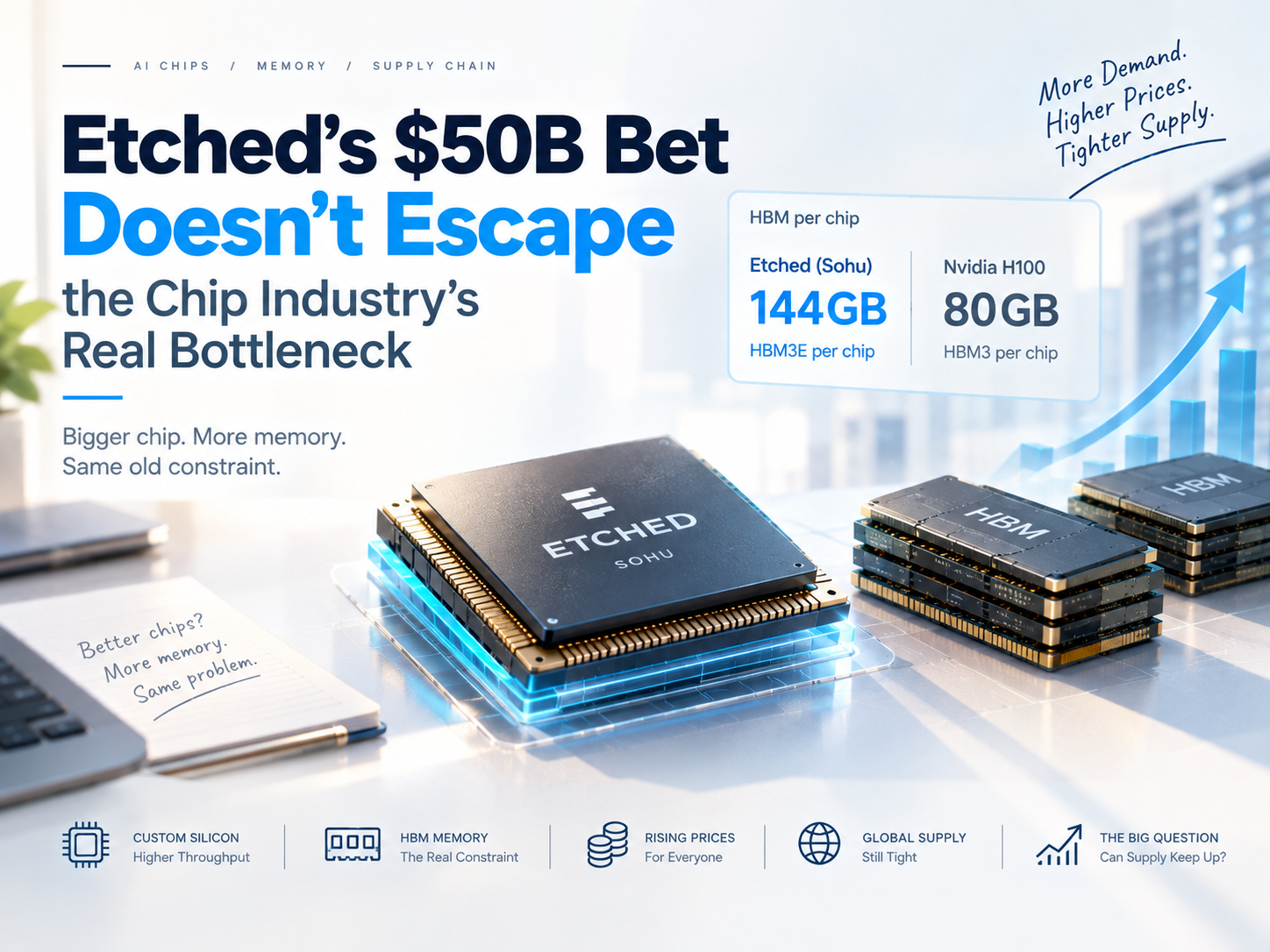
Here's the detail that complicates the "custom silicon beats Nvidia" narrative: Sohu isn't actually lighter on high-bandwidth memory (HBM) than the GPUs it's designed to replace. Each Sohu chip carries 144GB of HBM3E, compared to 80GB of HBM3 on Nvidia's H100 — nearly twice the memory capacity per chip, which Etched needs to keep its hard-coded transformer pipeline fed at the throughput speeds it advertises. SK Hynix, one of only three companies in the world that manufactures HBM at volume, is itself an investor in Etched — a signal less about betting against Nvidia's architecture and more about ensuring demand for HBM keeps climbing regardless of which company's logo is on the chip.
Why That Matters for Everyone Who Isn't Buying AI Chips
HBM has become the scarcest, highest-margin product in electronics. Data centers are projected to consume roughly 70% of all high-end memory output in 2026, and HBM supply is reported sold out industry-wide for the year, with SK Hynix, Samsung, and Micron having shifted the overwhelming majority of their combined production toward it. That reallocation has pushed conventional DRAM contract prices up as much as 93–98% quarter-over-quarter in early 2026 by some trackers, with J.P. Morgan Global Research projecting DRAM prices could rise more than 400% from the start of 2024 to the end of 2026. The practical result: PC, tablet, and smartphone buyers are facing projected price increases of 10% to 20% by year-end, and analysts at Micron have signaled the shortage may not meaningfully ease before 2028.
Specialized Silicon Was Supposed to Be the Escape Hatch
The entire thesis behind alternative chip architectures — Etched's Sohu, Groq's LPU, and others — is that purpose-built silicon can sidestep the inefficiencies of general-purpose GPUs. And in raw throughput, Etched's claims back that up: the company says an 8-chip Sohu server can push roughly 500,000 tokens per second on Llama 70B, against roughly 23,000 for an equivalent Nvidia H100 setup. But throughput gains built on top of more HBM per chip, not less, mean specialized inference silicon isn't reducing the industry's dependence on the memory bottleneck — it's intensifying it, just more efficiently per token generated.
If HBM remains sold out through 2026 and possibly beyond, the company best positioned to profit isn't necessarily the one with the cleverest chip architecture — it's whoever can actually secure memory supply at scale. Etched's valuation run suggests investors believe it can. But with Samsung, SK Hynix, and Micron all playing favorites among a handful of mega-customers, the open question isn't whether Sohu outperforms an H100. It's whether there's enough physical memory in the world for every company racing to build the next Etched.

Vicky Galfat
University of Mumbai/Major
Learning, building, and exploring the world of technology one project at a time.