Back to News
News AlertWorld Money
FCA Proposes 90-Day Redemption Notice as FSB Flags Private Credit Risk
V
Author
Vicky Galfat
Published
October 10, 2026
Reading Time
5 MIN READ
Spread the Word
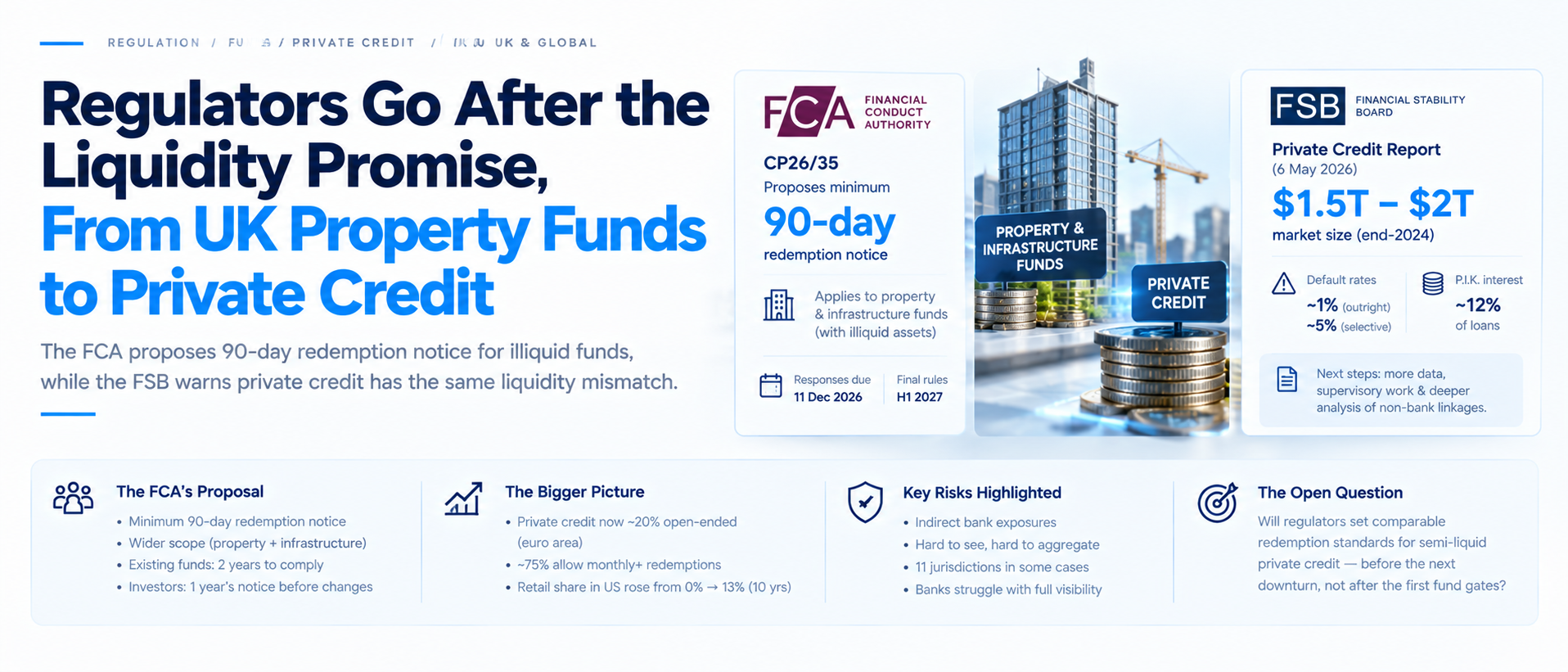
The FCA proposes 90-day withdrawal notice for property and infrastructure funds as the FSB warns private credit has the same liquidity mismatch.
FCA CP26/35, 90-day redemption notice, open-ended property funds, illiquid assets funds, FSB private credit report, private credit vulnerabilities, non-bank financial intermediation, liquidity mismatch, semi-liquid funds, UK fund regulation 2026.
FCA CP26/35, 90-day redemption notice, open-ended property funds, illiquid assets funds, FSB private credit report, private credit vulnerabilities, non-bank financial intermediation, liquidity mismatch, semi-liquid funds, UK fund regulation 2026.
Regulators Go After the Liquidity Promise, From UK Property Funds to Private Credit
A fund that lets investors withdraw cash on short notice while holding buildings, infrastructure or private loans is making a promise it may not be able to keep. In the past week, regulators have attacked that promise from two directions. Read together, they show a familiar problem moving from property funds into a newer, larger asset class.
The FCA Tries Again on Notice Periods
On 8 October, the UK Financial Conduct Authority opened consultation CP26/35, proposing minimum redemption terms for retail funds that invest mainly in assets that are slow to sell. It applies to non-UCITS retail schemes with at least 50% of their assets in inherently illiquid holdings, such as real estate and infrastructure, and to other such schemes with limited redemption arrangements. According to FinanceFeeds, the headline proposal is a minimum 90-day notice period, with longer periods possible where the asset mix warrants it.
This is a proposal, not a rule. Responses are due by 11 December 2026, and the FCA expects to publish final rules in the first half of 2027. Existing funds would reportedly get two years to comply, and investors at least one year's notice before terms change.
It is also not the FCA's first attempt. In August 2020, when roughly £12.5 billion of savings was reportedly trapped in suspended property funds, the regulator floated a 90 to 180 day notice period, then put its final decision on hold after feedback about operational readiness and ISA eligibility. A survey by the platform AJ Bell at the time found 54% of DIY investors said they would sell if a notice period was imposed. The 2026 paper revives the idea, widens it to infrastructure, and says it will align UK rules with new international standards.
The FSB's Warning on Private Credit
The second move came from the Financial Stability Board, not the Bank for International Settlements as is sometimes reported. On 6 May 2026, the FSB published its first dedicated report on vulnerabilities in private credit, drawing on a workstream that included the BIS, the Basel Committee, the IMF and IOSCO. The FSB estimates the market at $1.5 trillion to $2 trillion at the end of 2024, with about $1 trillion in the United States.
The report is not binding, and it stops short of new rules. It sets out further work on interlinkages between non-banks, clearer definitions, supervisory discussions and better data. Its warnings are specific: outright default rates are low at around 1%, but rise to around 5% once selective defaults are counted, and roughly 12% of loans use payment-in-kind interest. The FSB stresses that private credit remains untested in a prolonged downturn.

Banks' Exposure Is Smaller Than the Headlines, and Harder to See
The bank angle is more nuanced than "interconnectedness is rising." The FSB finds direct bank lending to private credit funds relatively small: member data captures about $220 billion in drawn and undrawn credit lines, though commercial estimates could be more than twice that, and the aggregate is below 0.5% of bank assets where it can be identified.
The concern is the indirect channels. Banks also finance fund portfolios, extend revolving credit to companies that borrow from private credit funds, form partnerships with asset managers, and trade synthetic risk transfers. The late-2025 collapses of First Brands and Tricolor showed how this can look in practice, with lenders in 11 jurisdictions and several banks exposed through different routes. Some banks, the FSB notes, struggle to aggregate these exposures at all.
Where the Two Stories Meet
Private credit funds have traditionally been closed-end, which limits liquidity mismatch. That is changing. The FSB says around 20% of euro-area private credit funds are open-ended, with about three quarters of those allowing monthly or more frequent redemptions, and retail investors' share of US private credit vehicles has risen from virtually zero to around 13% in a decade. In early 2026, several semi-liquid private credit funds reportedly received redemption requests above their stated withdrawal limits, which for some funds is 5% of net asset value, and managers leaned on those limits to manage the pressure.
That is the thread. The FCA is retrofitting notice periods onto property and infrastructure funds after repeated suspensions. The FSB is describing the early stages of the same mismatch in private credit, before a downturn tests it. The FSB notes that most UK-managed private credit funds match redemption terms to asset liquidity, so the problem there is limited to a small number of funds for now.
The FCA's proposal fixes what the last cycle broke. Whether regulators will set comparable redemption standards for semi-liquid private credit before the next downturn, rather than after the first fund gates, is the question the FSB report leaves open.

Vicky Galfat
University of Mumbai/BCA
Learning, building, and exploring the world of technology one project at a time.