Back to News
News AlertWorld Unicorn
Hurun Index 2026 Crowns Anthropic the $965B King; UK Overtakes India
V
Author
Vishal Sable
Published
July 11, 2026
Reading Time
4 MIN READ
Spread the Word
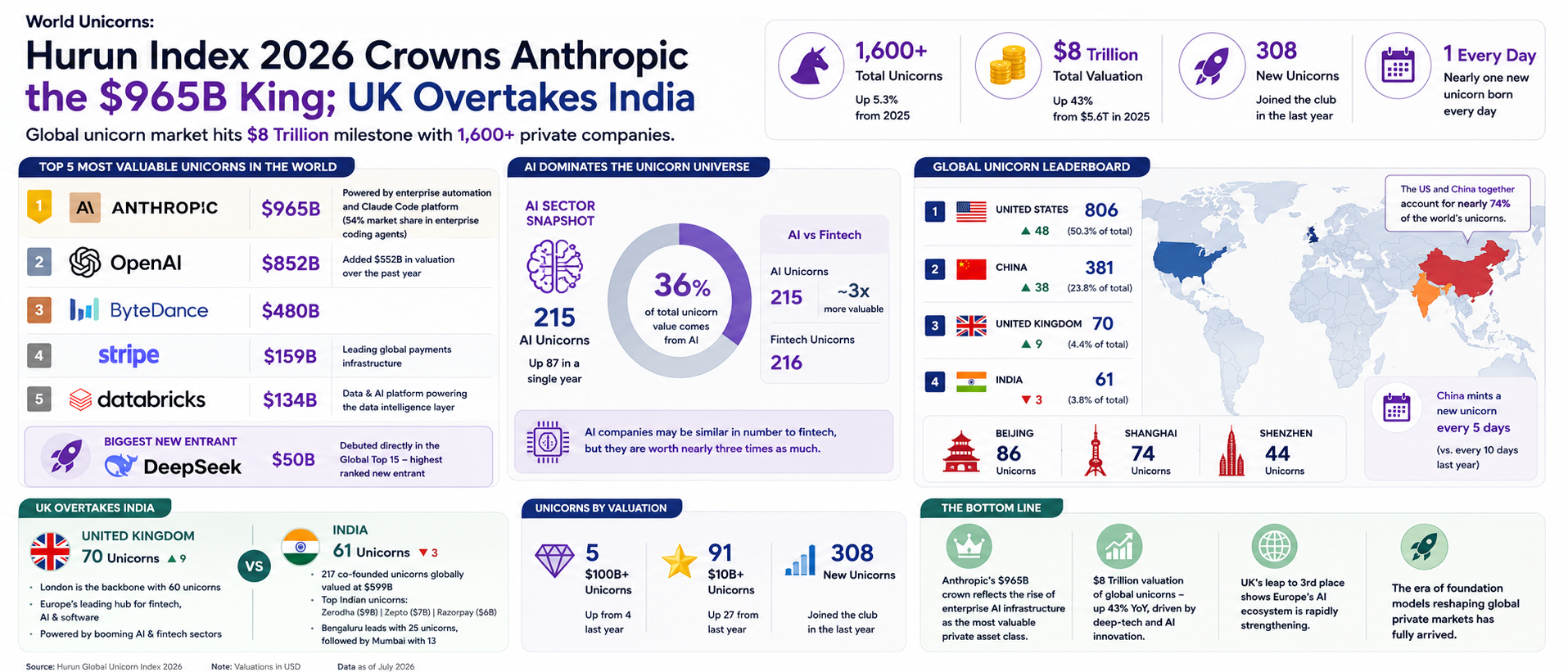
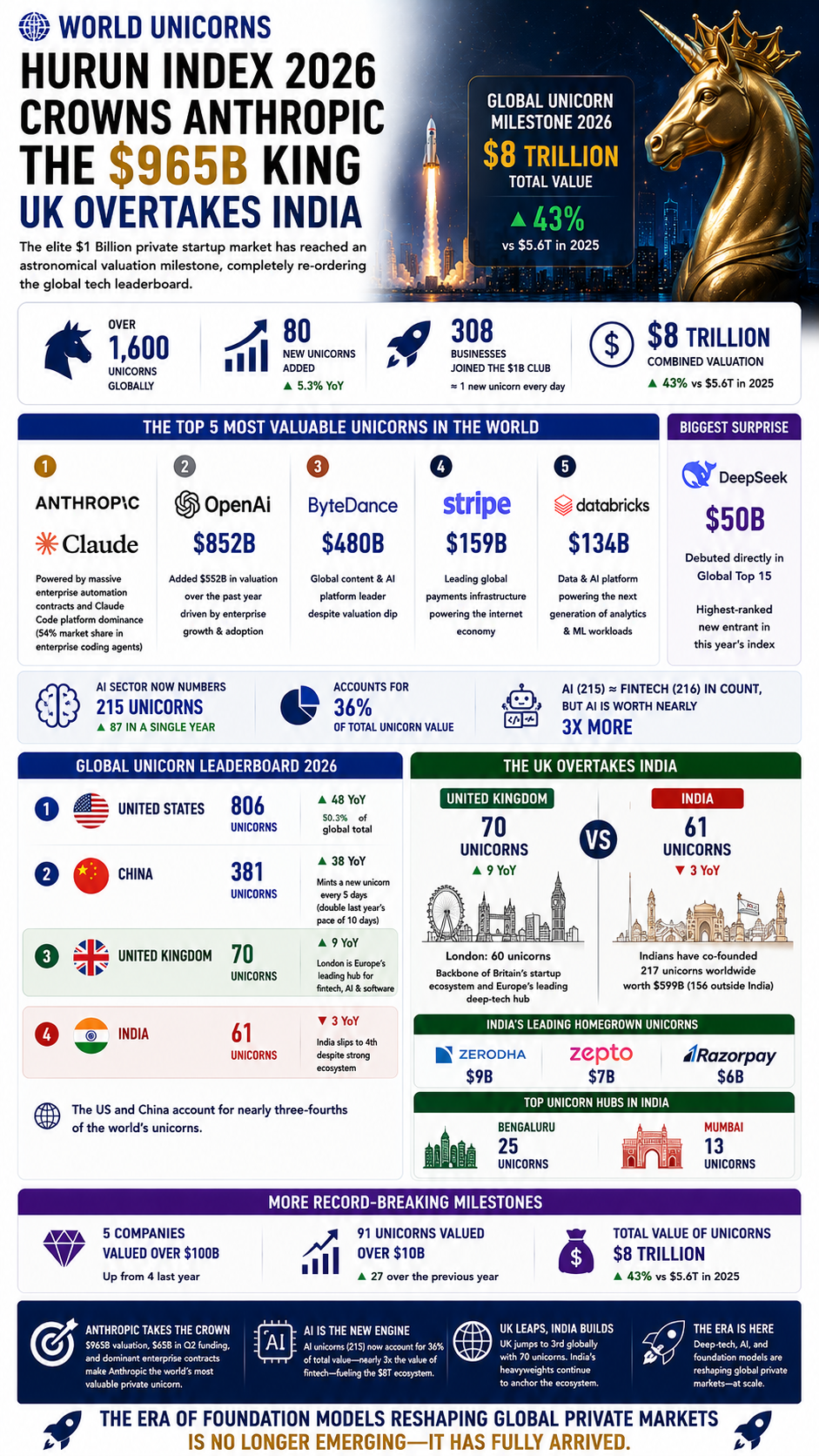
The elite $1 Billion private startup market has officially reached an astronomical valuation milestone, completely re-ordering the global tech leaderboard. The newly published Hurun Global Unicorn Index 2026 revealed that the global unicorn count has climbed to over 1,600 private companies, totaling a jaw-dropping $8 trillion in collective value—up 43% from $5.6 trillion in 2025. The number of unicorns hit a record high, up 5.3% from the previous year with 80 new additions, and 308 businesses joined the billion-dollar club for the first time, equivalent to nearly one new unicorn every day.
The Latest News
In a historic market shakeup, Anthropic has claimed the rank as the world's most valuable private unicorn at $965 billion, powered by its massive enterprise automation contracts and the dominance of its Claude Code platform, which commands 54% market share in the enterprise coding agent sector. OpenAI ranks second at $852 billion, adding $552 billion in valuation over the past year, while ByteDance slipped to third place with a valuation of $480 billion. For the first time, five private companies are now valued at more than $100 billion, up from four last year, while the number of unicorns valued above $10 billion jumped to 91, an increase of 27 over the previous year. Rounding out the top five are Stripe at $159 billion and Databricks at $134 billion. Among the biggest surprises was China's DeepSeek, which debuted directly in the global Top 15 with a valuation of $50 billion, making it the highest-ranked new entrant in this year's index. The AI sector now numbers 215 unicorns—up 87 in a single year—and accounts for 36% of total unicorn value, the highest share of any sector. Although AI has nearly the same number of unicorns as fintech's 216, AI companies are worth nearly three times as much, reflecting investor belief that generative AI could produce the next generation of trillion-dollar businesses.
The Geopolitical Shifts
Geopolitically, the United States leads the index with 806 unicorns—more than half the world's total—up 48 from last year and accounting for 50.3% of the global total. China remains firmly in second place with 381 unicorns, adding 38 over the past year. Together, the US and China account for nearly three-fourths of the world's unicorns. China now mints a new unicorn every five days on average, double last year's pace of one every 10 days, with Beijing leading with 86 unicorns, followed by Shanghai with 74 and Shenzhen with 44. In an intense structural shift, the United Kingdom has officially overtaken India to claim the 3rd place spot globally. The UK climbed to 70 unicorns—up by nine—pushing past India, which now counts 61 unicorns, down by three from last year. London is the backbone of Britain's startup ecosystem, accounting for 60 unicorns, and has become Europe's leading hub for fintech, artificial intelligence, and software companies. The UK's rise is heavily driven by its skyrocketing AI and fintech sectors, with London emerging as Europe's leading hub for deep-tech investment. Despite India's slip, Indians have co-founded 217 unicorns worldwide, valued at a combined $599 billion, with 156 of these based outside India. India's leading homegrown unicorns include Zerodha ($9 billion), Zepto ($7 billion), and Razorpay ($6 billion), with Bengaluru remaining India's top unicorn hub with 25 companies, followed by Mumbai with 13.
The Bottom Line
July 2026 marks a historic reordering of the private technology hierarchy. Anthropic's rise to the top of the unicorn leaderboard at $965 billion, powered by $65 billion in Q2 funding and dominant enterprise contracts, signals that enterprise AI infrastructure is now the most valuable asset class in private markets. The $8 trillion combined valuation of the world's unicorns—up 43% year-over-year—confirms that deep-tech and artificial intelligence are now the primary engines of global startup wealth creation. The UK's leap to third place globally reflects the growing strength of Europe's AI ecosystem, while Indian heavyweights like Zerodha, Zepto, and Razorpay continue to anchor the subcontinent's startup economy. The era of foundation models reshaping global private markets is no longer emerging—it has fully arrived.

Vishal Sable
B.Tech AD @ shri balaji institute of technology and management
Engineering and tech journalist. I love exploring the impact of emerging technologies on global defense, sovereignty, and everyday life. Always looking for the real story behind the headlines.