Back to News
News AlertWorld Unicorn
The Rise of "Physical" Tech Leaders Shakes Up the Leaderboard
V
Author
Vishal Sable
Published
July 9, 2026
Reading Time
4 MIN READ
Spread the Word
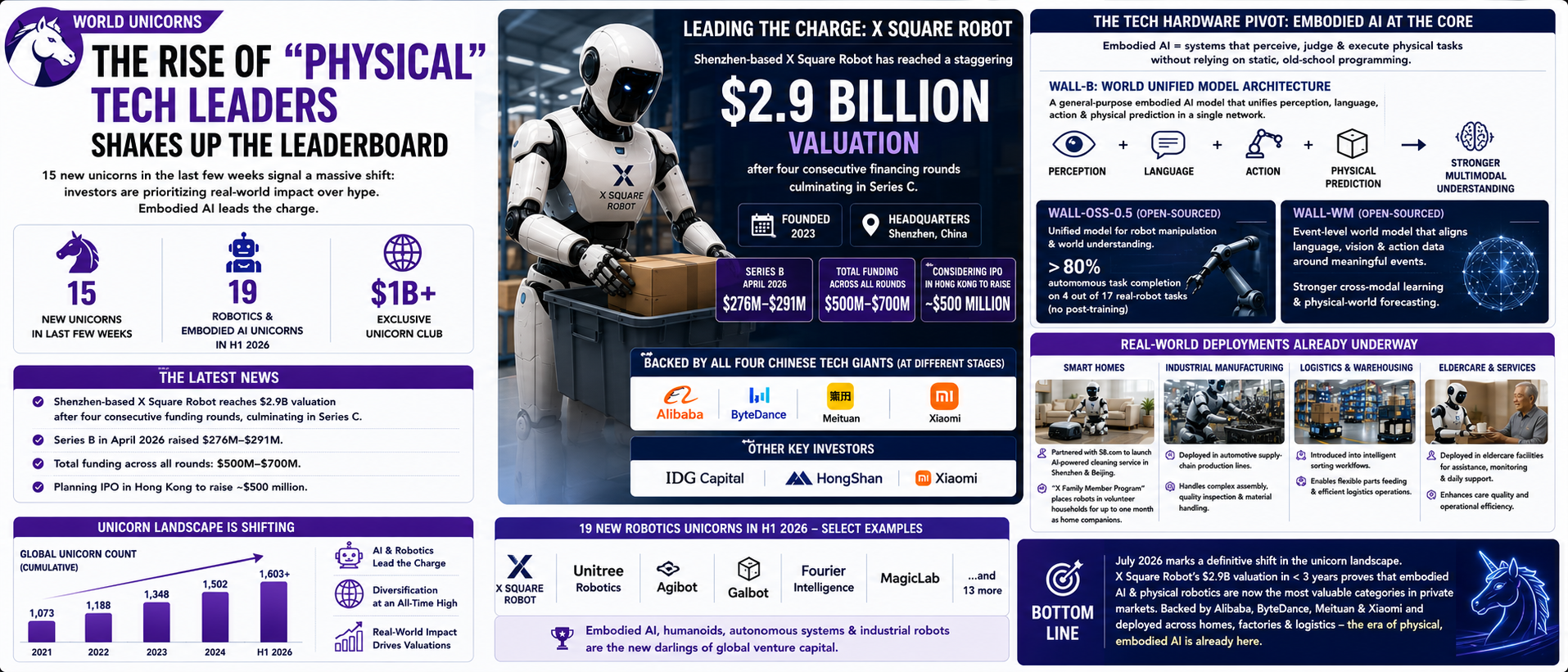
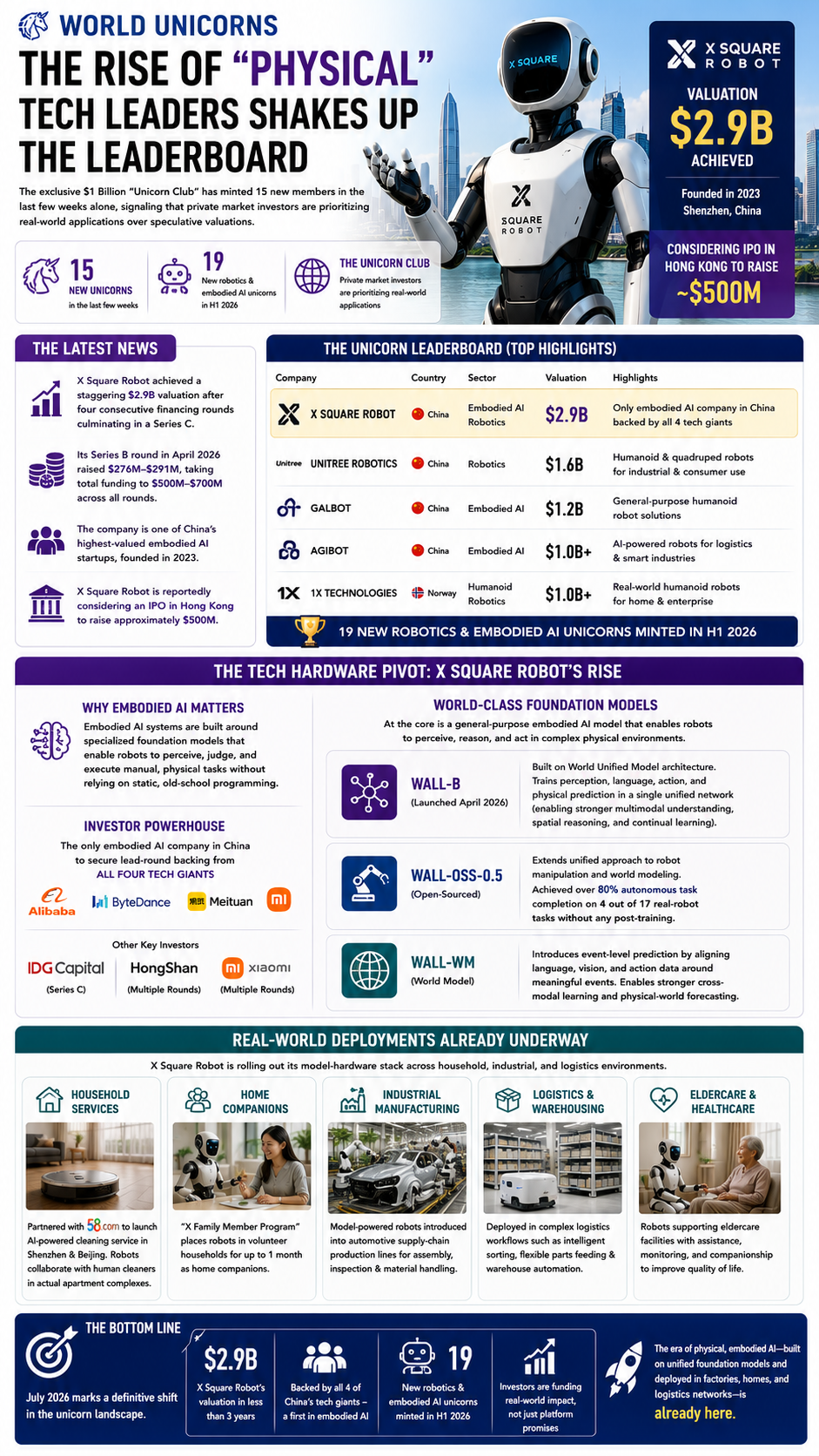
The exclusive $1 Billion "Unicorn Club" has minted 15 new members in the last few weeks alone, signaling that private market investors are prioritizing real-world applications over speculative valuations. The global unicorn landscape is experiencing a massive wave of diversification, with Shenzhen-based embodied AI startups leading the charge. According to the latest data, 19 new robotics and embodied AI companies achieved unicorn status in the first half of 2026 alone.
The Latest News
Leading the charge is Shenzhen-based X Square Robot, which achieved a staggering **$2.9 billion valuation** after securing four consecutive financing rounds culminating in a Series C. The company, founded in 2023, has rapidly become one of China's highest-valued embodied AI startups. Its Series B round in April 2026 brought in between $276 million and $291 million, pushing its total funding to somewhere between $500 million and $700 million across all rounds.
What sets X Square Robot apart is its investor lineup. The company has become the only embodied AI company in China to secure lead-round backing from all four of the country's tech giants—Alibaba, ByteDance, Meituan, and Xiaomi—at different stages. IDG Capital participated in the Series C round, while HongShan and Xiaomi have backed the company across multiple previous rounds. The company is reportedly considering an IPO in Hong Kong to raise approximately $500 million.
The Tech Hardware Pivot: X Square Robot's Rise
X Square Robot's rise highlights the market's obsession with Embodied AI—systems built around specialized foundation models that enable robots to perceive, judge, and execute manual, physical tasks without relying on static, old-school programming.
At the core of X Square Robot's technology is a general-purpose embodied AI model designed to enable robots to perceive, reason, and act in complex physical environments. In April 2026, the company introduced WALL-B, a foundation model built on its World Unified Model architecture. Unlike modular vision-language-action approaches that stitch together separate components, WALL-B trains perception, language, action, and physical prediction within a single unified network. This enables stronger multimodal understanding, spatial reasoning, and continual learning from real-world interactions.
The company has also open-sourced WALL-OSS-0.5 and WALL-WM, extending its unified approach to robot manipulation and world modeling. WALL-OSS-0.5 achieved over 80% autonomous task completion on four out of 17 real-robot tasks without any post-training. WALL-WM introduces event-level prediction by aligning language, vision, and action data around meaningful events, enabling stronger cross-modal learning and physical-world forecasting.
Real-World Deployments Already Underway
X Square Robot is already rolling out its model-hardware stack across household, industrial, and logistics environments. The company has partnered with 58.com to launch an AI-powered cleaning service in Shenzhen and Beijing, where robots collaborate with human cleaners in actual apartment complexes. Since May, it has also introduced the "X Family Member Program," placing robots in volunteer households for up to one month as home companions. Beyond the home, its model-powered robots are being introduced into automotive supply-chain production lines, complex logistics workflows such as intelligent sorting and flexible parts feeding, and eldercare facilities.
The Bottom Line
July 2026 marks a definitive shift in the unicorn landscape. X Square Robot's $2.9 billion valuation—achieved in less than three years—demonstrates that embodied AI and physical robotics are now the most valuable categories in private markets. The company's unique position as the only embodied AI startup backed by all four of China's internet giants underscores the strategic importance of physical AI infrastructure. With 19 new robotics unicorns minted in the first half of 2026 alone, the era of software-only unicorns is fading. The era of physical, embodied AI—built on unified foundation models and deployed in real-world factories, homes, and logistics networks—is already here.

Vishal Sable
B.Tech AD @ shri balaji institute of technology and management
Engineering and tech journalist. I love exploring the impact of emerging technologies on global defense, sovereignty, and everyday life. Always looking for the real story behind the headlines.