Back to News
News AlertWorld Money

Islamic Finance Heads for $10.5 Trillion by 2030

T
Author
Tushar Shrivas
Published
October 24, 2026
Reading Time
5 MIN READ
Spread the Word
Islamic Finance Heads for $10.5 Trillion by 2030
LSEG and ICD project Islamic finance assets will exceed $10.5 trillion by 2030, driven by sukuk issuance, Islamic banking and emerging markets. 
Islamic Finance Development Report 2026, sukuk issuance 2025, Islamic banking growth, Malaysia Islamic finance, Saudi Arabia sukuk market, LSEG ICD report

What Happened?

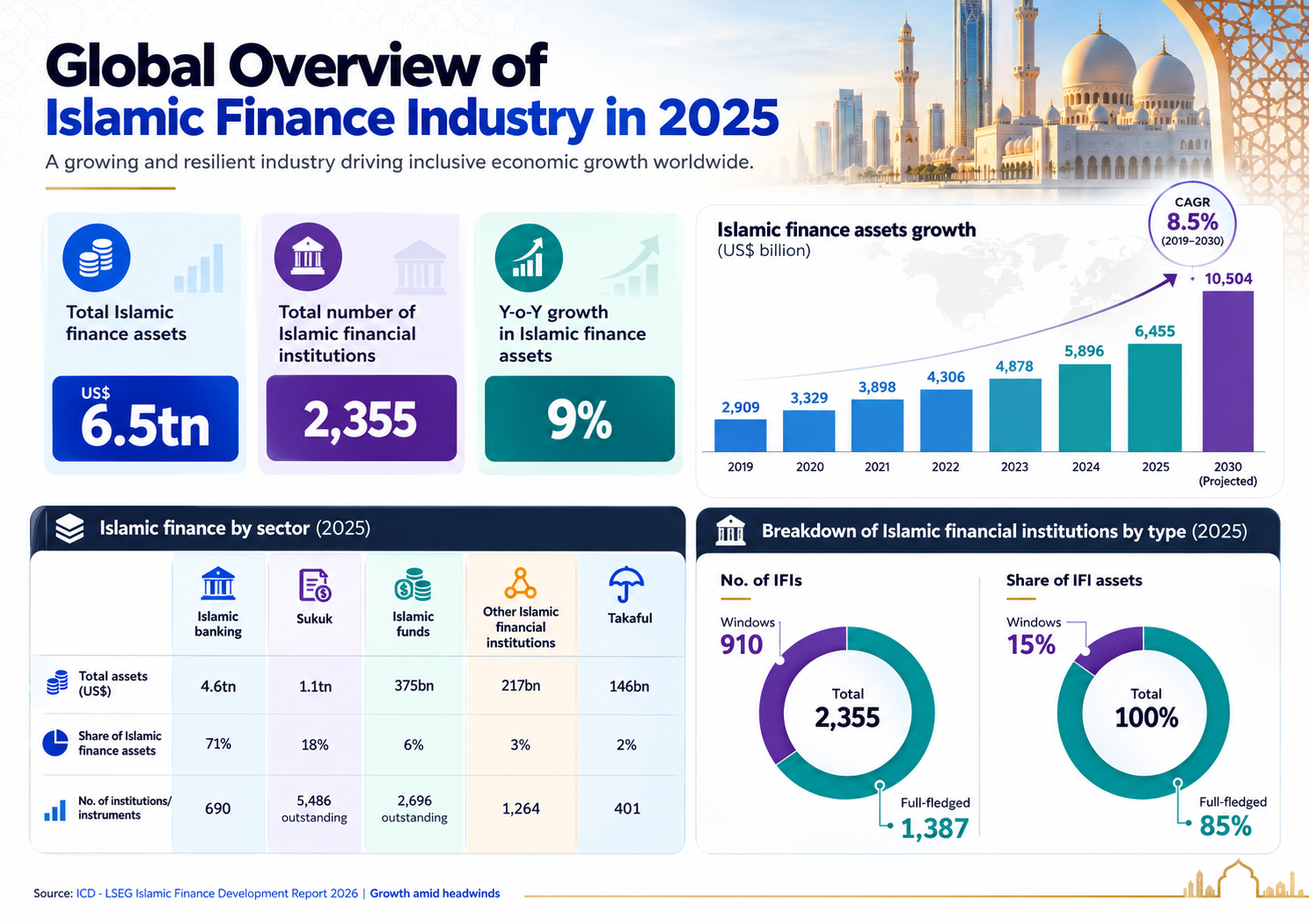
Global Islamic finance assets are projected to exceed $10.5 trillion by 2030, according to the 2026 Islamic Finance Development Report attributed to the London Stock Exchange Group (LSEG) and the Islamic Corporation for the Development of the Private Sector (ICD). The report was reportedly unveiled on October 21, 2026, at the Kuala Lumpur Islamic Finance Forum in Malaysia. LSEG

The industry had approximately $6.5 trillion in assets in 2025, representing 9% year-on-year growth. Sukuk issuance, Islamic banking expansion and wider adoption of Shariah-compliant financial products are among the reported drivers of the projected increase.  TradeArabia

What Does the Source Say?

The reported forecast places Islamic finance among the significant areas of growth in global financial services. According to the article's cited reporting, LSEG's head of Islamic finance, Mustafa Adil, identified Islamic banking, sukuk issuance, emerging markets, and demand for sustainable and digital financial products as contributors to the sector's expansion. Arab news

The report also highlights the importance of sukuk, financial instruments structured to comply with Islamic principles. The article reports that global sukuk issuance reached $291.4 billion in 2025, a 14.5% increase, while Saudi Arabia became the largest market by outstanding value. Malaysia reportedly ranked first in the Islamic Finance Development Indicator, followed by Saudi Arabia and the United Arab Emirates. 
What Is Still Unknown?

The $10.5 trillion figure is a projection, not a confirmed future outcome. The supplied material does not establish precisely how much each segment—Islamic banking, sukuk, Islamic funds and takaful—is expected to contribute to the forecast.

The article also does not provide a detailed breakdown of the assumptions underlying the forecast, including the expected contribution of individual countries, the effect of regulatory changes, or the potential impact of slower economic growth. These details matter when assessing how realistic the projection is.

There is also a distinction between the industry's reported 9% growth in 2025 and the annual growth needed to reach $10.5 trillion by 2030. Starting from $6.5 trillion, the target implies a compound annual growth rate of approximately 10.1% over five years. This is an independent calculation based on the figures supplied, not a separately reported forecast.  ICD

Why Does It Matter?

Islamic finance provides financial products structured around Shariah principles, including restrictions on interest and requirements relating to underlying economic activity. Its expansion could increase the availability of alternative financing options for governments, businesses and investors in markets where these products are in demand.

Sukuk issuance is particularly important because governments and companies can use it to raise capital for eligible projects and financing needs. If issuance continues to grow, it could deepen capital markets and expand the range of investment opportunities available to institutions and individuals.

Malaysia and Saudi Arabia are important to this story because of their reported positions in Islamic finance and sukuk markets. However, the projected global expansion will depend on continued investor demand, suitable regulations, market infrastructure and the availability of qualified professionals.

LSEG's official report page

Post image
Our Analysis

The projected increase from $6.5 trillion in 2025 to more than $10.5 trillion by 2030 represents growth of approximately 61.5%. Achieving that target would require annual compound growth of around 10.1%, assuming a five-year period from the end of 2025 to the end of 2030.

This calculation shows why the forecast should be assessed separately from the industry's reported 9% growth in 2025. A single year's growth rate does not establish the rate the sector will maintain over the following five years.

Sukuk issuance is a useful indicator to monitor because it provides evidence of activity in Islamic capital markets. However, issuance alone does not explain the growth of the entire industry. Islamic banking, funds, takaful, changes in asset valuations and differences in market coverage can also affect the total.

The key question is whether the industry can sustain growth while addressing constraints such as specialist talent shortages, regulatory differences and uneven market development. The supplied material identifies these issues but does not quantify how much they could affect the 2030 projection.

Sources and References

  1. LSEG
    Source Type: Official Report Page
    Link:  https://www.lseg.com/en/data-analytics/islamic-finance/islamic-market-intelligence/islamic-finance-development-report-2026

  2. ICD
    Source Type: Institutional Press Release
    Link:  https://icd.africa-newsroom.com/press/global-islamic-finance-industry-assets-to-reach-us105-trillion-by-2030-as-adoption-broadens?lang=en


TradeArabia

  1. Source Type: Business News Report
    Link: https://tradearabia.com/News/488345/Global-Islamic-finance-industry-assets-to-hit-$10.5-trillion-by-2030

  2. Arab News
    Source Type: News Report
    Link: https://www.arabnews.com/business/global-islamic-finance-assets-forecast-to-reach-105tn-by-2030-report-says-3007683

  3. The Cooperator
    Source Type: News Report
    Link: https://thecooperator.news/global-islamic-finance-assets-projected-to-hit-us-10-5trn-by-2030/


Tushar Shrivas

Tushar Shrivas

B.Tech CS@ Shri Balaji Institute of Technology & Management

LinkedIn Profile

I write at Metaplugs — breaking down the latest in tech, economics, and business into simple, impactful stories for everyday readers. Passionate about software testing and global finance.