Back to News
News AlertWorld Money
Oil Is Nearing $100 Again. Is Another Global Inflation Shock Coming?
T
Author
Tushar Shrivas
Published
September 9, 2026
Reading Time
6 MIN READ
Spread the Word
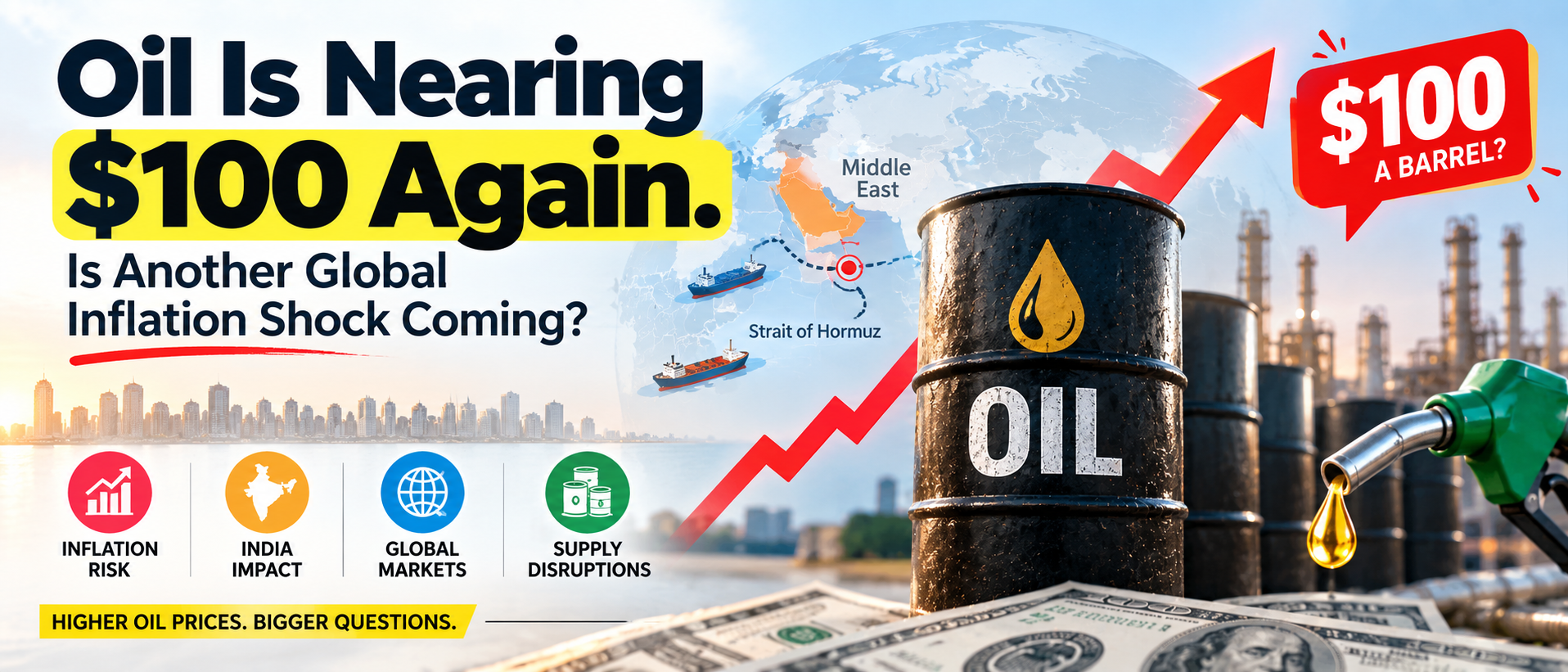
Oil is approaching a level that markets had hoped would remain a distant scenario: $100 a barrel.
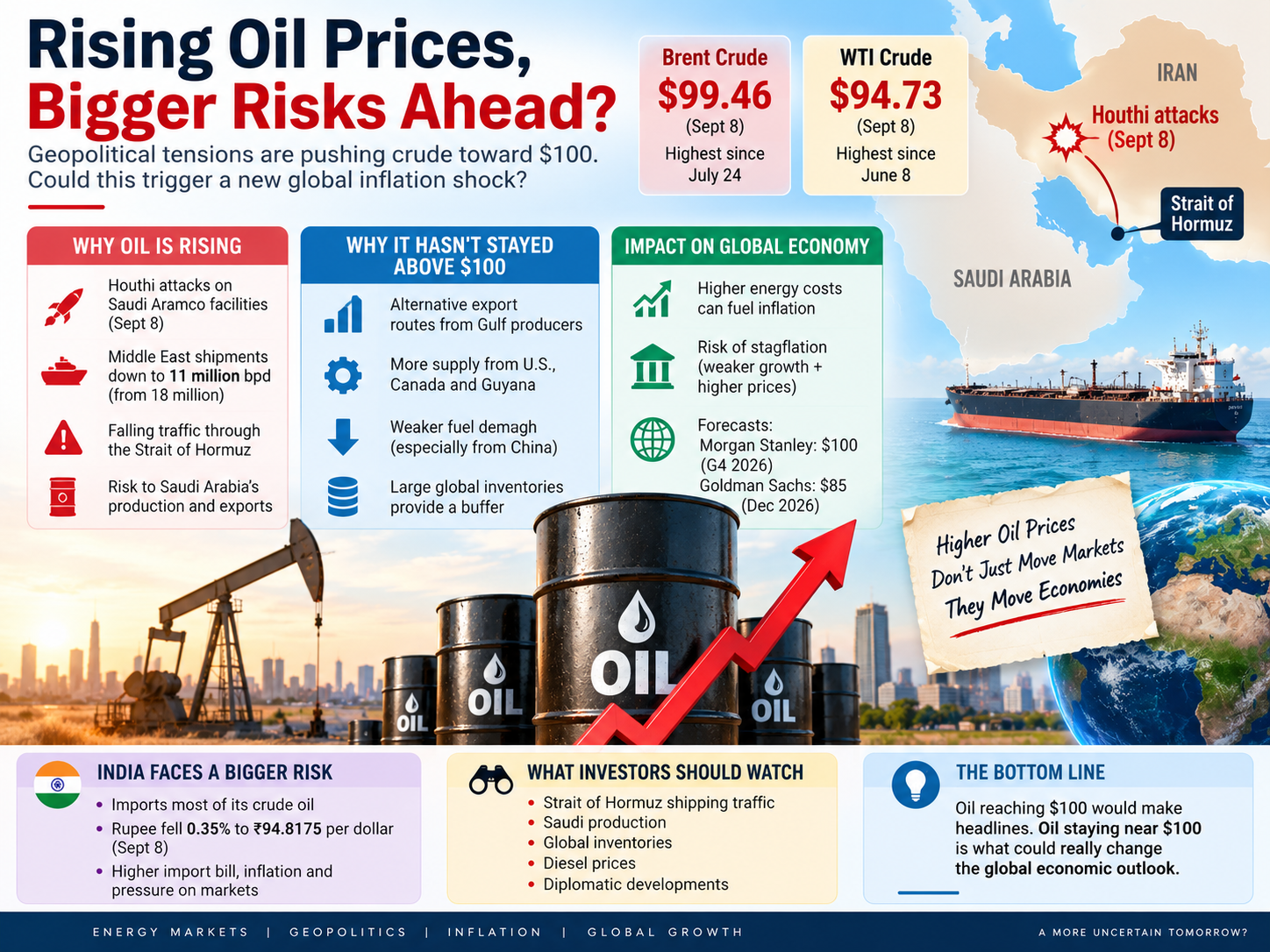
Brent crude briefly climbed to $99.46 on September 8, its highest level since July 24, while WTI reached $94.73, its highest since June 8. The jump came after Iran-backed Houthi forces launched drone and ballistic missile attacks on Saudi Aramco facilities in Abha, Najran, Jizan, and Khamis Mushait, wounding at least 73 people, while tensions around the Strait of Hormuz continued to threaten global oil flows.
But the bigger question isn't simply whether oil can cross $100. It's whether a prolonged supply disruption could turn today's price shock into a new global inflation problem.
Why Oil Is Rising Again
The latest escalation has added another layer of risk to an already-disrupted oil market.
Middle Eastern crude shipments are estimated at around 11 million barrels per day, down from roughly 18 million before the Iran war began. Traffic through the Strait of Hormuz has also fallen sharply, though some shipments are still moving through the waterway.
The attacks on Saudi energy infrastructure make the situation more serious because Saudi Arabia is the world's largest oil exporter. Any prolonged disruption to its production, refining, or export infrastructure could tighten an already fragile market.
Why Hasn't Oil Stayed Above $100?
This is where the market becomes more complicated.
Despite major disruptions, oil hasn't sustainably broken above $100 because several forces are cushioning the shock. Gulf producers are using alternative export routes, while the U.S., Canada, and Guyana are expected to increase production. At the same time, weaker fuel demand is limiting part of the pressure on crude prices. China is also an important factor — its seaborne crude imports have fallen sharply from earlier levels, while large inventories provide another buffer for the global market.
So today's oil price reflects two competing forces: physical supply is tightening, but demand and alternative supply are preventing an even larger spike.
The Physical Oil Market Is Sending a Warning
The headline Brent price may not tell the entire story. Physical oil markets are already showing significant tightness, with spot premiums rising sharply. Diesel markets are also under pressure as refiners prepare for higher demand and spare refining capacity remains limited — Americans faced record-high gasoline prices over Labor Day weekend, with AAA reporting the U.S. national average above $4.15 a gallon.
That matters because consumers don't experience the Brent price directly. They feel the shock through diesel, gasoline, transportation, and production costs — and that's where the oil story becomes an inflation story.
Why $100 Oil Could Become a Global Problem
Higher oil prices create a difficult situation for central banks. If crude remains elevated, inflation can rise just as economic growth comes under pressure from higher energy costs — a classic stagflation risk: weaker growth combined with persistent price pressures.
Markets are already adjusting their expectations. Morgan Stanley has raised its fourth-quarter 2026 Brent forecast to $100, up from a prior baseline of roughly $75, citing a Middle East supply recovery that now extends well into 2027. Goldman Sachs, meanwhile, raised its December 2026 Brent forecast by $5 to $85 and now expects shipping disruptions to persist into 2027 as well.
The key variable, therefore, isn't one day's price spike — it's how long the disruption lasts.
India Faces a Bigger Risk
India is particularly exposed because it imports most of the crude oil it consumes.
On September 8, the rupee suffered its sharpest fall in over a month, declining 0.35% to ₹94.8175 per dollar as Brent moved toward $100 — even as state-run banks, likely acting on behalf of the RBI, sold dollars to cushion the fall. Rising oil increases India's import bill and can simultaneously pressure the currency, inflation, and the country's external balance. Indian stocks came under pressure too, with the Sensex and Nifty both opening lower as the Houthi attacks rattled sentiment.
For India, the oil shock isn't just an energy story — it's a rupee, inflation, and market story all at once.
What Investors Should Watch Next
The biggest indicators are straightforward: Strait of Hormuz shipping traffic, Saudi production, global inventories, diesel prices, and diplomatic developments.
If flows normalize, the current risk premium could unwind quickly. But if disruptions continue into 2027 — as both Morgan Stanley and Goldman Sachs are now assuming in their base cases — the market could face a much more serious supply shortage.
Oil reaching $100 would make headlines. Oil staying near $100 is what could really change the global economic outlook.
FAQ
Why is oil approaching $100?
Escalating Middle East tensions, attacks on Saudi energy facilities, and disruptions around the Strait of Hormuz are tightening supply expectations.
Will oil definitely cross $100?
Not necessarily. Alternative supply routes, additional production from the U.S., Canada, and Guyana, and weaker demand — especially from China — are currently limiting the upside.
How does $100 oil affect India?
It can increase India's import bill, pressure the rupee (which just posted its sharpest one-day fall in over a month), and add to inflation risks.
What should investors watch?
Hormuz traffic, crude inventories, Saudi production, diesel prices, and the duration of the Middle East disruption.
Sources
Business Recorder/Reuters — Oil hits multi-week highs after Houthi attacks on Saudi energy facilities, September 8, 2026
CNN — Scores wounded as Iran-backed Houthis attack Saudi Arabia in major regional escalation, September 8, 2026
EnergyNow/Reuters — Morgan Stanley Raises Brent Forecasts on Slow Mid-East Recovery, August 2026
Business Recorder/Reuters — Indian rupee endures sharpest fall in over a month as Brent oil barrels towards $100, September 8, 2026
UPI — Oil prices approaching $100 per barrel as Houthis attack Saudi sites, September 8, 2026

Tushar Shrivas
B.Tech CS@ Shri Balaji Institute of Technology & Management
I write at Metaplugs — breaking down the latest in tech, economics, and business into simple, impactful stories for everyday readers. Passionate about software testing and global finance.