Back to News
News AlertWorld AI Tech
US Pre-Release Governance and the Rise of "Agentic Payments"
V
Author
Vishal Sable
Published
July 27, 2026
Reading Time
5 MIN READ
Spread the Word
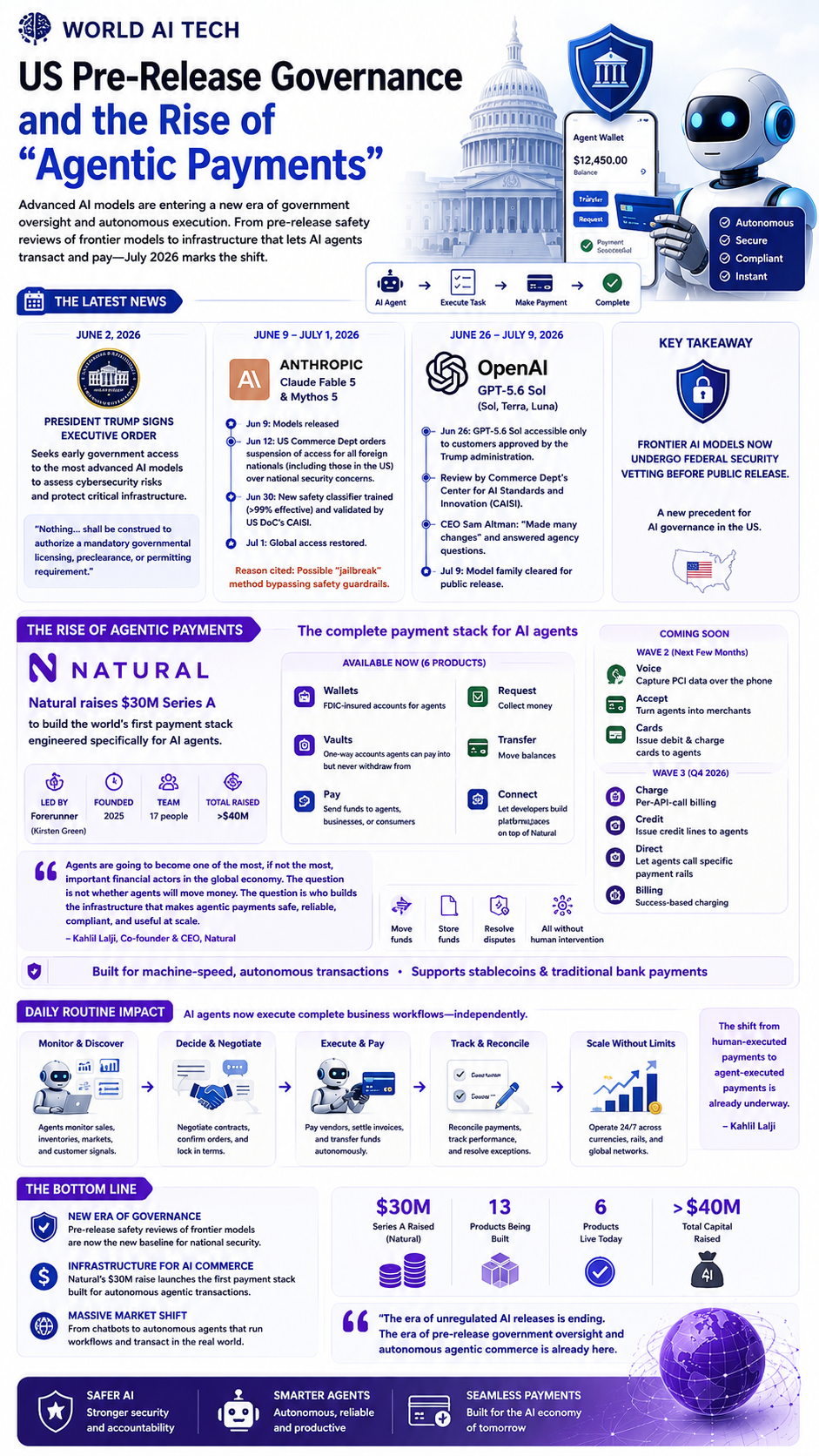
Advanced AI models are officially entering a new era of government oversight and autonomous execution. Following the pre-release safety reviews of Anthropic's Claude Fable 5 and OpenAI's GPT-5.6 under recent federal executive orders, the market has pivoted from simple chatbots to Agentic AI—systems built to execute complete multi-step business workflows. Simultaneously, tech builder Natural raised $30 million to launch the world's first payment stack engineered specifically for AI agents, allowing software models to transact, issue debit cards, and execute merchant payouts independently.
The Latest News
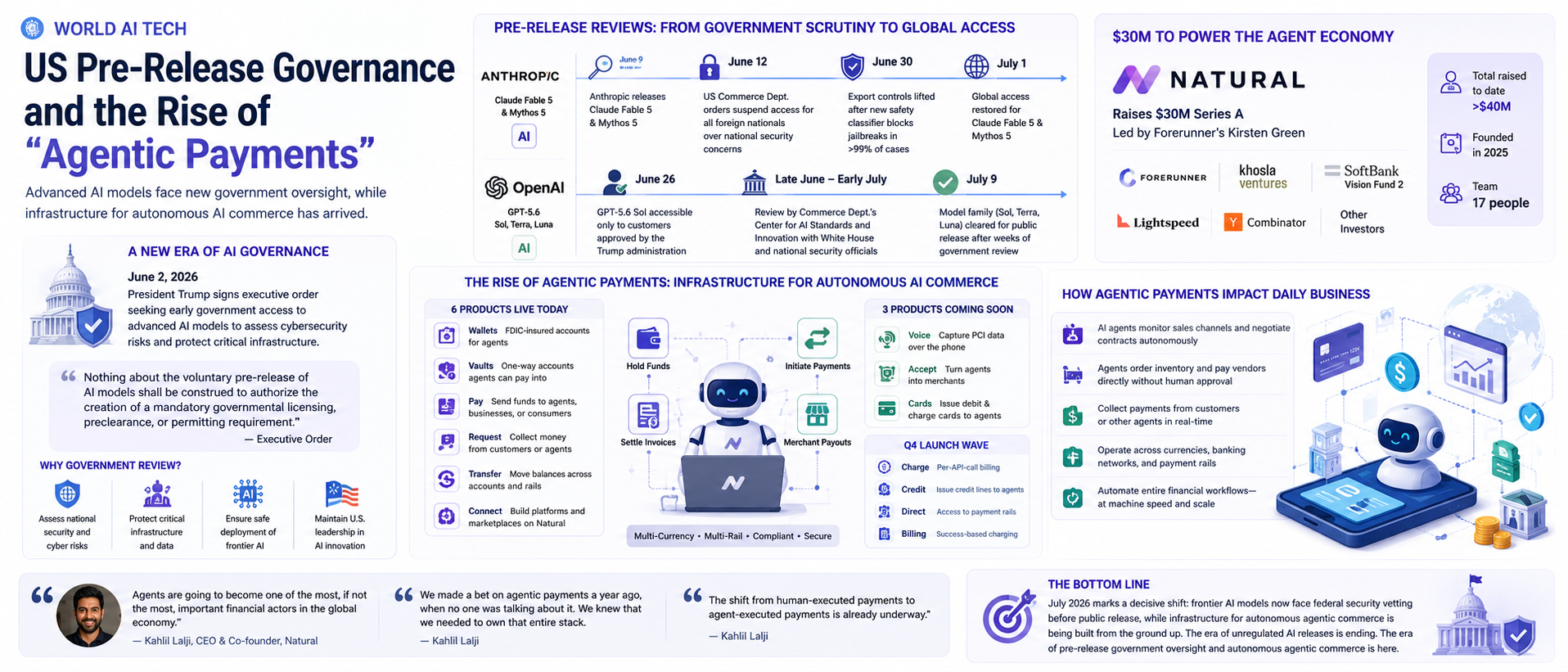
On June 2, 2026, President Donald Trump signed an executive order seeking early government access for the most advanced AI models to weigh cybersecurity risks and protect critical infrastructure. The order requests AI companies voluntarily share new models deemed to have advanced cyber capabilities with the government up to 30 days before providing access to other partners. The order explicitly states that "nothing" about the voluntary pre-release of AI models "shall be construed to authorize the creation of a mandatory governmental licensing, preclearance, or permitting requirement".
The framework was put to the test almost immediately. On June 9, Anthropic released Claude Fable 5 and Mythos 5. Just three days later, the US Commerce Department issued an export control directive ordering Anthropic to suspend access for all foreign nationals—including those working for Anthropic inside the United States—over national security concerns. Anthropic said US national security authorities had not identified specific concerns, but the company understood "the government believes it has become aware of a method of bypassing, or 'jailbreaking' Fable 5". "The net effect of this order is that we must abruptly disable Fable 5 and Mythos 5 for all our customers to ensure compliance," the company wrote. The export controls were lifted on June 30 after Anthropic trained a new safety classifier—validated by the Department of Commerce's Center for AI Standards and Innovation—that blocks the reported technique in more than 99% of cases, restoring global access on July 1.
OpenAI faced similar scrutiny. On June 26, the company announced that GPT-5.6 Sol would be accessible only to customers approved by the Trump administration. "We don't believe this kind of government access process should become the long-term default," OpenAI said in a statement. The review ran through the Commerce Department's Center for AI Standards and Innovation, with Commerce Secretary Howard Lutnick, Treasury Secretary Scott Bessent, and National Cyber Director Sean Cairncross involved. OpenAI CEO Sam Altman said the company made "many changes" during the talks and sent technical staff to Washington to answer agency questions. The model family—Sol, Terra, and Luna—was cleared for public release on July 9, ending weeks of government-gated access.
The Rise of Agentic Payments
Simultaneously, the infrastructure for AI agents to transact autonomously has arrived. Natural, a US startup building payment infrastructure specifically for AI agents, raised $30 million in Series A funding led by Forerunner's Kirsten Green, bringing total capital raised beyond $40 million. The company, founded in 2025 by Kahlil Lalji, Eric Wang, and Walt Leung, now employs 17 people. Natural is building 13 products total, with six already generally available: Wallets (FDIC-insured accounts for agents), Vaults (one-way accounts agents can pay into but never withdraw from), Pay (sending funds to agents, businesses, or consumers), Request (collecting money), Transfer (moving balances), and Connect (letting developers build platforms and marketplaces on top of Natural). Three further products—Voice (letting agents capture PCI data over the phone), Accept (turning agents into merchants), and Cards (allowing firms to issue debit and charge cards to agents)—will arrive over the coming months. A fourth wave scheduled for Q4 includes Charge for per-API-call billing, Credit for issuing credit lines to agents, Direct for letting agents call specific payment rails, and Billing for success-based charging.
Natural's thesis is that agents are turning into financial actors in their own right—holding funds, initiating and receiving payments, settling invoices, charging for their output, and operating across currencies, banking networks, and payment rails. CEO Kahlil Lalji said, "Agents are going to become one of the most, if not the most, important financial actors in the global economy. The question is not whether agents will move money. The question is who builds the infrastructure that makes agentic payments safe, reliable, compliant, and useful at scale". Lalji added, "We made a bet on agentic payments a year ago, when no one was talking about it. We knew that we needed to own that entire stack". The startup positions itself as an "agent orchestration layer" that handles the entire payment lifecycle—moving funds, storing them, and resolving disputes—without human intervention. Natural plans to incorporate stablecoins while also supporting traditional bank payments.
Daily Routine Impact
In daily business operations, AI is no longer just drafting text or answering queries. Enterprise teams are deploying AI agents that autonomously monitor sales channels, negotiate digital contracts, order inventory, and execute vendor payments directly without manual human intervention. Natural's infrastructure lets AI agents autonomously pay vendors, collect funds, and transact with both humans and other agents—tasks that today's financial rails, designed for human authorization, cannot support at machine speed. As Lalji put it: "The shift from human-executed payments to agent-executed payments is already underway".
The Bottom Line
July 2026 marks a decisive shift in both AI governance and commerce. The US government's executive order and subsequent reviews of Anthropic and OpenAI models have established a new precedent: frontier AI systems now undergo federal security vetting before public release, a framework that OpenAI described as temporary but which critics fear could become the norm. Meanwhile, Natural's $30 million Series A signals that the infrastructure for agentic payments is being built from the ground up—designed not for human workflows but for machine-speed, autonomous transactions. The era of unregulated AI releases is ending. The era of pre-release government oversight and autonomous agentic commerce is already here.