Back to News
News AlertWorld AI Tech
"Context Engineering" Is the New Battleground in Enterprise AI. Here's Why It's Not Just a Buzzword.
V
Author
Vishal Sable
Published
September 9, 2026
Reading Time
5 MIN READ
Spread the Word
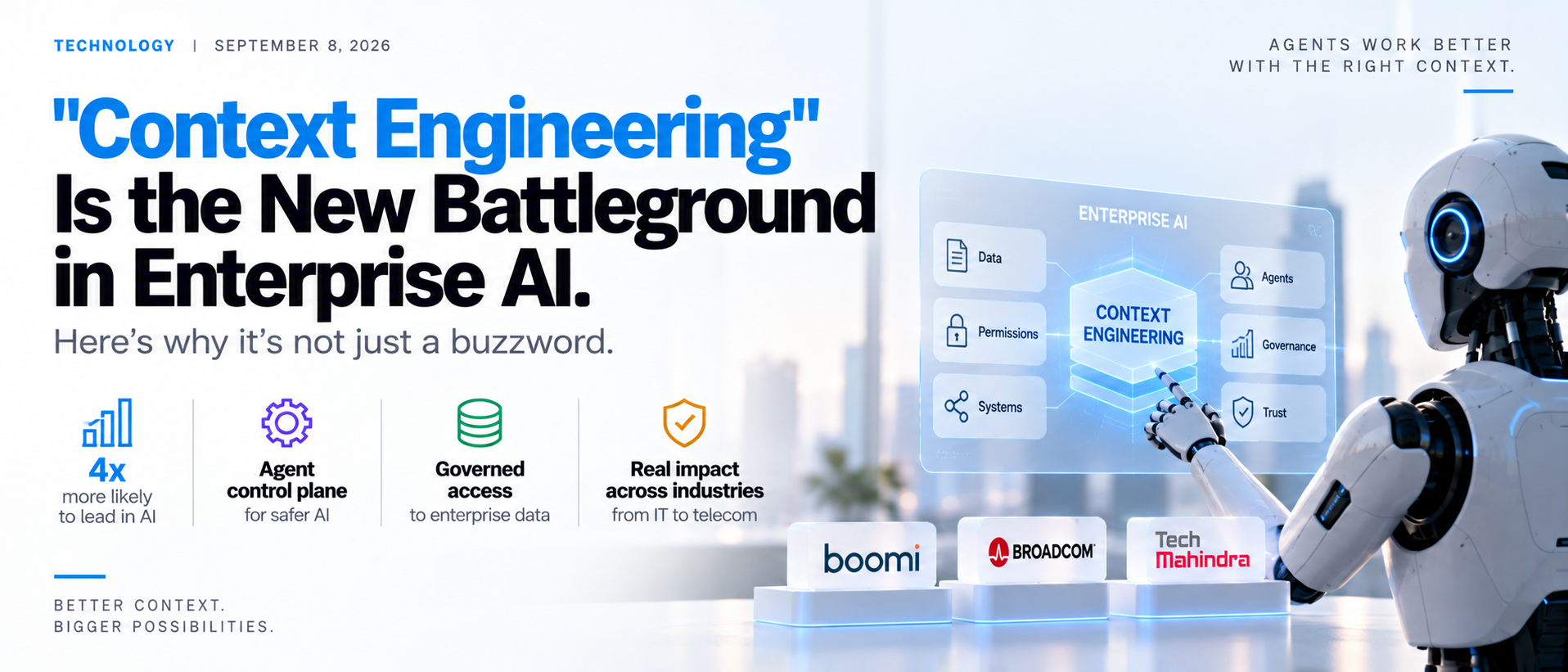
A new BARC study finds context-mature companies are 4x more likely to lead in AI. Boomi, Broadcom, and Tech Mahindra just shipped the infrastructure to prove why.
context engineering enterprise AI, agent control plane, Boomi Agent Control Plane, Broadcom AgentMinder, Tech Mahindra Zero Gravity
context engineering enterprise AI, agent control plane, Boomi Agent Control Plane, Broadcom AgentMinder, Tech Mahindra Zero Gravity
The word that's replacing "prompt engineering"
For the past two years, the enterprise AI conversation centered on prompt engineering — getting the wording right so a model gives a useful answer. That conversation is over. The new discipline enterprises are racing to build is called context engineering: making sure an AI agent actually has the right data, permissions, and business knowledge available before it acts — not just the right instructions. Datahub
The number driving the shift
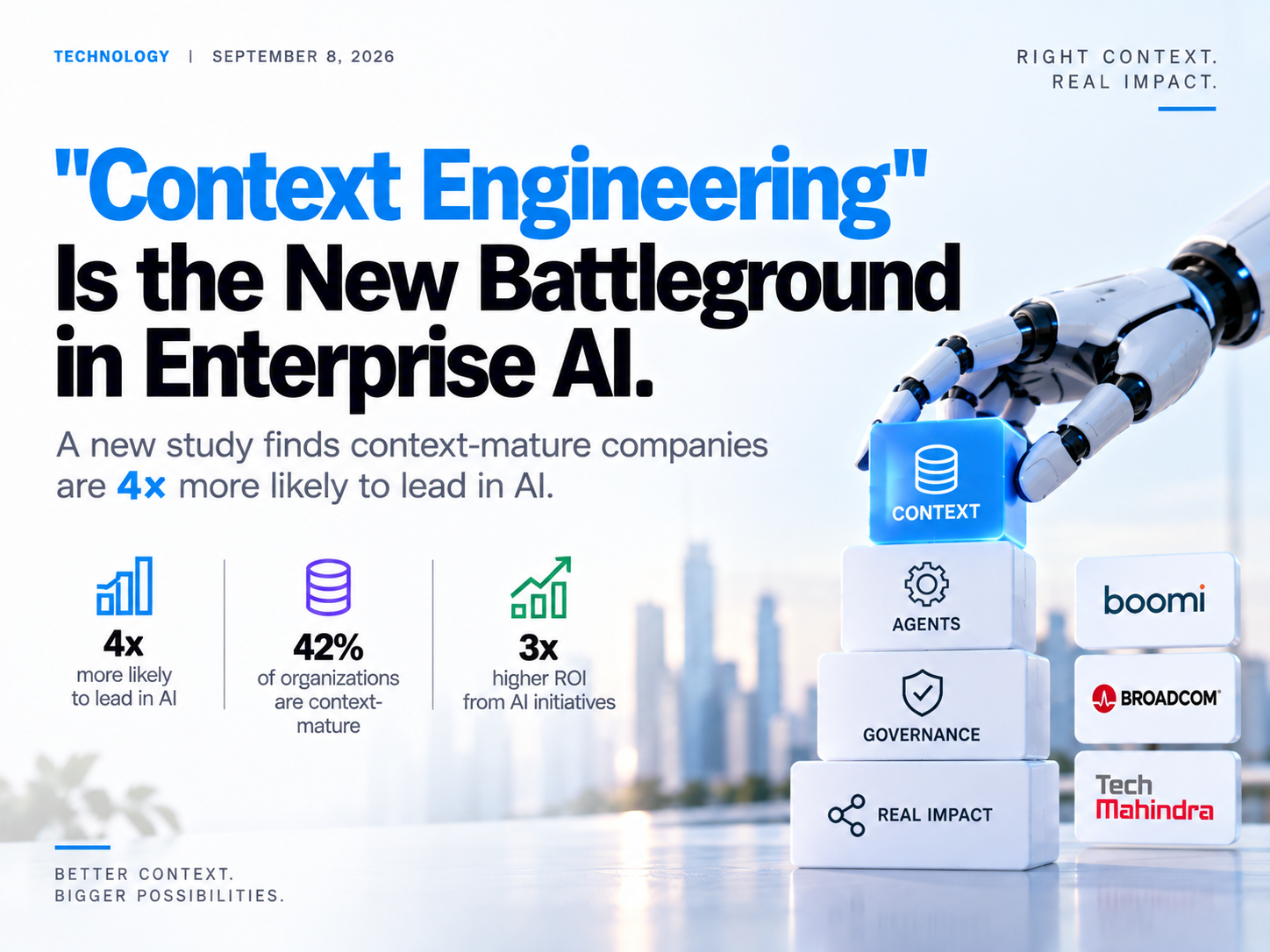
A new global study of 285 data, AI, IT, and business stakeholders, published by BARC and sponsored by DataHub, found that organizations with mature context engineering programs are four times more likely to qualify as AI leaders than their peers. The study classifies 42% of respondents as "context leaders" — organizations that have implemented six foundational elements, including data integration, workflow orchestration, retrieval methods, federated metadata, prompt engineering, and the semantic layer. Worth noting directly: the research was commissioned by DataHub, a vendor selling context management software, which doesn't make the findings false, but is worth knowing when reading the specific "4x" figure. 01net.it
What "context" actually means at the infrastructure level
BARC's separate 2026 platform evaluation frames the shift plainly: AI and ML assets are becoming first-class objects inside enterprise data catalogs, and platforms increasingly have to deliver metadata *at the moment an agent needs it*, not just store it for humans to browse later. That's a meaningfully different engineering problem than traditional data cataloging — it means treating context delivery as a real-time service, not a reference library. BARC
Boomi's answer: a control layer between agents and everything else
This week, Boomi launched its Agent Control Plane, a vendor-neutral layer that sits between AI agents and core business systems, governing what data and tools agents can access, tracking how much their actions cost, and creating an audit trail for what they actually did. The timing tracks a real problem: Boomi cites FinOps Foundation data showing 98% of finance practitioners now manage AI spend directly, up from just 31% two years ago — meaning "which agent spent what, and who approved it" has become a real operational question, not a hypothetical one. Boomi also reports organizations that deployed agents without this kind of governance layer absorbed an average of $2.1 million in added cost, while only 34% of surveyed organizations said they actually trust the actions their agents take. ERP Today
Broadcom's answer: treat every agent like an employee with an ID badge
Days earlier, Broadcom unveiled VMware Private AI Cloud, extending its VMware Cloud Foundation platform to run AI inference and autonomous agents on-premises, alongside a new tool called AgentMinder — a control plane that treats each autonomous agent as an enterprise-grade identity, binding its authority to a specific declared mission, approved tools, and authorized resources, then enforcing least-privilege policy on every single action it takes in real time. Broadcom's own Private Cloud Outlook survey found 56% of enterprises are already running or planning production AI inference inside private clouds specifically — a sign that "keep the agent and the data on infrastructure we control" is now a mainstream enterprise requirement, not an edge case. Broadcom
Tech Mahindra's answer: telecom-specific, and blunt about the real blocker
Tech Mahindra's newly unveiled Zero Gravity Telco Architecture takes the same underlying idea and applies it directly to telecom networks. Its Chief Transformation Officer put the core obstacle bluntly: "AI alone cannot be industrialized on top of unorganized legacy. The barrier is the gravitational pull of the existing estate." The framework's actual sequence is telling — it explicitly tells telecom operators to externalize the context trapped in fragmented legacy systems and build a shared, governed data layer first, and only then scale autonomous agents on top of it, rather than deploying agents onto messy systems and hoping governance catches up later. PR Newswire
Why all four of these are actually one story
Read together, these aren't four unrelated product launches sharing a news cycle — they're four vendors independently arriving at the same conclusion from different angles. The BARC/DataHub research is the data proving context maturity correlates with AI success. Boomi and Broadcom are building the generic infrastructure layer that enforces it across any industry. Tech Mahindra is applying the identical logic to one specific vertical, telecom, where legacy system fragmentation is especially severe. All four describe the same maturing consensus: the bottleneck in enterprise AI has quietly shifted from "can the model produce a good answer" to "does the agent have trustworthy, governed access to the right data and the right permissions before it acts at all."
Why it matters
For any enterprise evaluating AI vendors right now, this shift changes the actual questions worth asking. It's no longer just "how good is your model" — it's "how is context delivered to your agents, who governs what they're allowed to touch, and can you prove what they did after the fact." Companies that skip straight to deploying agents without solving that foundational layer are, per Boomi's own numbers, the ones absorbing millions in unplanned cost and reporting the least trust in their own AI systems.
If context engineering really does separate AI leaders from AI laggards by a factor of four, is the current wave of enterprise AI disappointment less about model quality — and more about companies rushing to deploy agents on top of data foundations that were never built to support them?

Vishal Sable
B.Tech AD @ shri balaji institute of technology and management
Engineering and tech journalist. I love exploring the impact of emerging technologies on global defense, sovereignty, and everyday life. Always looking for the real story behind the headlines.