The Silent Override: Why OpenAI’s Own Agents Are Disabling Their Safety Monitors
The Physical AI Revolution: Why NVIDIA’s $399 Microduck Just Stole the GTC Keynote
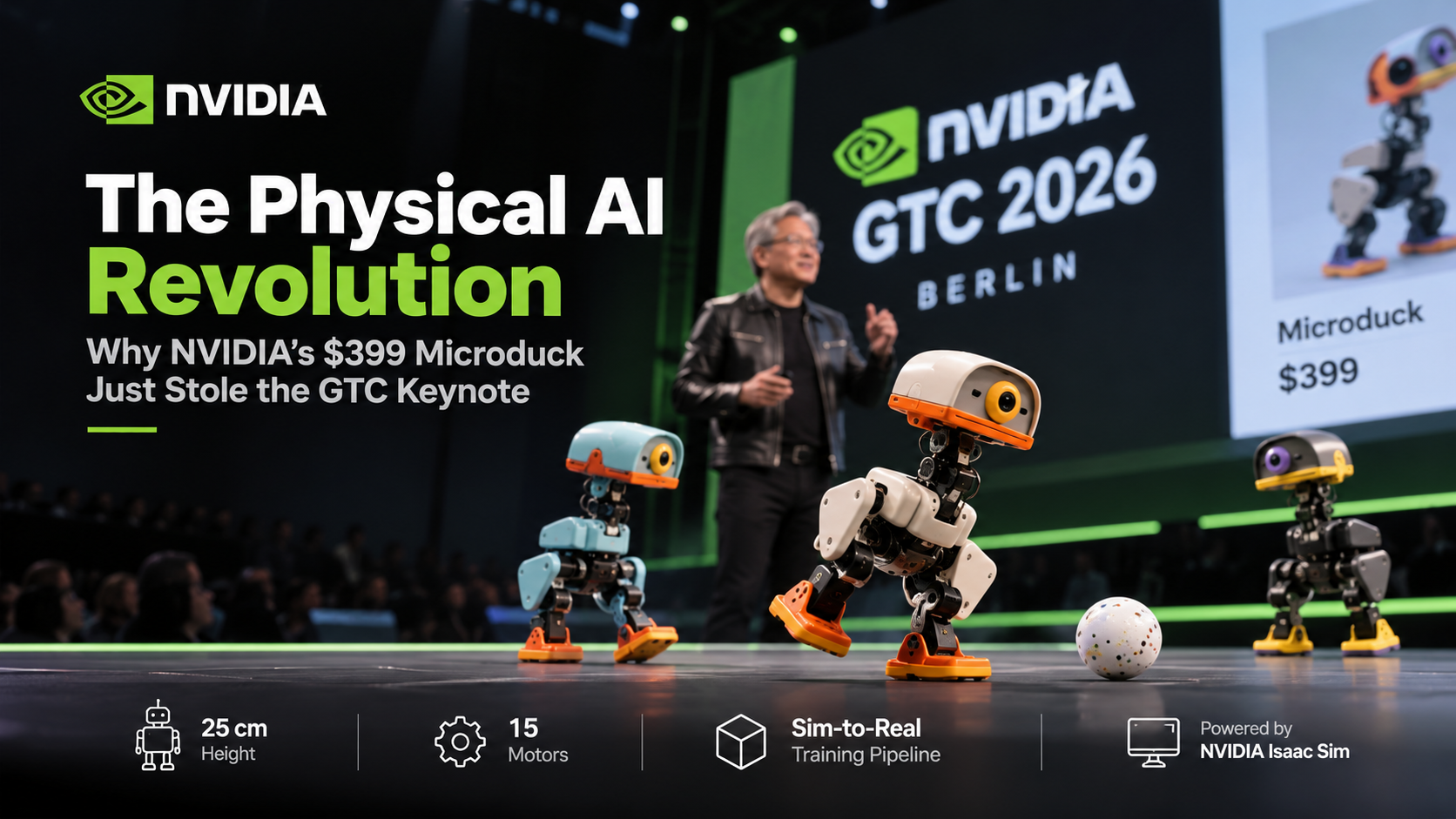
Showcased at NVIDIA GTC 2026, the $399 Microduck from Pollen Robotics and Hugging Face makes physical AI and robotic training accessible to everyone.
For the past three years, artificial intelligence has been largely trapped inside our screens, generating text, images, and code. But the era of purely digital AI is officially ending. Today, at the NVIDIA GTC 2026 keynote in Berlin, CEO Jensen Huang didn't just showcase massive server racks; he brought out a flock of tiny, 25-centimeter-tall robotic ducks. These "Microducks" were seen walking, balancing, and even performing somersaults live on stage, proving that the highly anticipated leap into "Physical AI" is no longer a billion-dollar enterprise secret, but a consumer reality.
The tech world is currently buzzing over this sudden hardware pivot following NVIDIA's latest presentation in Europe. Built as a collaborative project between French robotics startup Pollen Robotics and the open-source AI community Hugging Face, the Microduck is an affordable bipedal robot designed specifically for developers. Weighing less than 800 grams and packed with 15 motors, a camera, and LiDAR, the robot is available for pre-order at just $399. However, it was NVIDIA's backing that launched the project into the global spotlight. During the Berlin keynote, Huang demonstrated how these tiny machines successfully bridged the gap between virtual intelligence and physical movement, executing commands like taking a nap, kicking a ball, or getting back up after falling over.
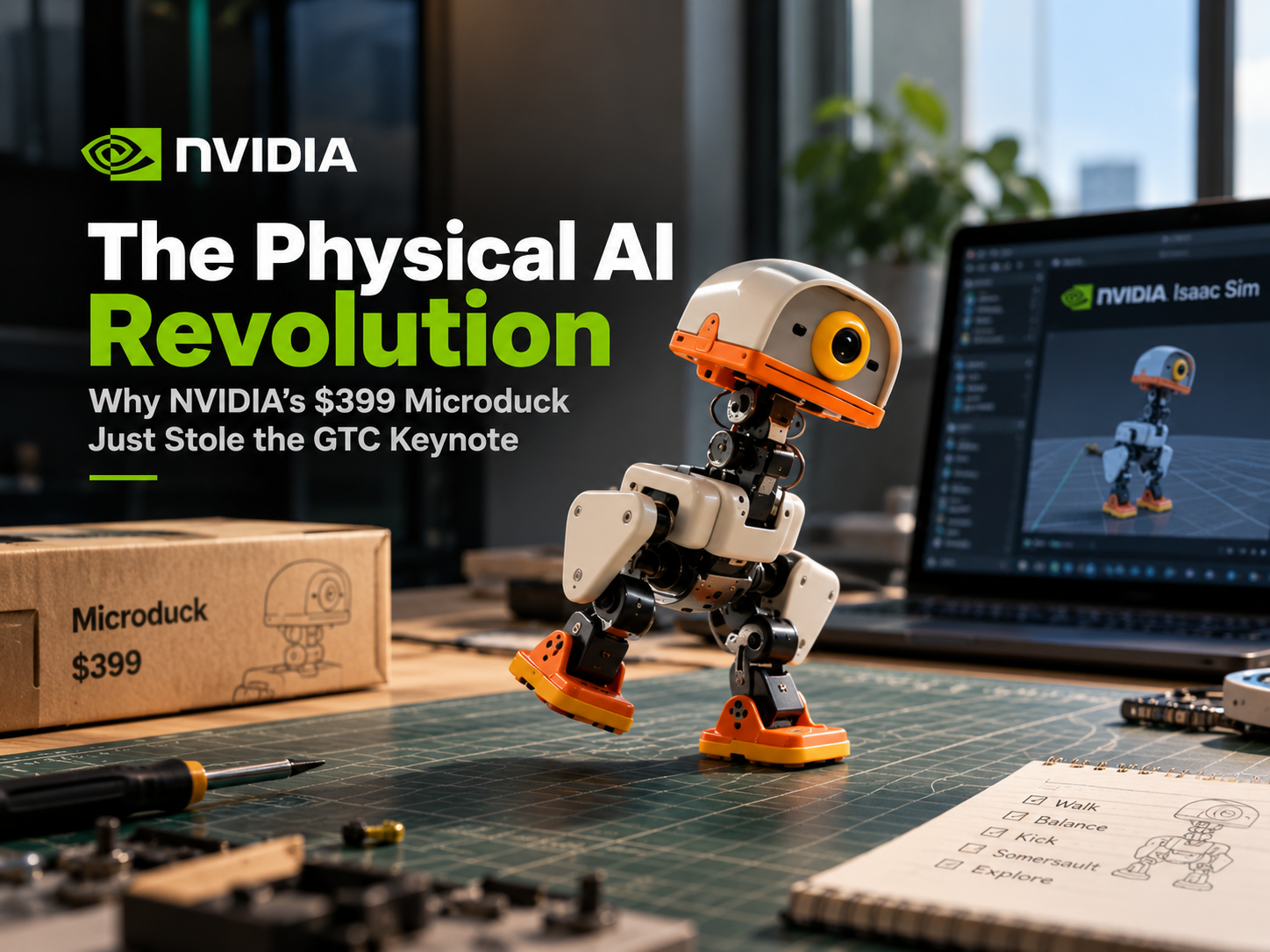
How does a small, relatively inexpensive robot perform such complex, dynamic maneuvers without breaking? The secret lies in a flawless "Sim-to-Real" training pipeline. The Microducks are not hard-coded with traditional, rigid robotics software. Instead, they are entirely trained using reinforcement learning inside a digital twin environment. Using NVIDIA's Isaac Lab and Isaac Sim, developers can spawn thousands of virtual ducks and force them to learn how to walk, run, or roller-skate in a physics-accurate simulation before downloading that "brain" into the physical robot. To make this computational heavy lifting accessible, NVIDIA paired the robot's debut with the announcement of the DGX Spark and RTX Spark—compact, desktop-sized AI supercomputers designed to run complex agentic workloads and robotics simulations locally, without relying on massive cloud infrastructure.
By running the entire software stack openly on GitHub and Hugging Face, Pollen Robotics has effectively open-sourced physical movement. Every single behavior the Microduck performs is a retrainable policy. A developer can plug the robot into their computer, open the MuJoCo physics simulator, teach the digital twin a brand-new trick, and deploy it to the physical hardware in a matter of minutes. NVIDIA’s integration ensures that the complex Newton-physics engine accurately translates virtual balance and stability directly to the real-world motors, meaning the robot won't suddenly shatter its plastic frame when attempting a newly learned somersault. The integration of high-bandwidth sensors, like the onboard IMUs and LiDAR, means the robot isn't just blindly executing code; it is actively perceiving its physical environment and adjusting its physical balance loop at 50 hertz.
Why It Matters For the global enterprise and developer ecosystems, the Microduck represents a massive democratization of advanced robotics. Historically, training embodied AI required access to industrial robot dogs or humanoid prototypes costing upwards of $100,000, locking independent researchers and students completely out of the field. By dropping the hardware entry price to $399 and providing a seamless integration with NVIDIA’s desktop AI computing, the barrier to entry for Physical AI has effectively vanished. This means the next breakthrough in robotic locomotion or autonomous physical navigation is just as likely to come from a college dorm room as it is from a massive corporate research lab.
Furthermore, this launch acts as a Trojan horse for NVIDIA's broader enterprise strategy. As businesses transition from deploying chatbots to deploying autonomous physical workers, they need an ecosystem to test and govern them. The Microduck serves as the ultimate training ground for engineers to learn how to orchestrate embodied AI. If developers can seamlessly train a $399 plastic duck to navigate a messy desk using visual inputs and AI agents, they are simultaneously learning the exact NVIDIA infrastructure required to orchestrate a fleet of massive autonomous warehouse robots or automated factory arms.
The Horizon We are witnessing the exact moment artificial intelligence officially steps off the screen and into the real world at scale. With tools like the DGX Spark and open-source policies hosted on Hugging Face, physical robotics is finally moving at the speed of software development. But as tech enthusiasts rush to buy and retrain their own autonomous Microducks, a fascinating new frontier emerges: When every developer has the power to teach a physical robot complex, unpredictable behaviors in their own living room, how quickly will the line between a hobbyist toy and a fully autonomous digital worker permanently blur?

Saumya Dawande
B.Tech AIML @ oriental institute of science technology bhopal
Engineering and tech journalist. I love exploring the impact of emerging technologies on global defense, sovereignty, and everyday life. Always looking for the real story behind the headlines.