Back to News
News AlertWorld Money
World Bank Backs Small AI for Developing Economies
T
Author
Tushar Shrivas
Published
October 18, 2026
Reading Time
6 MIN READ
Spread the Word
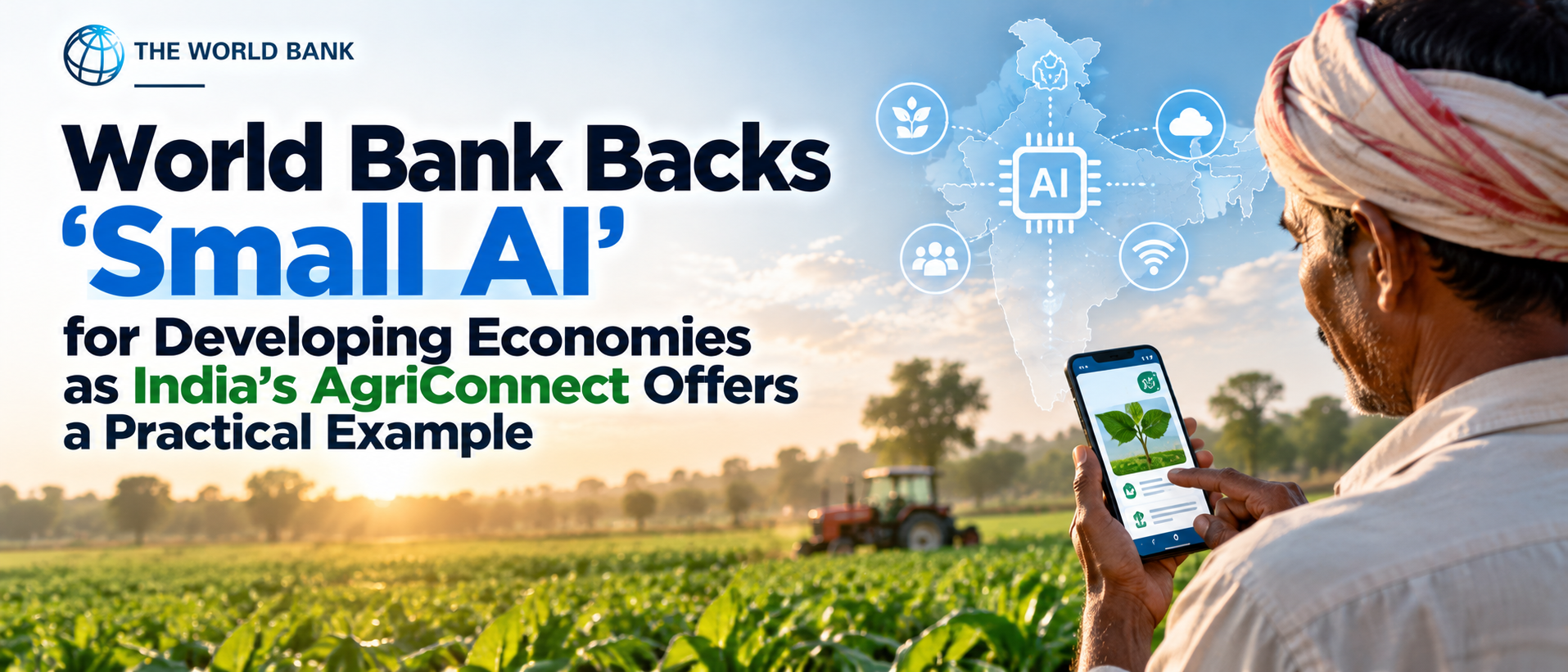
The World Bank is promoting small AI models that work on phones with limited connectivity. India’s AgriConnect highlights the opportunity and infrastructure challenge.
small language models developing countries, Paschal Donohoe World Bank, AI in emerging markets, AgriConnect India, edge AI low connectivity, IMF World Bank Annual Meetings 2026
small language models developing countries, Paschal Donohoe World Bank, AI in emerging markets, AgriConnect India, edge AI low connectivity, IMF World Bank Annual Meetings 2026
World Bank Pushes Small AI as a Development Tool
The World Bank is urging developing economies to build “small AI” systems designed to operate on mobile phones, work with limited connectivity and address local needs. Speaking to The Guardian during the IMF–World Bank Annual Meetings in Bangkok, Paschal Donohoe, the World Bank Group’s managing director and chief knowledge officer, argued that locally adapted AI could help emerging economies accelerate development. The idea is to make useful AI available beyond countries and companies with access to expensive computing infrastructure. The Guardian
Donohoe said economic development that might otherwise take centuries could potentially happen within decades. This is an optimistic assessment of AI’s potential, not a measured forecast or a guaranteed outcome. The broader discussion reflects a shift towards practical applications that improve productivity and public services, rather than focusing exclusively on increasingly powerful general-purpose AI models.
What Is Small AI, and Why Does It Matter?
Small AI generally refers to compact, specialised models designed for particular tasks. Unlike large, general-purpose systems that may depend on substantial computing resources and cloud infrastructure, some smaller models can run directly on devices or operate with limited connectivity. Their practical value depends on the task, the model’s hardware requirements and the quality of its local-language data.
For developing economies, this approach could make AI more accessible in agriculture, healthcare, education and small businesses. A farmer might use a local-language tool to understand crop symptoms, while a community health worker could access relevant guidance without relying on a constant high-speed connection. These are potential applications, however, rather than proof that every small model will work reliably in real-world conditions. World Bank Live
India’s AgriConnect Shows the Potential
India is an important part of the discussion. In its October 6, 2026, India Development Update, the World Bank identified small AI as one way to adapt technology to local needs. The report says the World Bank Group is investing in targeted, locally adapted tools through AgriConnect, with the aim of making AI’s benefits more accessible. It also emphasises the need to strengthen infrastructure, skills and the business environment so that adoption can translate into broader economic gains. World Bank
The agricultural use case is straightforward: India has a large farming population, and specialised digital tools could help farmers access information such as soil analysis in their own languages. Donohoe told The Guardian that AI could help address the shortage of scientists and agricultural experts available to support every small farm. The opportunity is to extend access to useful knowledge, not to assume that an AI model can replace expert testing, local agricultural extension services or human judgement.
Electricity and Internet Access Remain Major Barriers
Small AI cannot remove every obstacle to digital development. IMF Managing Director Kristalina Georgieva stressed that governments need to provide reliable electricity, digital infrastructure, preparation for technology adoption and safeguards against misuse. Even a model that runs locally requires a functioning device, power and a way to receive updates or access information when those are necessary.
The infrastructure gap remains significant. The Guardian reported that the World Bank’s annual World Development Report, published in August, highlighted that almost one-third of rural schools in sub-Saharan Africa lacked electricity, while more than two-thirds lacked a consistent internet connection. These figures illustrate why the benefits of small AI will depend on basic infrastructure as well as software development.
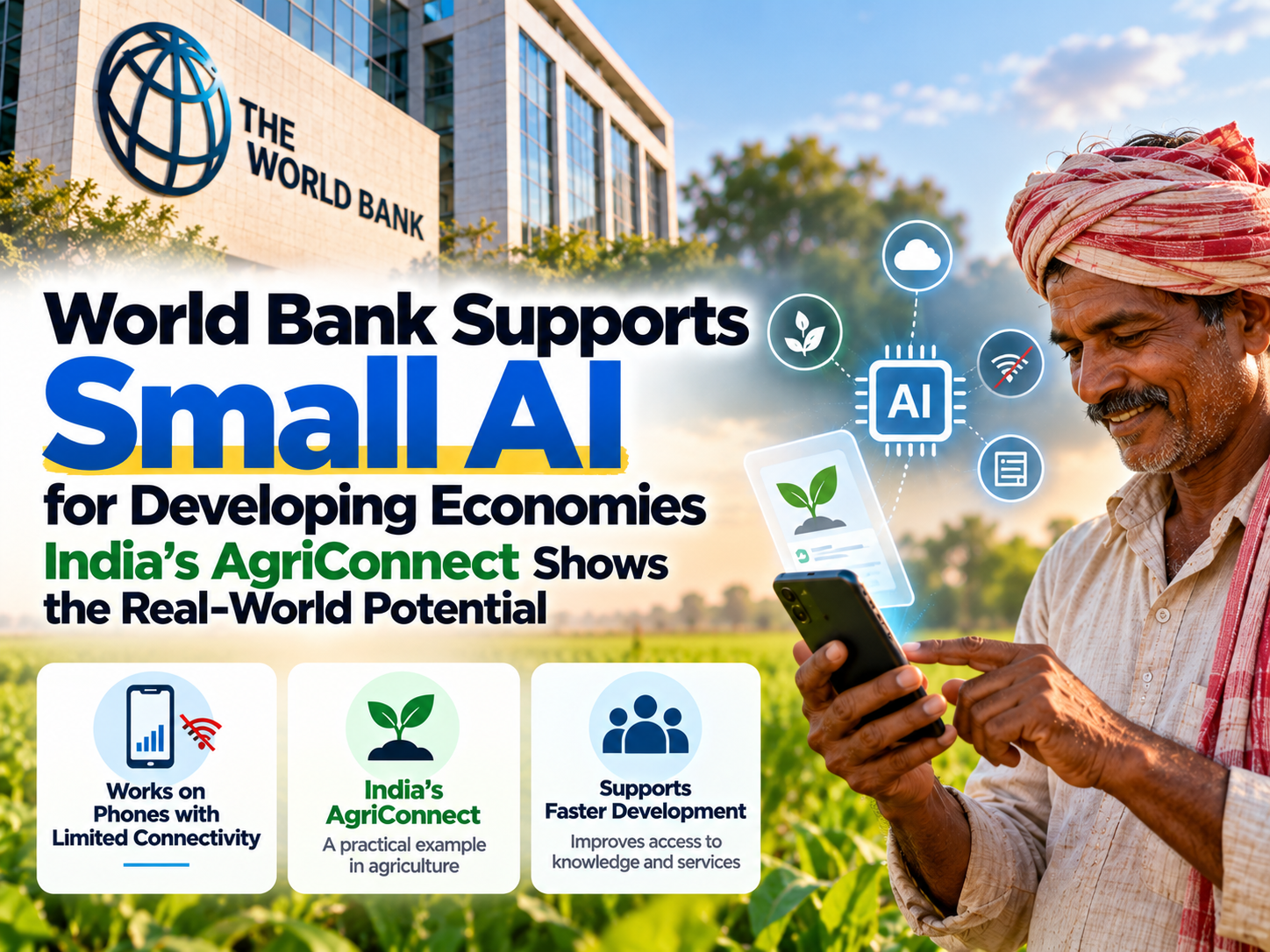
Why Small AI Matters for Jobs and Economic Growth
The World Bank’s argument is also connected to employment. At the Bangkok meetings, leaders discussed how AI could improve productivity and support job creation in emerging economies. For countries with large young populations, locally relevant applications could help workers, farmers and small businesses use technology without having to build frontier-scale AI infrastructure themselves. The result will depend on whether these tools are affordable, useful and supported by appropriate skills and institutions.
There is also a financing question. Donohoe told The Guardian that the World Bank had mobilised $120 billion in private capital over the preceding year through guarantees and other financial instruments. That figure refers to private capital mobilisation across the bank’s work; it should not be interpreted as a dedicated $120 billion fund for small AI. The reporting does not establish a separate small-AI funding allocation or a universal rollout timetable. The Guardian
FAQ
What Happens Next?
The next test is implementation. Governments and technology providers will need to develop models for local languages, build trustworthy datasets, protect users’ information and evaluate whether AI recommendations work accurately in local conditions. Affordable devices, electricity, connectivity and training will remain essential, particularly in rural communities.
The World Bank’s October update supports adapting AI to local conditions, but it also stresses that infrastructure and workforce capacity must improve. Small AI therefore represents a development opportunity, not a shortcut around the fundamentals of economic progress.
World Bank — India Development Update
World Bank — India Development Update
Bottom Line
The World Bank’s small-AI push offers developing economies an alternative to relying exclusively on expensive, large-scale AI systems. India’s AgriConnect initiative provides a relevant example of how targeted tools could improve access to agricultural information. But the long-term impact will depend on reliable electricity, digital access, local-language data, skills and responsible implementation. The ambition is substantial; the economic benefits still need to be demonstrated through real-world results.
FAQ
What is small AI?
Small AI refers to compact or specialised AI models designed for particular tasks. Some can operate on mobile devices and work with limited connectivity, depending on their design and hardware requirements.
Why is the World Bank promoting small AI?
The bank sees locally adapted AI as a potential way to improve productivity and access to services in developing economies without depending entirely on costly computing infrastructure.
How is India involved?
The World Bank’s October 2026 India Development Update identifies AgriConnect as an avenue for investing in targeted, locally adapted small-AI tools.
Can small AI work without the internet?
Some models can run directly on a device without a continuous internet connection. However, downloads, updates and certain information services may still require connectivity.
Has the World Bank announced a dedicated small-AI fund?
The sources reviewed do not establish a separate, dedicated funding allocation or a universal implementation timeline for small AI. The World Bank has discussed broader AI-related development efforts and private-capital mobilisation.
What is the biggest challenge to adoption?
Reliable electricity, affordable devices, digital connectivity, suitable local data, workforce skills and safeguards for responsible AI use are all important.

Tushar Shrivas
B.Tech CS@ Shri Balaji Institute of Technology & Management
I write at Metaplugs — breaking down the latest in tech, economics, and business into simple, impactful stories for everyday readers. Passionate about software testing and global finance.