Back to News
News AlertWorld Unicorn
AI Drives 90 New Billion-Dollar Members in H1 2026; Prometheus Hits $41B
V
Author
Vishal Sable
Published
July 7, 2026
Reading Time
3 MIN READ
Spread the Word
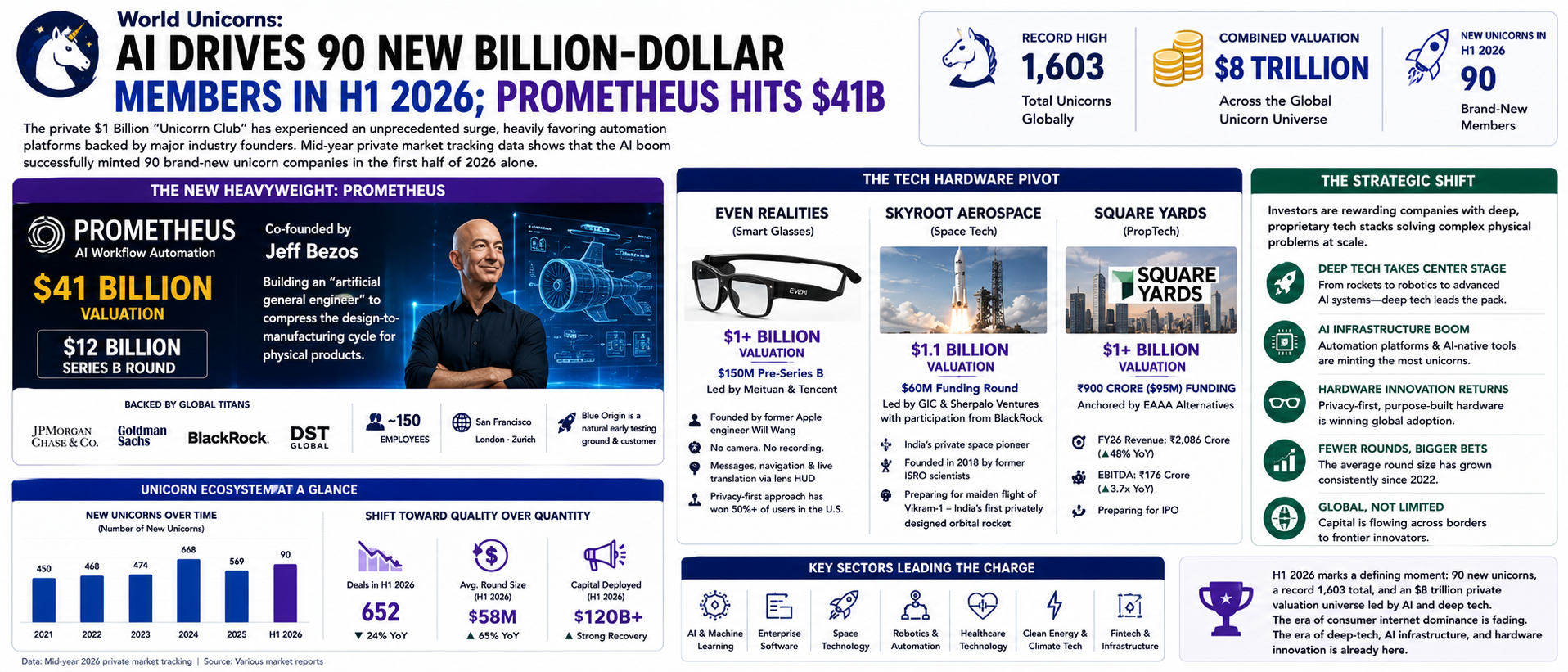
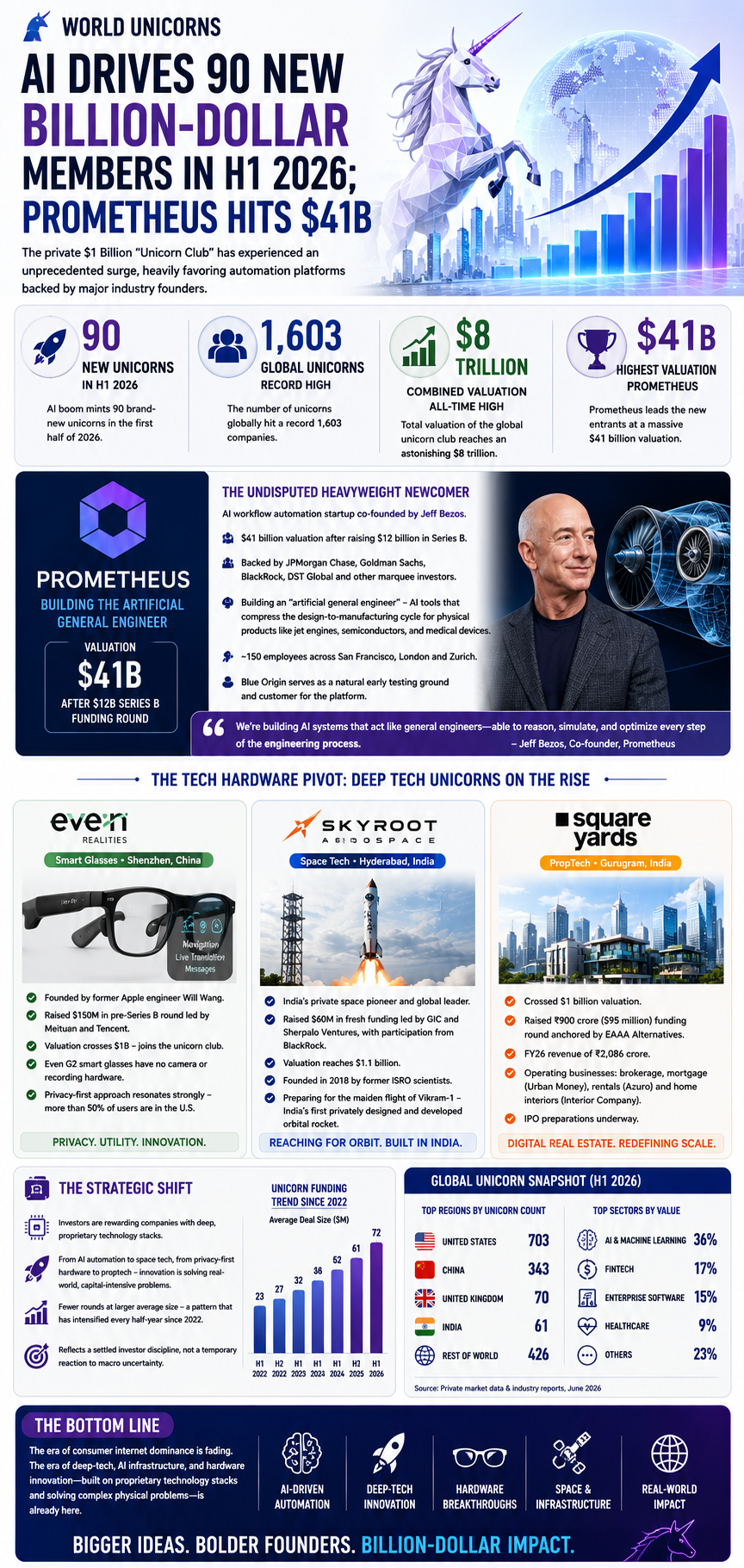
The private $1 Billion "Unicorn Club" has experienced an unprecedented surge, heavily favoring automation platforms backed by major industry founders. Mid-year private market tracking data shows that the AI boom successfully minted 90 brand-new unicorn companies in the first half of 2026 alone . The number of unicorns globally hit a record 1,603, with a combined valuation of $8 trillion .
The undisputed heavyweight crown among the new entrants belongs to Prometheus, an AI workflow automation startup co-founded by Jeff Bezos, which secured an eye-watering $41 billion valuation following a $12 billion Series B funding round . Backed by investors including JPMorgan Chase, Goldman Sachs, BlackRock, and DST Global, Prometheus is building what Bezos calls an "artificial general engineer"—AI tools designed to compress the design-to-manufacturing cycle for physical products like jet engines, semiconductors, and medical devices . The company has approximately 150 employees across San Francisco, London, and Zurich, and Blue Origin serves as a natural early testing ground and customer for the platform .
The Tech Hardware Pivot
While AI dominates, deep tech is thriving globally. In consumer tech, Even Realities—a Shenzhen-based smart-glass hardware maker founded by former Apple engineer Will Wang—officially cleared the $1 billion mark after raising $150 million in a pre-Series B round led by Meituan and Tencent . The company's flagship Even G2 smart glasses have no camera or recording hardware, instead sending messages, navigation, and live translation through a heads-up display embedded in the lenses—a privacy-first approach that has resonated with more than half its user base in the United States .
India's private space tech pioneer Skyroot Aerospace solidified its position on the international leaderboard with a $1.1 billion valuation after securing $60 million in fresh funding led by GIC and Sherpalo Ventures, with participation from BlackRock . The Hyderabad-based startup, founded in 2018 by former ISRO scientists, is preparing for the maiden flight of Vikram-1—India's first privately designed and developed orbital rocket . Proptech platform Square Yards also crossed the $1 billion threshold following a ₹900 crore ($95 million) funding round anchored by EAAA Alternatives, with the company reporting FY26 revenue of ₹2,086 crore and preparing for an IPO .
The Strategic Shift
This new wave of unicorns highlights that private investors are strictly rewarding companies with deep, proprietary technology stacks—whether that means launching commercial orbital rockets, developing privacy-first smart glasses, or building AI that compresses engineering design cycles . The underlying pattern, fewer rounds at larger average size, has intensified every half-year since 2022 and reflects a settled investor discipline rather than a temporary reaction to macro uncertainty . The era of consumer internet dominance is fading. The era of deep-tech, AI infrastructure, and hardware innovation—built on proprietary technology stacks and solving complex physical problems—is already here.

Vishal Sable
B.Tech AD @ shri balaji institute of technology and management
Engineering and tech journalist. I love exploring the impact of emerging technologies on global defense, sovereignty, and everyday life. Always looking for the real story behind the headlines.