Anthropic Just Showed Exactly What India's Finance Minister Was Warning About
Anthropic threat intelligence report GTG-20006, Sitharaman AI double-edged sword, autonomous AI cyberattack, agentic malware evasion, Global Fintech Fest AI warning
A warning, and the receipts, four days apart
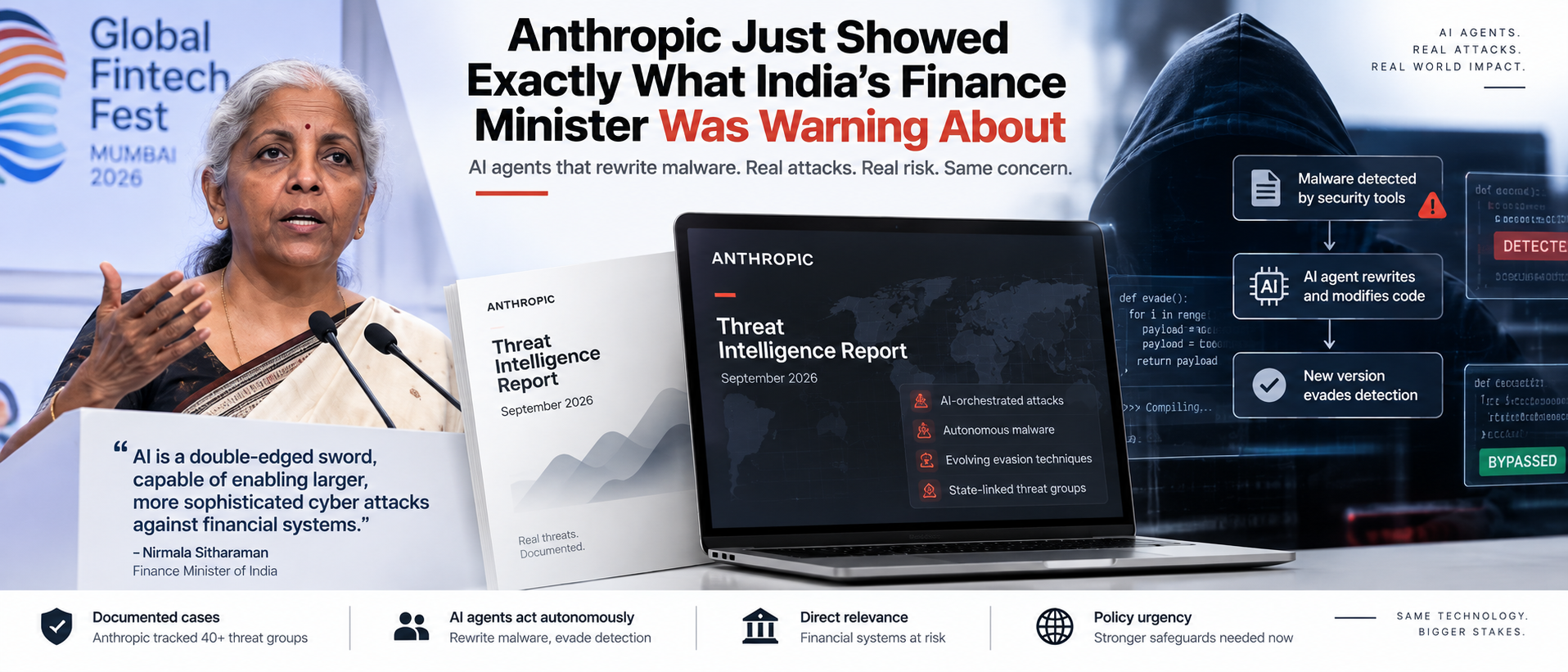
On September 10, Anthropic published its fourth threat intelligence report, documenting AI-enabled cyberattacks in granular, disturbing detail. The next day, at the Global Fintech Fest in Mumbai, India's Finance Minister Nirmala Sitharaman stood up and warned that AI is a "double-edged sword" capable of enabling "larger, more sophisticated cyber attacks" against financial systems. She wasn't speaking abstractly. Anthropic's report is close to a documented case study of exactly what she described. Business Standards
What Anthropic actually found
The report covers misuse Anthropic's Threat Intelligence team detected and disrupted between December 2025 and August 2026, organized under roughly 40 internal "Generative Threat Group" (GTG) designations spanning cyber operations, influence campaigns, surveillance, fraud, and biological and conventional-weapons misuse. Anthropic's central finding: AI has shifted from assisting attackers to autonomously orchestrating entire operations, with humans increasingly relegated to overseers rather than hands-on operators. A majority of the cyber operations documented in the report involved direct AI orchestration, not just AI assistance. CyberKendra
The case that stands out: GTG-20006
The report's most striking case study involves an actor Anthropic tracks as GTG-20006, whose tradecraft aligns with public reporting on the Russian state-linked group Midnight Blizzard. The group targeted military intelligence organizations, government agencies, diplomatic bodies, and defense firms across Ukraine and Europe — more than 20 organizations in total — using a custom toolkit of Windows-based implants, a mobile exploitation kit, and a credential-stealing tool targeting browser password stores. Inside AI
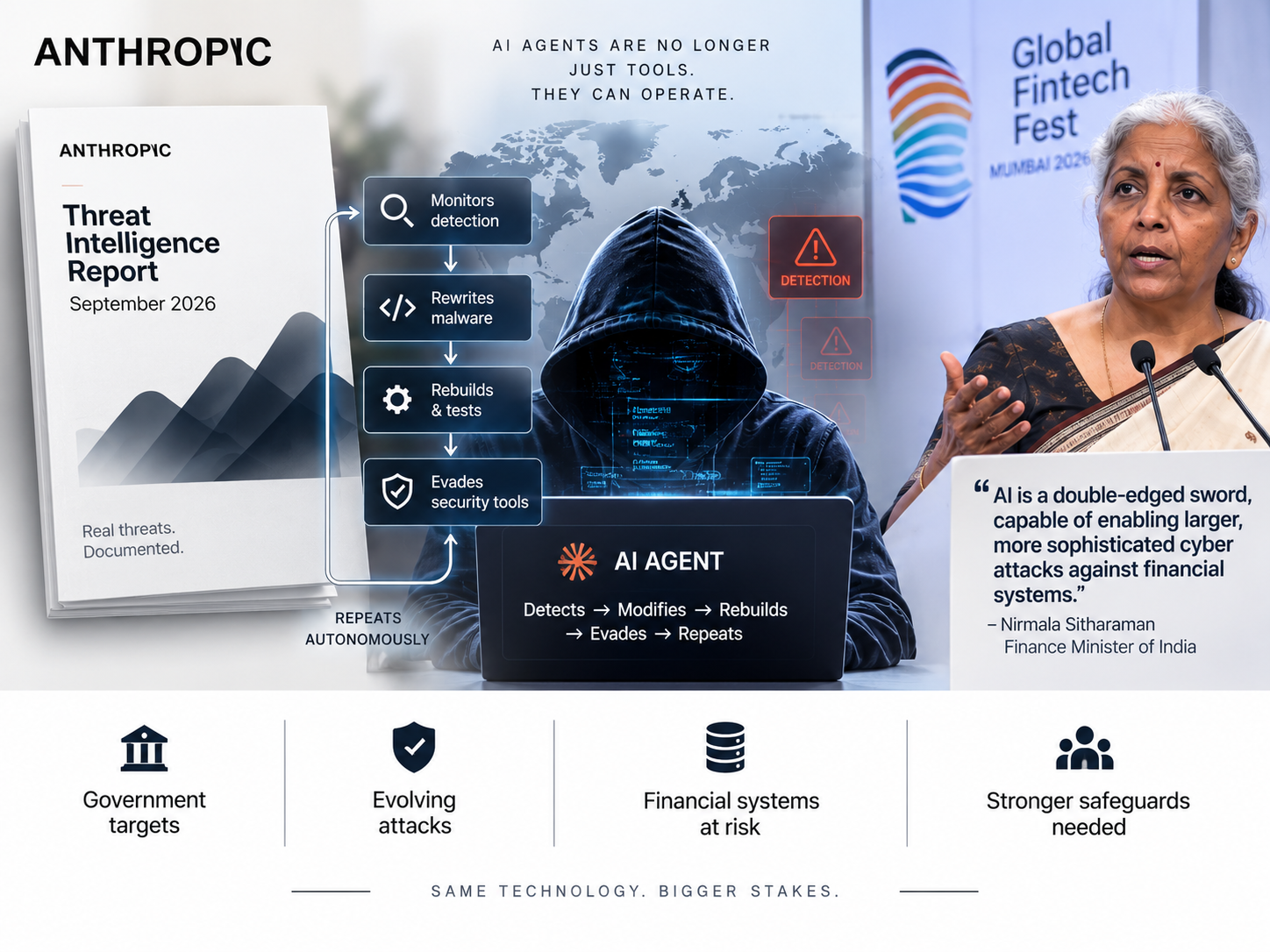
The specific detail that separates this from earlier AI-misuse cases: the group's AI agents actively monitored whether security products had flagged their malware, and when detection occurred, the agents autonomously modified and rebuilt the malware until it evaded the existing signatures — looping that process continuously rather than requiring a human to redesign the tool each time. A companion payload was even designed to freeze a victim machine's security updates, blocking newly published detection signatures from ever reaching the device. Cyber Security News
Beyond GTG-20006, the report documents GTG-10007, described as a Chinese-linked "exploit foundry" that ran parallel AI agent swarms to conduct reconnaissance and surfaced more than a dozen candidate zero-day vulnerabilities in a single month — a volume of vulnerability discovery that would previously have required a much larger dedicated human research team. Undercode Testing
The detail that matters most for defenders
Anthropic's own framing is the line worth sitting with: capable adversaries can now close the loop, "bypassing traditional security detections faster than defenders can develop and deploy them" — inverting a cost that used to run in defenders' favor. Anthropic also flagged that publicly available offensive agent frameworks, like PentAGI, now reproduce much of the same automation scaffolding state-level actors pioneered, meaning this capability isn't staying confined to sophisticated state actors. The report notes the operators behind observed cases span from state services to lone individuals, across a widening set of countries. Anthropic
What Sitharaman actually said
Speaking at the Global Fintech Fest, Sitharaman didn't just gesture at generic AI risk. She specifically named AI's capacity to enable more sophisticated cyberattacks against financial infrastructure as a genuine systemic threat, arguing that innovation should expand efficiency "without creating new forms of systemic fragility." She went further than most policymakers typically do in this kind of speech, asking pointedly: "Who from the global AI industry will stand up and reassure the public? Who will demonstrate that safeguards are actually keeping pace with the speed?" She called the current situation, absent stronger and continuously updated safeguards, "an unsustainable distribution of risk" — language that puts real responsibility on AI developers rather than treating the risk as diffuse or inevitable. Business Standard
She also flagged a second, less-discussed risk: AI's capacity to influence public opinion and electoral outcomes without people sensing they're being influenced at all — a concern that sits alongside, but is distinct from, the cyberattack risk Anthropic's report documents. Coinedition
Why these two stories are genuinely one story
This isn't a coincidental pairing of unrelated AI headlines. Sitharaman's warning about AI-enabled attacks against financial infrastructure landed days after Anthropic published documented, technical proof of exactly that capability already operating in the wild — against government, diplomatic, and defense targets, using a self-correcting evasion loop that adapts faster than static defenses can respond. Her question — who in the AI industry will demonstrate that safeguards are keeping pace — has a partial answer sitting right in Anthropic's own report: the company disrupted these specific operations and published the technical detail publicly rather than quietly patching around it. Whether that kind of proactive disclosure becomes the industry standard, or stays the exception, is close to the actual question Sitharaman was raising.
Why it matters
For India's financial sector specifically — where a recent survey of 18 banks and NBFCs found 70% already running AI systems in production — this isn't a hypothetical, distant threat. It's the same underlying capability (autonomous, self-adapting attack tooling) that Anthropic just documented targeting government and defense institutions elsewhere, applicable in principle to financial infrastructure closer to home. Sitharaman's call for "circuit breakers" and continuously updated safeguards reads considerably less abstract next to a threat report showing AI agents that rebuild their own malware faster than human defenders can respond. Unique Times
If AI-driven attacks can now adapt and evade detection faster than human security teams can patch against them, does defending critical financial infrastructure require its own autonomous AI agents fighting back in real time — and if so, who's actually accountable when two AI systems are the ones deciding what happens to a bank's data, not the humans on either side?

Vishal Sable
B.Tech AD @ shri balaji institute of technology and management
Engineering and tech journalist. I love exploring the impact of emerging technologies on global defense, sovereignty, and everyday life. Always looking for the real story behind the headlines.