LATEST NEWS
Anthropic Just Showed Exactly What India's Finance Minister Was Warning About
September 13, 2026 6M
Back to News
News AlertWorld AI Tech
Scientists Just Finished Wiring Up an Entire Animal's Brain — And AI Did Most of the Grunt Work
S
Author
Saumya Dawande
Published
September 13, 2026
Reading Time
4 MIN READ
Spread the Word
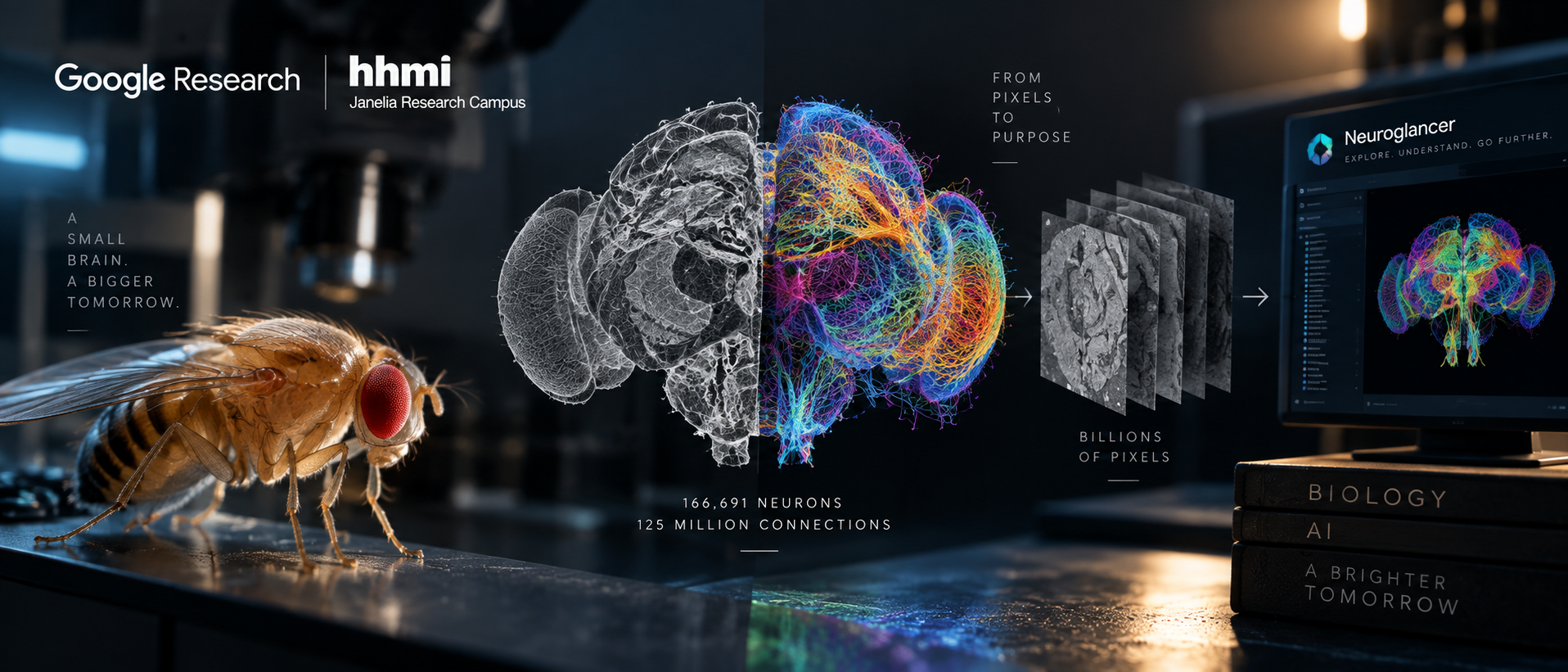
Google and HHMI Janelia mapped all 166,691 neurons in a male fruit fly's nervous system — an estimated 44 person-years of human proofreading behind an AI-built map
On September 3, Google Research and the HHMI Janelia Research Campus published something neuroscience has been building toward for nearly two decades: a complete, cell-by-cell wiring diagram of an entire animal's central nervous system. Not a slice of it, not an estimate — every one of the 166,691 neurons in an adult male fruit fly's brain and nerve cord, and roughly 125 million synaptic connections between them, fully mapped and cross-checked by hand. Google Research Blog, Sci.News
The achievement, published in the journal *Cell* alongside three companion papers, is the largest brain map ever assembled by neuron count — bigger than the "hemibrain" Janelia released in 2020, which covered roughly 25,000 neurons and 21 million connections and was itself a record at the time. It's also the first connectome to cover a fly's full central nervous system, brain and ventral nerve cord together, rather than just the brain in isolation. A fruit fly's nervous system is a rounding error next to a human's roughly 86 billion neurons, but that's exactly the point: it's small enough to fully map with today's tools, while still being complex enough to walk, fly, navigate, and perform the kind of intricate courtship behavior neuroscientists actually want to study. Google Research Blog, LifeScienceHistory
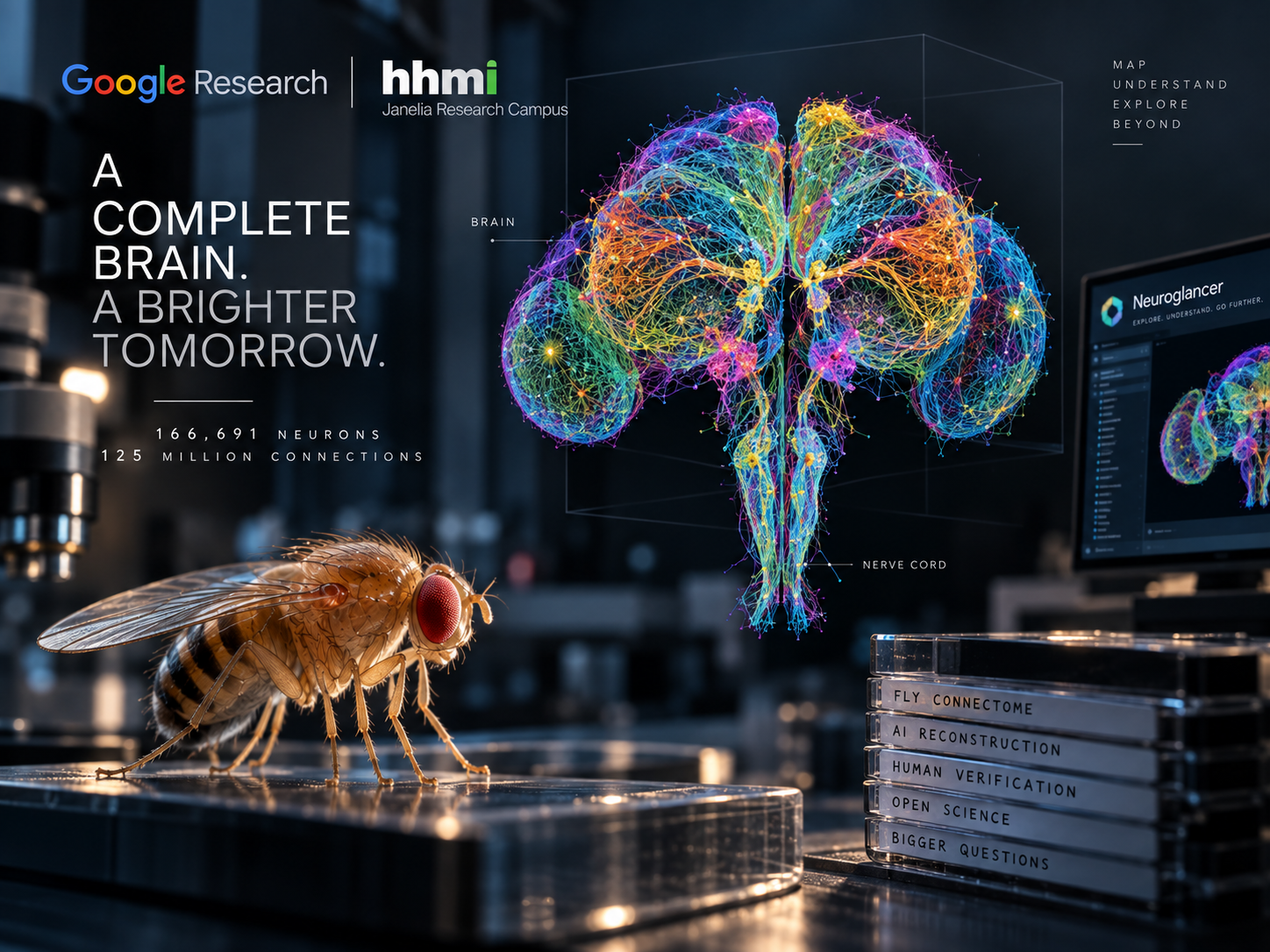
Getting there required turning a physical brain into billions of pixels, then turning those pixels back into a 3D structure a computer — and a human — could actually read. Researchers sliced the fly's nervous system into an enormous stack of ultra-thin sections and imaged each one under an electron microscope. From there, Google's connectomics team used AI models built on "flood-filling networks" — convolutional neural networks that start at a single pixel and trace outward to identify every pixel belonging to the same neuron — to reconstruct the raw images into continuous 3D shapes. Their newer system, called PATHFINDER, was trained in part on synthetic neurons generated to sharpen its accuracy, since the sheer variety of real neuron shapes makes for a tough training set on its own. Google Research Blog
Even with AI handling the reconstruction, none of it shipped without a human checking the computer's work. A team of experts at HHMI Janelia proofread and annotated every neuron the AI segmented, sorting them into 11,691 distinct cell types — an effort the paper estimates took about 44 person-years of manual review. That number is the real headline for anyone who thinks AI has made this kind of science push-button: the AI did the heavy lifting on reconstruction, but verifying that a machine correctly traced 166,691 individual, tangled, microscopic wires still took the equivalent of dozens of scientists working full-time for well over a year. PMC / *Cell*
The real scientific payoff isn't just having a map — it's having two. A complete female fruit fly connectome already existed, so this male map gives researchers the first-ever cell-by-cell comparison of male and female brain wiring in any animal. The team found 7,205 neuron types that are essentially identical between the sexes, 114 types that exist in both but are wired differently, and 331 types that are entirely sex-specific — concentrated overwhelmingly in the brain's higher-order processing centers rather than in the basic sensory and motor circuitry, which stays nearly identical between males and females. That pattern gives neuroscientists a real anatomical starting point for questions that have mostly been studied through behavior alone: what part of the wiring actually makes courtship, aggression, or other sex-typical behaviors happen. PMC / *Cell*, Janelia Research Campus
For anyone tracking where AI is actually changing science rather than just chatbots, this is a clean example: the entire dataset is free and public, explorable through Google's open-source Neuroglancer tool, and the same AI pipeline is already being pointed at harder targets. Google says it's now working with Columbia and Harvard on connectomes for the elephantnose fish and larval zebrafish — the first steps toward vertebrate brains — and has a mouse brain-mapping project underway. None of that closes the gap to 86 billion human neurons anytime soon. But a decade ago, mapping one full fly nervous system by hand would have been unthinkable; now the question isn't whether AI-assisted connectomics works, it's how many rungs up the animal kingdom it can climb before the proofreading bill becomes the real bottleneck again. Google Research Blog

Saumya Dawande
B.Tech AIML @ oriental institute of science technology bhopal
Engineering and tech journalist. I love exploring the impact of emerging technologies on global defense, sovereignty, and everyday life. Always looking for the real story behind the headlines.