The Foldable iPhone Wasn't the Story. John Ternus's First Exam Was.
A CEO eight days into the job
Ternus officially took over as CEO on September 1, 2026, succeeding Cook, who moved into the role of executive chairman after 15 years running the company — a stretch in which Apple's value grew from roughly $350 billion to about $4.7 trillion.The timing wasn't accidental. Apple's board approved the succession unanimously months earlier, in April, giving Cook the summer to hand things over before the September product cycle began — rather than throwing Ternus onstage mid-transition. It meant Ternus's first keynote would still be Cook's product roadmap; his own would come next year.
Apple Newsroom
What actually launched — and what didn't
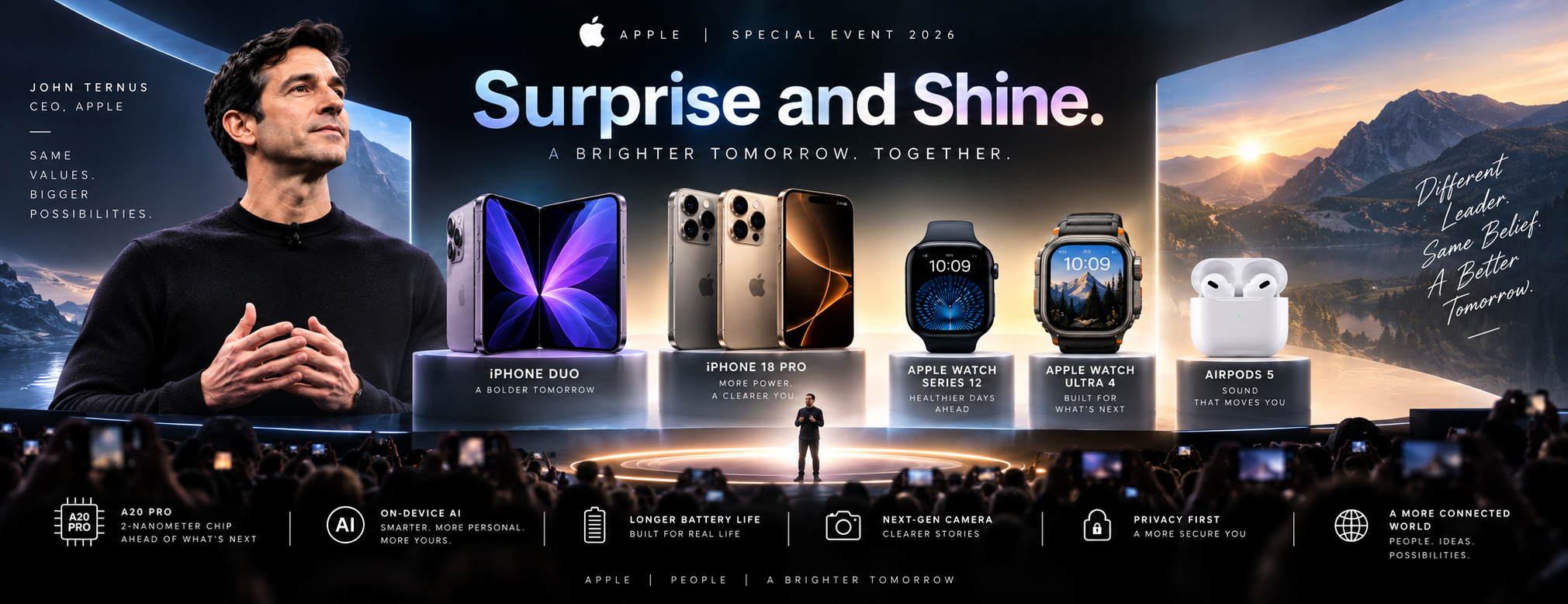
Apple's "Surprise and Shine" event introduced the iPhone 18 Pro and iPhone 18 Pro Max, the Apple Watch Series 12, Apple Watch Ultra 4, and AirPods 5, with pre-orders opening September 12 and shipping September 18.
Two things were conspicuously missing. The standard iPhone 18 was pushed to spring 2027, and the foldable "iPhone Duo" ships separately on October 23 — meaning anyone assuming the full iPhone 18 lineup launched on September 9 only saw part of it. For a first keynote, that's an unusually incomplete lineup to defend. MacRumors
The chip doing the quiet work: A20 Pro
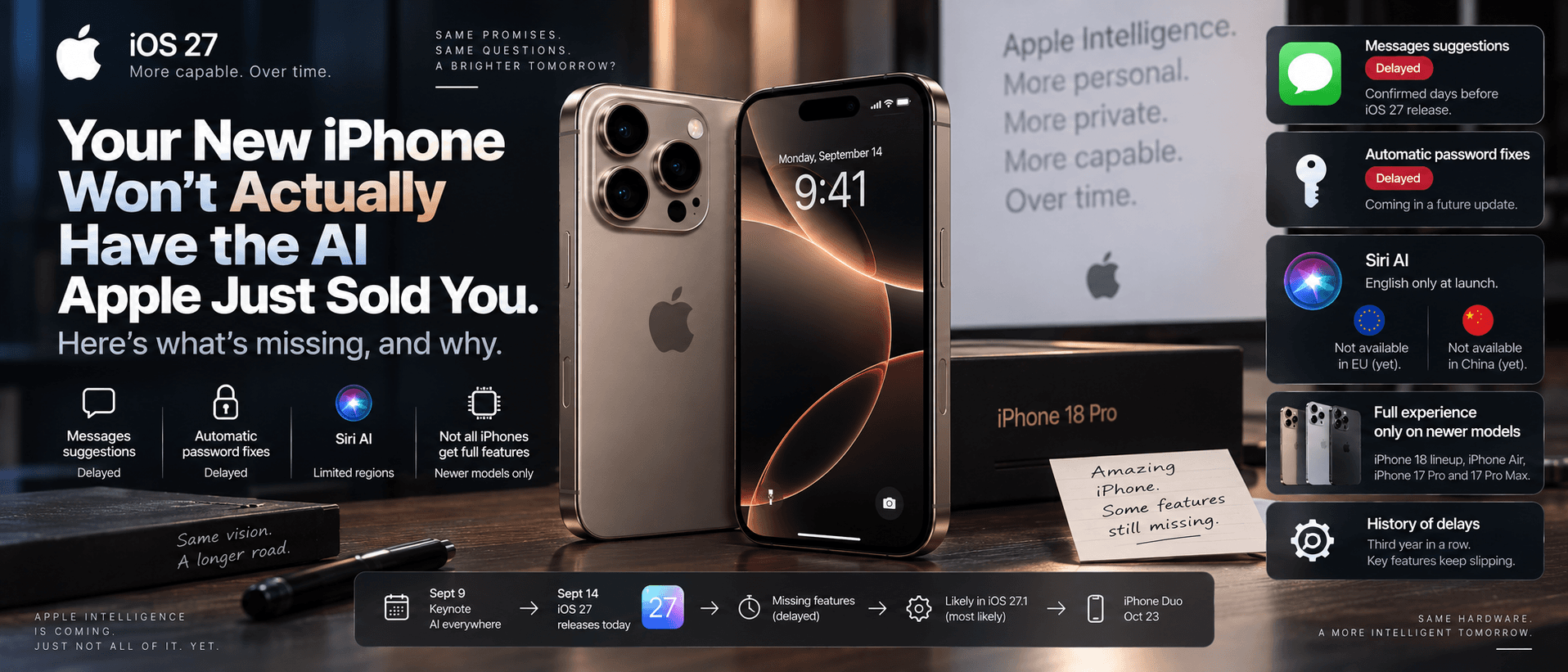
The A20 Pro is Apple's first chip built on a 2-nanometer process, paired with 12GB of RAM and up to 2TB of storage on the Pro Max. Moving to 2nm is a real manufacturing milestone, not a marketing bump — smaller transistors generally mean better performance per watt, which is why Apple leaned on battery-life claims rather than raw speed this cycle. That chip is also the hardware gate behind two headline features: the shrunken Dynamic Island, made possible by tighter component integration that relocates some Face ID sensors beneath the display, and on-device Siri AI, which Apple says requires the full 12GB of RAM to run its most advanced model. In other words, the A20 Pro isn't just a speed bump — it's the line that decides which iPhones get Apple's newest AI features at all. AH
The Wall Street warning that came with the applause
Ahead of the keynote, KeyBanc Capital Markets flagged the event as a potential negative catalyst for Apple's stock, warning that the company faced a choice between raising prices to offset higher costs — partly driven by an industry-wide memory shortage — or absorbing pressure on margins and demand. Once pricing was confirmed on stage, that warning stopped being hypothetical. MacRumors
What buyers actually pay — and why it isn't the same everywhere
The new lineup's price gaps across countries are large enough to change how a shopper should think about when and where to buy.
The iPhone 18 Pro starts at $1,199 in the US (roughly ₹1,14,300) versus ₹1,64,900 in India for the identical 256GB model — a gap of about ₹50,600. The Pro Max starts at $1,299 in the US against ₹1,79,900 in India. The gap widens further on the foldable: the iPhone Duo starts at $1,999 in the US but ₹2,99,900 in India, putting India's starting price at more than double the US sticker on a straight currency conversion. This isn't Apple charging what it likes for identical hardware — it's mostly what each government adds on top of Apple's base price. India's cost is inflated by GST and import duty layered on top, which is why the country consistently lands near the expensive end of every global comparison Apple's launches generate. The US comes out cheapest largely because it has no federal VAT-equivalent at the point of sale, and Apple manufactures or assembles a meaningful share of its US-bound inventory under trade arrangements that avoid the import tariffs a device faces landing in India. Deccan Chronicle
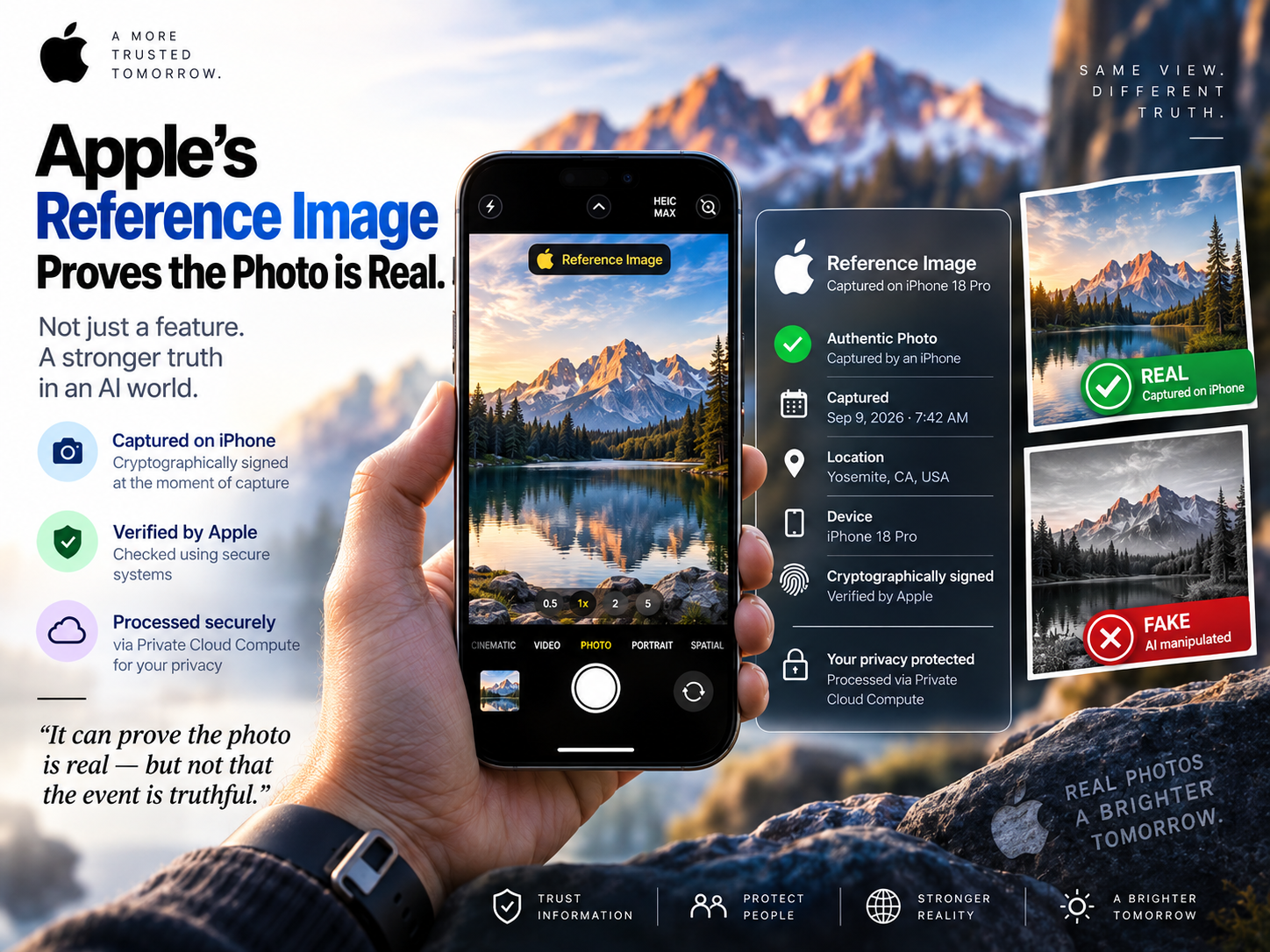
The feature nobody asked about, but everyone will need: Apple Reference Image
Separate from the marketing renders, Apple is quietly testing "Apple Reference Image" — a photo-authentication system spotted in the iOS 27 beta. An opt-in "Reference" mode in the Camera app embeds cryptographic provenance data at the moment of capture, so a photo can later be verified as genuinely shot on an iPhone rather than AI-generated or manipulated. Verification runs through Apple's Private Cloud Compute rather than an open standard: tapping the "Reference" badge sends the raw image, sensor signatures, capture timeframe, and hardware identifiers to Apple's servers, which confirm the capture and return an authenticated version. That's a deliberate departure from the industry's existing approach — Leica, Sony, Nikon, and Google's Pixel 10 already use the open C2PA Content Credentials standard for the same purpose, but Apple is building its own closed system instead.
The privacy design matters here: unlike a typical C2PA setup, where a verifying server usually inspects the actual image, Apple's approach is built so its servers never plainly read the raw photo. As of the beta, the feature ships off by default, and Apple hasn't said whether or when it goes live publicly. AppleMagazine
An authenticated file is good evidence that it came from an iPhone camera in Reference Mode and passed Apple's checks — useful for photojournalism, insurance claims, property inspections, marketplace listings, and event records. It does not prove the contents are truthful: someone could photograph an AI image on another screen, stage a scene, or crop out decisive context, and the phone would still have captured a "real" photograph of something misleading. And unless location and timestamp data are explicitly part of the signed record — which Apple hasn't confirmed — authentication alone won't establish when or where a photo was taken. AppleMagazine
The real test isn't the phone
Strip away the hardware, and September 9 was a stress test of Ternus himself: a marquee product delayed, a budget phone pushed a full year out, a live pricing backlash, and quiet infrastructure work — chip architecture, photo authentication — that will define Apple's next several product cycles more than anything shown onstage. Cook's tenure will be remembered for turning Apple into the world's most valuable company. Ternus now has to defend that valuation through his first complete product cycle, without the benefit of having built the roadmap himself. Washington Post
FAQ
Who is Apple's CEO now?
John Ternus, formerly senior vice president of hardware engineering, became CEO on September 1, 2026, succeeding Tim Cook, who is now executive chairman.
What's new in the A20 Pro chip?
It's Apple's first 2-nanometer chip, paired with 12GB of RAM — the threshold Apple has set for running its most advanced on-device Siri AI model.
Why is the iPhone 18 Pro cheaper in the US than in India?
Mainly taxes and duties: India adds GST and import duty on top of Apple's base price, while the US has no equivalent federal VAT/GST. The gap is about ₹50,600 on the Pro model.
Can I save money buying my iPhone abroad and bringing it into India?
Not meaningfully. India's duty-free allowance for returning residents is capped at ₹50,000 — far below the price gap on any model in this lineup — so the savings are largely wiped out by duty owed at customs.
What is Apple's "Reference Image" cryptographic authentication feature? An opt-in Camera mode, spotted in the iOS 27 beta, that embeds cryptographic provenance data at capture and verifies photos via Apple's Private Cloud Compute. It's off by default and Apple hasn't confirmed a public release date.

Tarun Punde
B.Tech AIADS@ Shri Balaji Institute of Technology & Management
I write at Metaplugs — breaking down the latest in tech, economics, and business into simple, impactful stories for everyday readers. Passionate about software testing and global finance.