Apple's Post-Launch Week: A Photography Exhibition, Real Child Safety Upgrades, and a Pre-Order Rush
iPhone 18 Pro Shot on iPhone, What Holds Us exhibition Apple, Apple child safety features iOS 27, Apple Screen Time update 2026, iPhone 18 Pro pre-order
The week after the keynote is often the more revealing one
A week on from Apple's "Surprise and Shine" event, two follow-up stories say more about how Apple actually operates than the keynote itself did: a photography showcase built to prove the iPhone 18 Pro's camera claims with real work from real photographers, and a set of child safety tools that shipped with more actual substance than the typical incremental parental-controls update.
"What Holds Us": putting the camera claims to the test
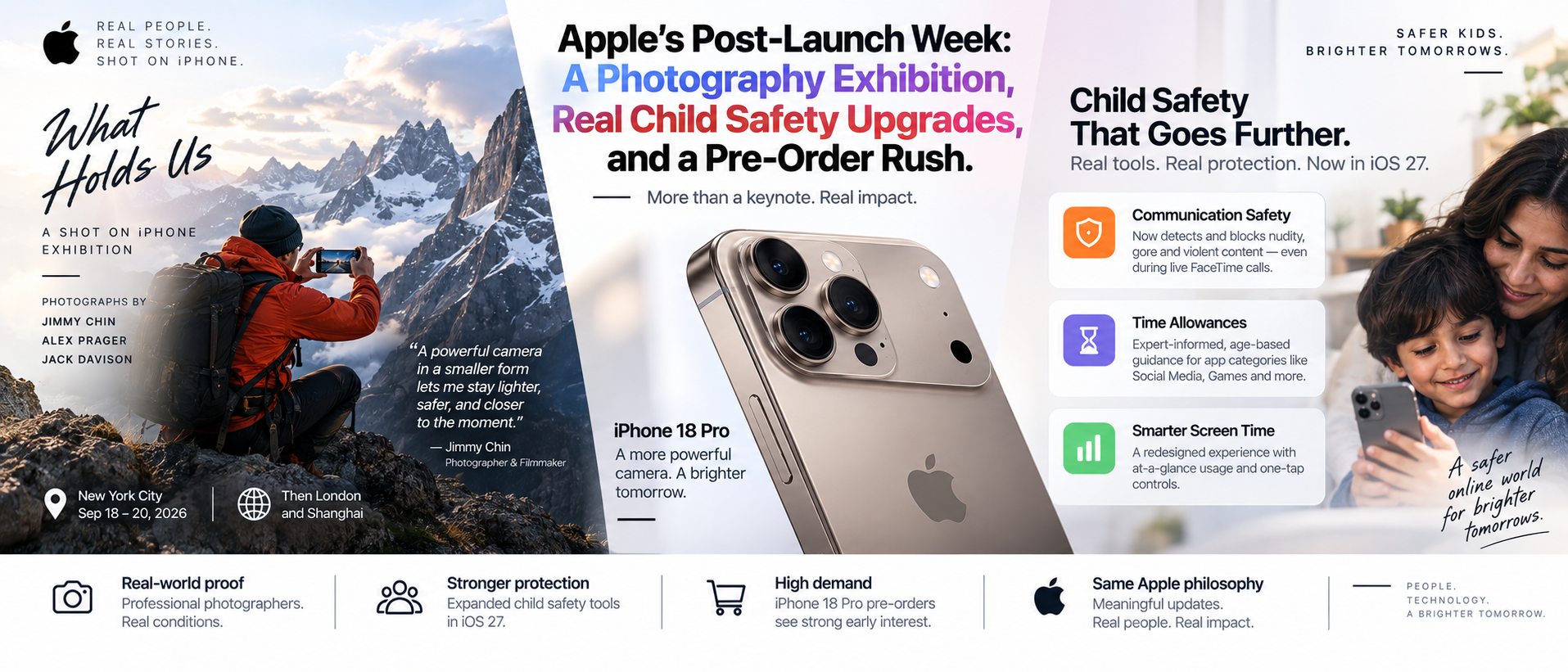
Apple's latest Shot on iPhone project, titled "What Holds Us," puts the iPhone 18 Pro's redesigned camera system — the variable aperture, the new low-light sensor — directly in the hands of three working photographers rather than just demonstrating it in a keynote slide. The exhibition, curated by former New York Times Magazine photography director Kathy Ryan, features work from Alex Prager, Jack Davison, and Jimmy Chin, built around the theme of human connection. It opens in New York City on September 18 and runs through September 20, before traveling to London and Shanghai. AppleInsider
Jimmy Chin's contribution is the most concrete demonstration of what the camera hardware actually changes in practice. The Academy Award-winning adventure photographer and filmmaker shot climbers in British Columbia's Bugaboo Mountains using the iPhone 18 Pro for close-ups, action shots, and large panoramas — describing the phone's compact, point-and-shoot form factor as a genuine practical and safety advantage while working in difficult, high-altitude mountain conditions where carrying less gear matters. "I've always been interested in human passion and meaning, and where that intersects with the raw beauty of wild landscapes," Chin said of the work. "When you spend a lot of time in these places, you start to look at things differently. You start to see the details." AppleInsider
Apple separately released a set of seven official sample images from the iPhone 18 Pro's camera, demonstrating the variable aperture's range in practice: the lens automatically widening to its widest setting of ƒ/1.48 to pull in more light for low-light and Night mode scenes, and narrowing to ƒ/4 to keep group shots in sharper focus while blurring the background. Pro users can also override the automatic behavior and select any of four aperture settings manually within the Camera app. Tech Times UK

Child safety: a genuinely substantial update, not just a rebrand
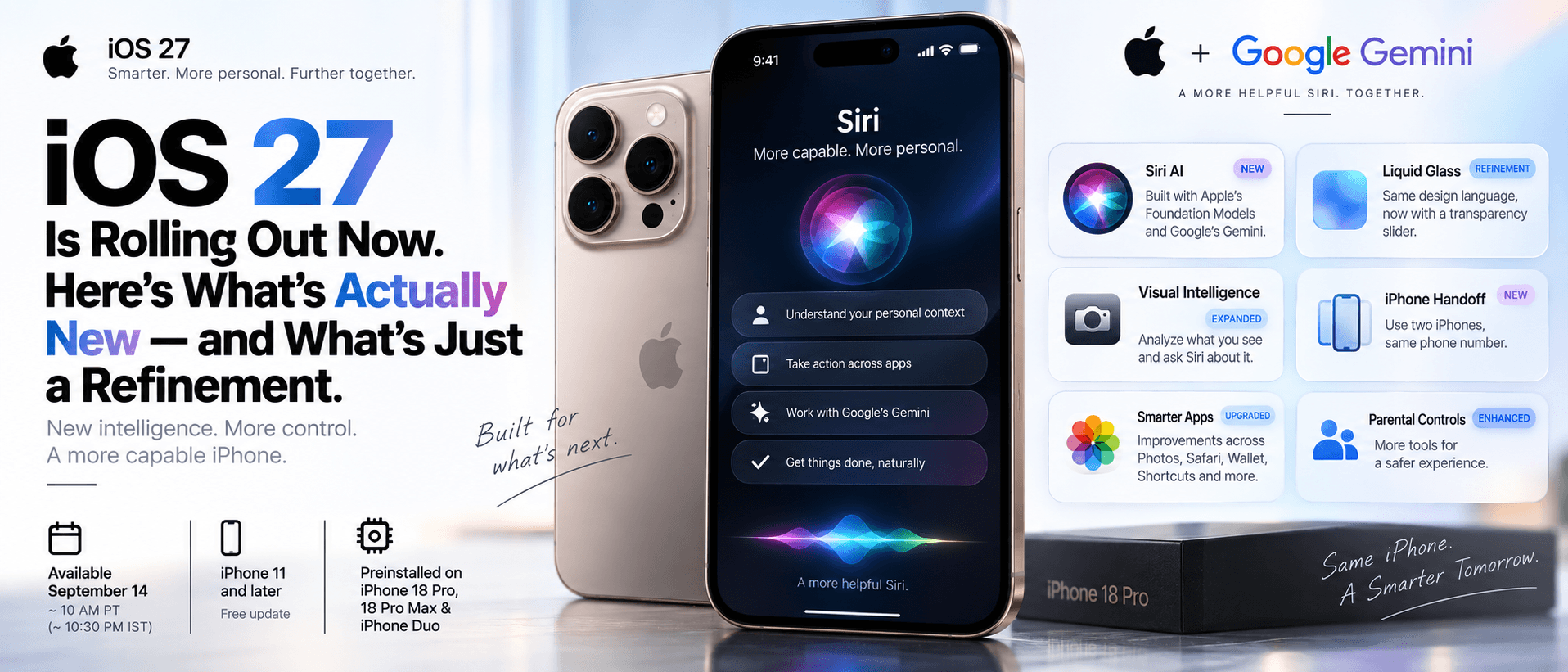
Apple's new child safety features, first previewed in June and now live, ship with iOS 27, iPadOS 27, and macOS 27 — worth correcting directly: the requirement is iOS 27 and later, not iOS 20+, and every device in a Family Sharing group needs to be updated to the matching iOS 27, iPadOS 27, macOS 27, watchOS 27, and visionOS 27 versions for the new Screen Time tools to work. Apple Newsroom
The actual feature set goes further than a typical incremental update. Communication Safety — Apple's on-device system for detecting sensitive content in shared images and videos — now extends beyond nudity to also flag and block gore and violent content, including during live FaceTime calls, not just static images. Apple also introduced Time Allowances, giving parents expert-informed, age-tailored starting-point guidance for how much time is reasonable across specific app categories like Social Media, Entertainment, and Games, rather than leaving parents to set arbitrary limits with no reference point. Screen Time itself was redesigned to give parents an at-a-glance usage view with one-tap controls to adjust access in the moment, rather than requiring a trip through multiple settings menus. Apple Newsroom
Apple is developing this specifically alongside the American Academy of Pediatrics, adapting the AAP's existing Family Media Plan into a reference guide built directly into how parents use these tools — a collaboration Apple frames as ongoing, not a one-time consultation for a press release. Apple Newsroom (June Preview)
Why these two stories, read together, say something real about Apple's current strategy
Neither story is a headline-grabbing hardware reveal, and that's precisely what makes them worth paying attention to. "What Holds Us" is Apple choosing to prove a specific hardware claim — the variable aperture, the low-light sensor — through real, unscripted professional work rather than another keynote demo. The child safety update is Apple shipping genuinely expanded protections (gore and violence detection, expert-calibrated time guidance) rather than just repackaging existing Screen Time settings with a new coat of marketing paint. Both are examples of Apple spending real effort on substance in the weeks after a keynote, when most companies quietly move on to the next announcement.
Why it matters
For iPhone 18 Pro buyers deciding whether the camera upgrade is worth the $100 price increase over last year's model, the "What Holds Us" images are a more honest test than Apple's own keynote demo — real working photographers, in real difficult conditions, using the phone as their only camera. For parents, the corrected system requirement matters practically: the new child safety tools require every device in the family group to run iOS 27 or later, so partial upgrades within a household won't unlock the full protection set.
If a phone's camera claims hold up under a professional photographer's real, unscripted use in genuinely difficult conditions, is that a stronger signal of actual quality than any keynote demo — and should more phone reviews be built around exactly that test instead of controlled studio comparisons?

Vishal Sable
B.Tech AD @ shri balaji institute of technology and management
Engineering and tech journalist. I love exploring the impact of emerging technologies on global defense, sovereignty, and everyday life. Always looking for the real story behind the headlines.