Back to News
News AlertWorld Unicorn
Augustus and Glow Join the Unicorn Club as Global Private Market Expands
V
Author
Vishal Sable
Published
July 27, 2026
Reading Time
4 MIN READ
Spread the Word
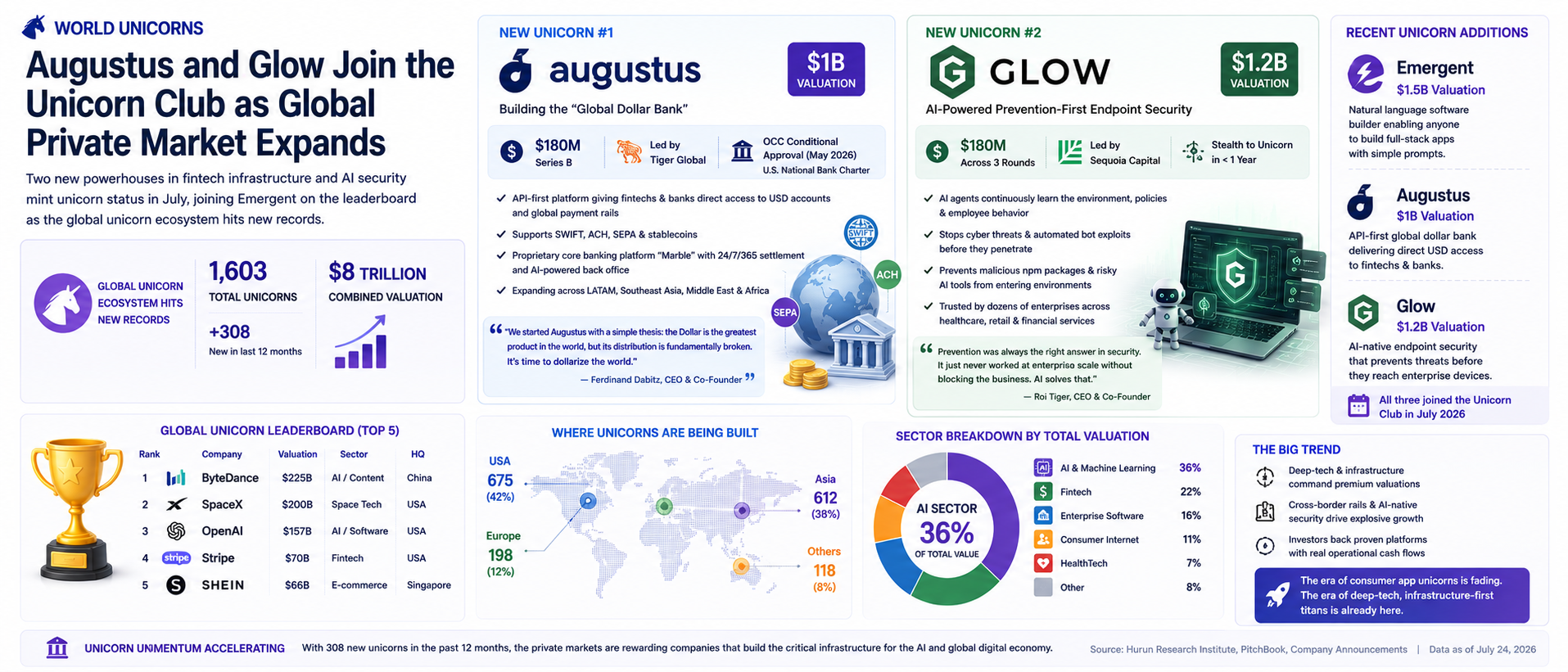
The global private $1 Billion "Unicorn Club" welcomed two major additions in the third week of July: fintech infrastructure leader Augustus ($1 billion valuation) and AI cybersecurity provider Glow ($1.2 billion valuation). They join recent natural-language software builder Emergent ($1.5 billion) on the private leaderboard, as the global unicorn count climbs to a record 1,603 companies with a combined valuation of $8 trillion.
Augustus: Building the "Global Dollar Bank"
Augustus, a U.S. fintech building a modern, federally chartered national bank, raised $180 million in a Series B round led by Tiger Global that valued the company at $1 billion. The round included participation from Hummingbird, QED Investors, and the founders of Nubank, Ramp, Circle, and Deel. The funding follows conditional approval granted to Augustus in May 2026 by the Office of the Comptroller of the Currency (OCC) for a U.S. national bank charter, making it the eighth bank to receive such conditional approval since 2010.
Augustus describes itself as building the "Global Dollar Bank"—an API-first platform designed to give international fintechs and banks direct access to USD accounts and payment rails. Its proprietary core banking platform, Marble, offers round-the-clock settlement times and uses AI across back-office functions. The platform supports traditional payment rails including SWIFT, ACH, and SEPA, alongside stablecoins. "We started Augustus with a simple thesis: the Dollar is the greatest product in the world, but its distribution is fundamentally broken," said CEO and co-founder Ferdinand Dabitz. "This financing lets us execute on our mission to provide high-quality dollar access to international fintechs and banks. It's time to dollarize the world". Augustus, which has raised $210 million to date, plans to expand its service offerings to fintechs and banks in Latin America, Southeast Asia, the Middle East, and Africa.
Glow: Prevention-First Endpoint Security
Glow, an AI-powered endpoint security company, emerged from stealth on July 22 with $180 million in funding at a $1.2 billion valuation, becoming a unicorn within a year of its founding. The funding was raised across three rounds: a $20 million seed round, a $60 million Series A, and a $100 million Series B led by Sequoia Capital, Cyberstarts, Greenoaks, and Redpoint Ventures, with participation from Index Ventures, Swish Ventures, Lux Capital, Operator Collective, and Holly Ventures.
Glow was founded by former Meta, Snowflake, and Claroty executives. CEO Roi Tiger spent nine years at Meta, most recently as VP of Engineering; CTO Omer Singer served as Snowflake's Head of Cybersecurity Strategy; and VP of R&D Ophir Arie served as VP R&D at Claroty. The company has nearly 100 employees, including 70 in Israel.
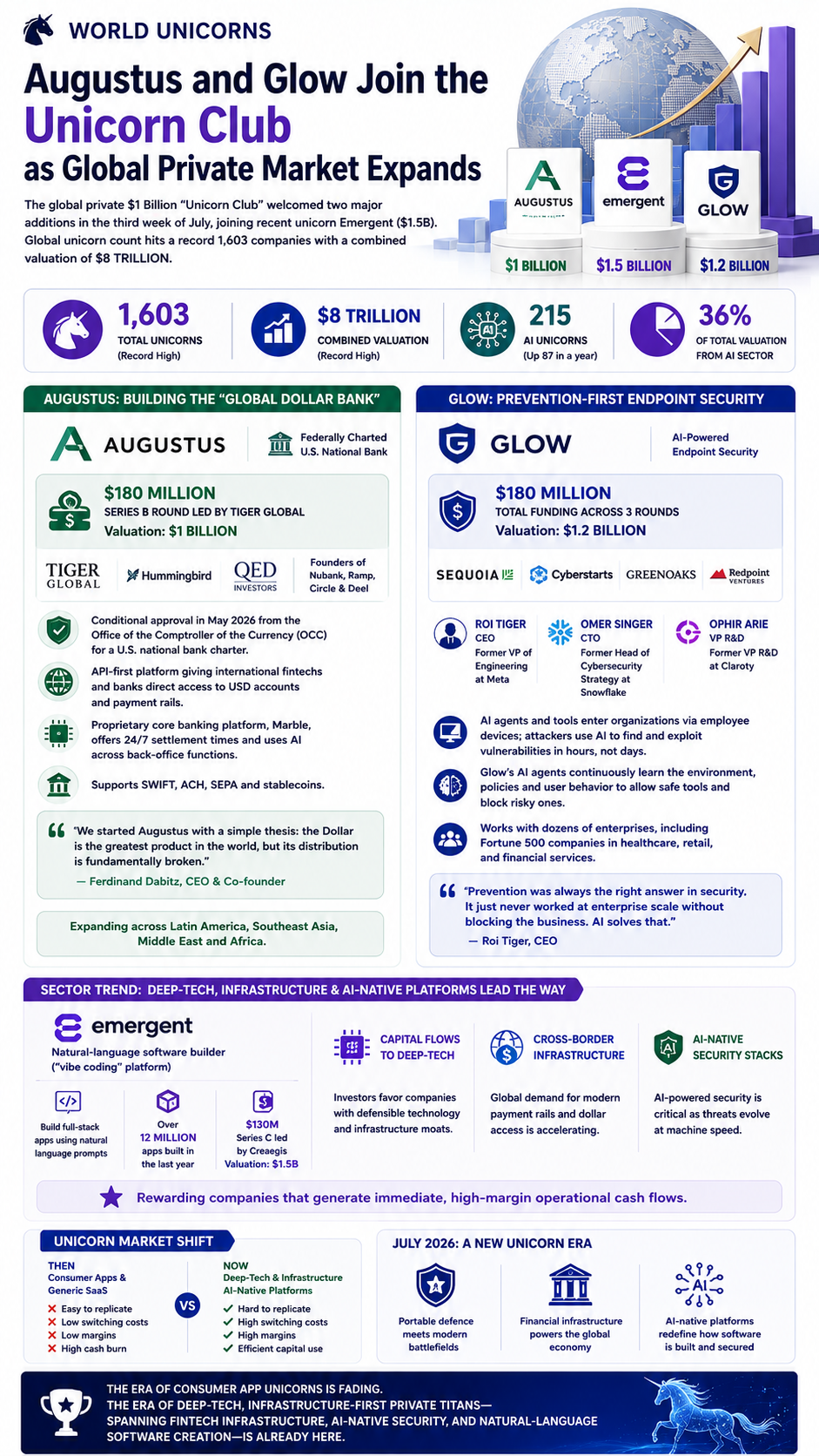
The company operates in endpoint security—the computers and devices through which employees connect to enterprise systems. Glow says the spread of AI has fundamentally changed the security landscape: AI tools and autonomous agents now enter organizations mainly through employees' personal computers, while attackers are also using AI models to detect weaknesses and exploit them more quickly. Security vulnerabilities that could once be exploited within days or weeks can now be compromised in hours. "Prevention was always the right answer in security. It just never worked at enterprise scale without blocking the business. AI solves that," said Tiger.
The Glow platform uses AI agents that continuously study the organization's work environment, security policies, and employee usage patterns to identify which AI software and tools can operate safely and which pose a risk. The company said it already works with dozens of enterprises, including Fortune 500 companies in healthcare, retail, and financial services.
Sector Trend
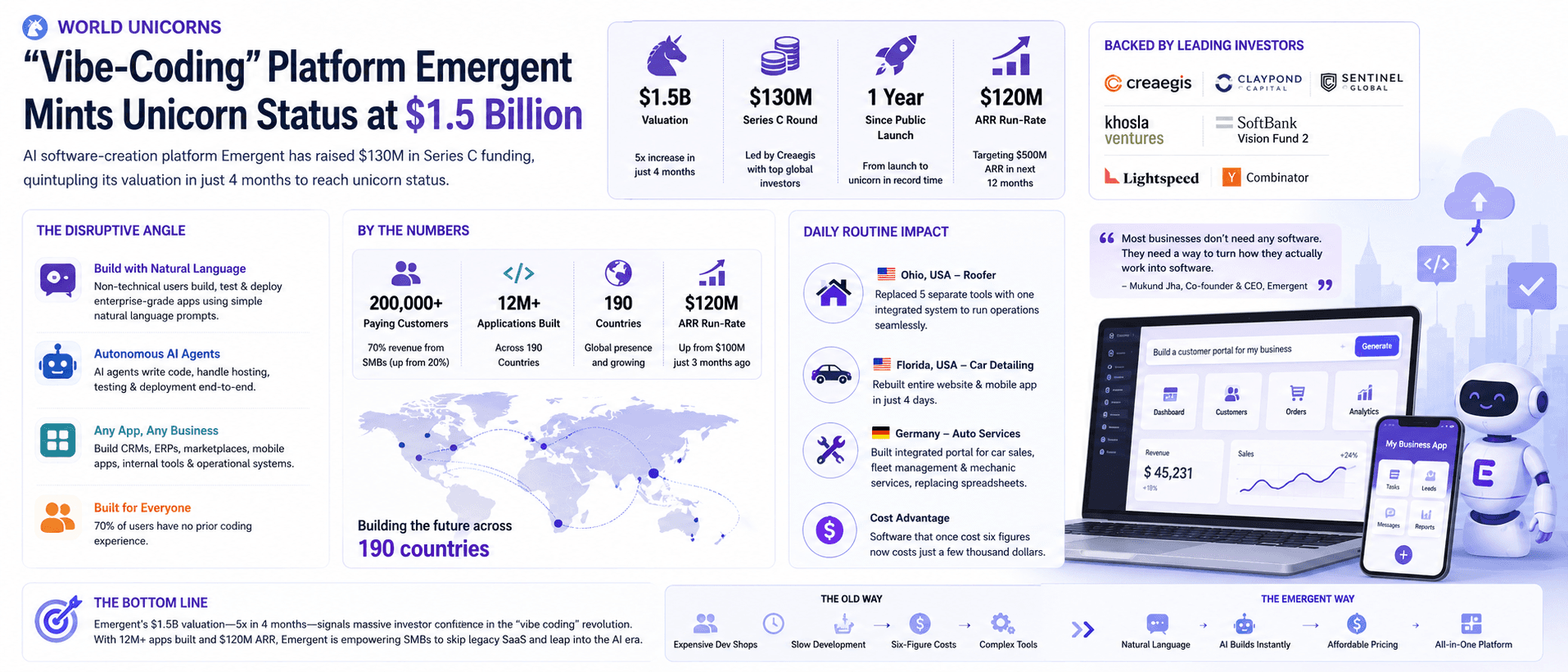
Modern unicorn creation is heavily concentrated in deep-tech, cross-border payment infrastructure, and AI-native security stacks—rewarding companies that generate immediate, high-margin operational cash flows. Emergent, which joined the unicorn club earlier in July with a $1.5 billion valuation after raising $130 million in a Series C led by Creaegis, exemplifies the "vibe coding" category, allowing non-technical business owners to build full-stack applications using natural language prompts. Over 12 million apps have been built on its platform in the last year.
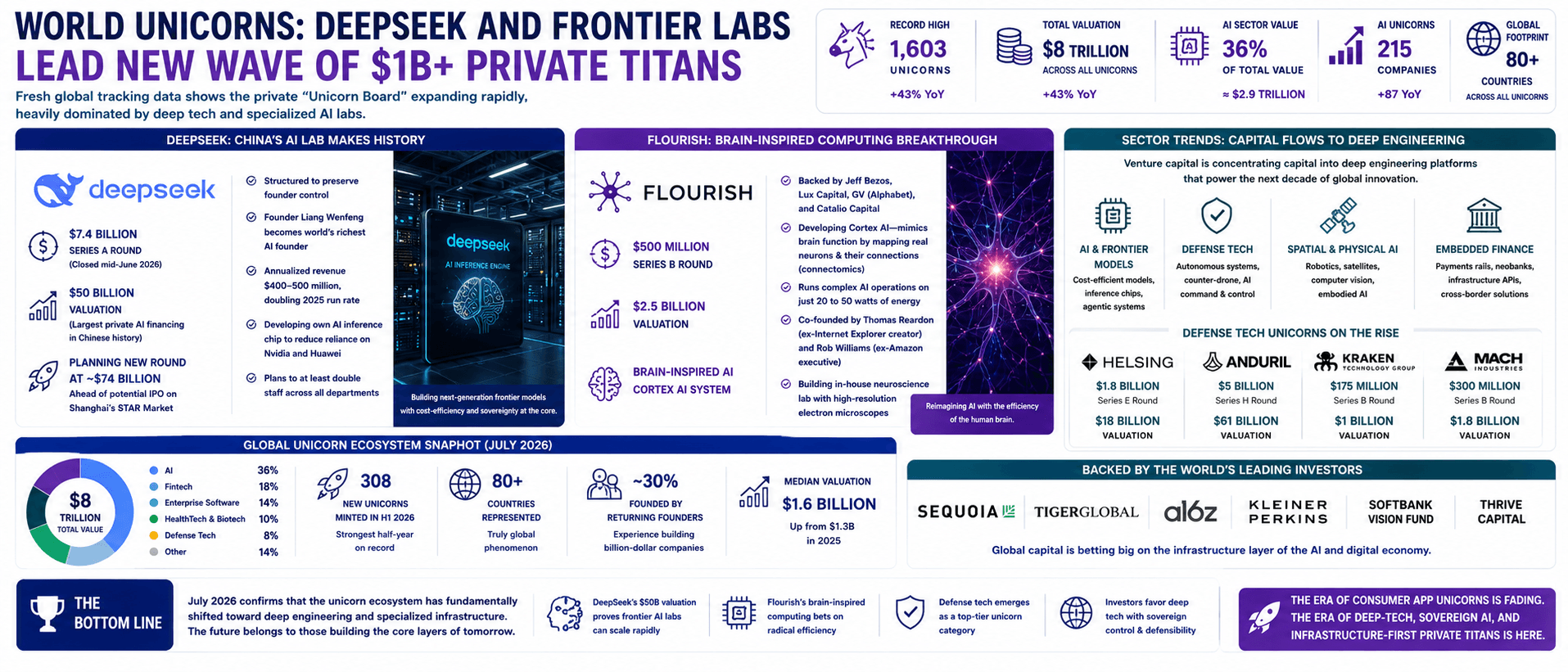
The AI sector now accounts for 36% of total unicorn value, with 215 AI unicorns—up 87 in a single year. The era of consumer app unicorns is fading. The era of deep-tech, infrastructure-first private titans—spanning fintech infrastructure, AI-native security, and natural-language software creation—is already here.