Back to News
News AlertWorld Money
Banks Are Minting Digital Dollars. Is the Wire Transfer Era Ending?
T
Author
Tushar Shrivas
Published
September 14, 2026
Reading Time
6 MIN READ
Spread the Word
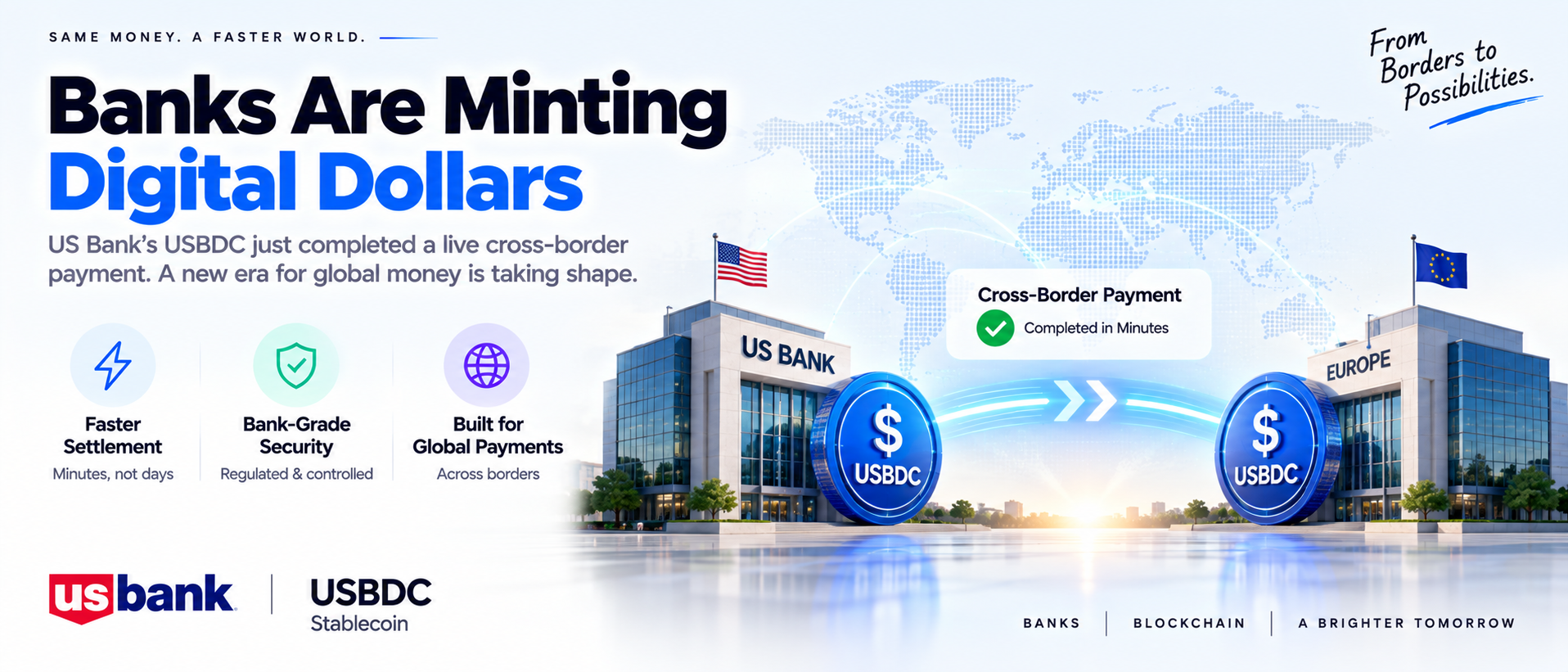
US Bank just settled a live cross-border payment in its own stablecoin, USBDC. Here's what that — and Circle's $400M Tazapay deal — actually mean.
US Bank stablecoin, cross-border settlement, Circle Tazapay acquisition, USDC payments, Stellar blockchain bank, tokenized settlement, correspondent banking
Banks Are Minting Digital Dollars. Is the Wire Transfer Era Ending?
Sending a message to London is effectively instantaneous. Moving money across borders is still constrained by correspondent banking, cut-off times, compliance checks, and settlement windows. This week, one of America's largest banks tested something meant to close that gap — not by using someone else's stablecoin, but by minting its own.
U.S. Bank, one of America's largest banks, announced on September 9 that it had completed a live pilot transaction using USBDC, its proprietary U.S. dollar-backed stablecoin, to move funds between its own North American and European entities. It's an important distinction: this was an internal treasury pilot between the bank's own entities, not yet a client-facing product moving third-party corporate or freelancer payments. U.S. Bank
The transaction ran on Stellar, a public blockchain, rather than a private bank-only ledger. The bank has reportedly been testing custom stablecoin issuance on Stellar since at least November 2025, working alongside PwC and the Stellar Development Foundation. Cointelegraph
The pilot also tested the specific controls a regulated bank needs before it can responsibly issue a digital dollar: minting, payment redemption, freezing, and clawback — the ability to reverse or seize a transaction, which is precisely the kind of institutional control that separates a bank-issued stablecoin from a permissionless crypto token. "This pilot is another step forward in our broader digital asset strategy," said Jamie Walker, U.S. Bank's head of Digital Assets and Money Movement, adding the focus remains on "delivering solutions that solve real client challenges" without compromising the safety clients expect. PYMNTS
This Isn't a One-Bank Story
U.S. Bank isn't moving alone. On September 1, 21 major financial institutions — including Bank of America, Citi, Goldman Sachs, Deutsche Bank, and UBS — announced plans to jointly form a company to issue their own dollar-denominated stablecoin, targeting a first-half-2027 launch before expanding into other G7 currencies aimed at wholesale and institutional settlement. Yahoo Finance
USBDC is currently being developed for institutional use, including cross-border treasury operations, liquidity management and collateral mobility, rather than public crypto-market trading. Unlike retail-facing tokens such as USDT or USDC, it is designed for regulated institutional payment and settlement use cases. U.S. Bancorp
It's also not just a stablecoin story. Four days before U.S. Bank's pilot, on September 5, DBS and Citi completed what they called the first-ever weekend cross-border USD payment between Singapore and the United States — settling in minutes instead of the usual two business days — using tokenized deposits rather than a stablecoin, routed through Swift's Digital Ledger. It was the second live transaction on that network since its July rollout across 17 banks spanning six continents, including HSBC, UBS, and BNP Paribas. The Block
Tokenized deposits work differently from a stablecoin like USBDC — the money never leaves each bank's own balance sheet or existing deposit rules, and Swift's ledger simply orchestrates and validates the transfer between the banks' separate systems. But the outcome consumers and treasurers actually feel is the same: money that used to sit frozen over a weekend now moves in minutes. Fintech News Singapore
Circle Is Making the Opposite Bet, at the Same Moment
While banks build their own stablecoins to move money between themselves, Circle — issuer of the far larger, publicly traded USDC — is making a different bet: buying its way into the local payout rails that would let USDC actually reach ordinary businesses in emerging markets. On September 8, Circle signed a definitive agreement to acquire Singapore-based cross-border payments firm Tazapay for $400 million in an all-stock deal, its largest acquisition since it bought crypto exchange Poloniex in 2018. CoinDesk
Tazapay isn't a stablecoin company itself — it's B2B payments infrastructure connecting more than 60 banking and fintech partners across over 100 markets, processing over $25 billion a year, roughly 60% of which already settles in stablecoins. That existing usage is exactly why Circle wants it: rather than convincing new merchants to accept USDC, Circle is buying rails where the behavioral shift toward stablecoin settlement has already happened. Payments Dive
The deal is signed, not closed. It still needs regulatory clearance, including from the Monetary Authority of Singapore, and Circle itself says it doesn't expect to close until sometime in 2027 — meaning the "USDC directly into local Asian banking rails" story is a real, funded bet, not yet a live integration. CoinMarketCap
Two Different Bets on the Same Problem
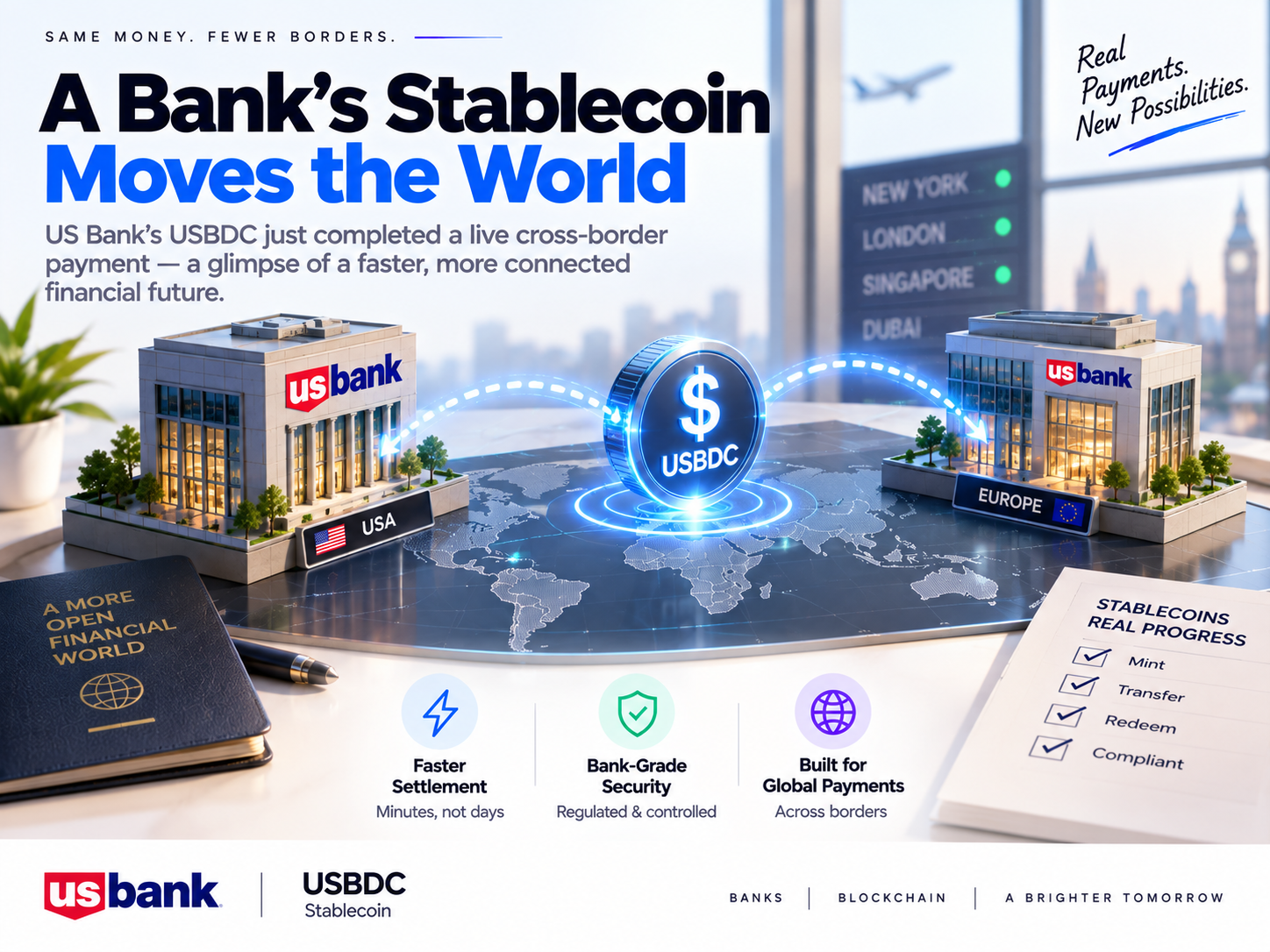
Both moves are aimed at the same target — the slow, expensive correspondent-banking system that still underlies most cross-border payments — but from opposite directions. U.S. Bank is testing whether a bank can issue and fully control its own dollar token without ceding settlement to an outside crypto company. Circle is proving the fastest path to USDC's global reach isn't building new rails from scratch, but buying the local infrastructure that already exists and already trusts stablecoins.
Neither is finished. U.S. Bank's pilot moved funds between its own entities, not yet a client's invoice or a freelancer's payout. Circle's acquisition won't close for roughly another year. But both point in the same direction: the institutions that actually control cross-border money movement no longer see stablecoins as something to resist — they see them as infrastructure worth owning outright.
FAQ
Is USBDC available to the public or to bank clients yet?
No. U.S. Bank's September 9 announcement describes a live pilot transaction moving funds between the bank's own North American and European entities — not a client-facing product. USBDC is currently being developed for institutional use, including cross-border treasury operations and liquidity management, rather than public crypto-market trading.
What blockchain does USBDC run on?
The pilot ran on Stellar, a public blockchain, rather than a private bank-only ledger — a notable choice for an institutional stablecoin pilot.
Has Circle's acquisition of Tazapay closed?
No. Circle signed a definitive agreement on September 8, 2026, in an all-stock deal valued at $400 million, but the deal still needs regulatory approval, including from Singapore's Monetary Authority, and isn't expected to close until 2027.
Why does Circle want Tazapay specifically?
Tazapay already processes more than $25 billion a year across 100+ markets, with about 60% of that volume already settling in stablecoins — giving Circle existing, proven local payout infrastructure rather than having to build stablecoin adoption from zero.

Tushar Shrivas
B.Tech CS@ Shri Balaji Institute of Technology & Management
I write at Metaplugs — breaking down the latest in tech, economics, and business into simple, impactful stories for everyday readers. Passionate about software testing and global finance.