Back to News
News AlertWorld Money
Why You'll Never Click 'Pay Now' Again: Agentic Commerce
T
Author
Tushar Shrivas
Published
September 9, 2026
Reading Time
6 MIN READ
Spread the Word
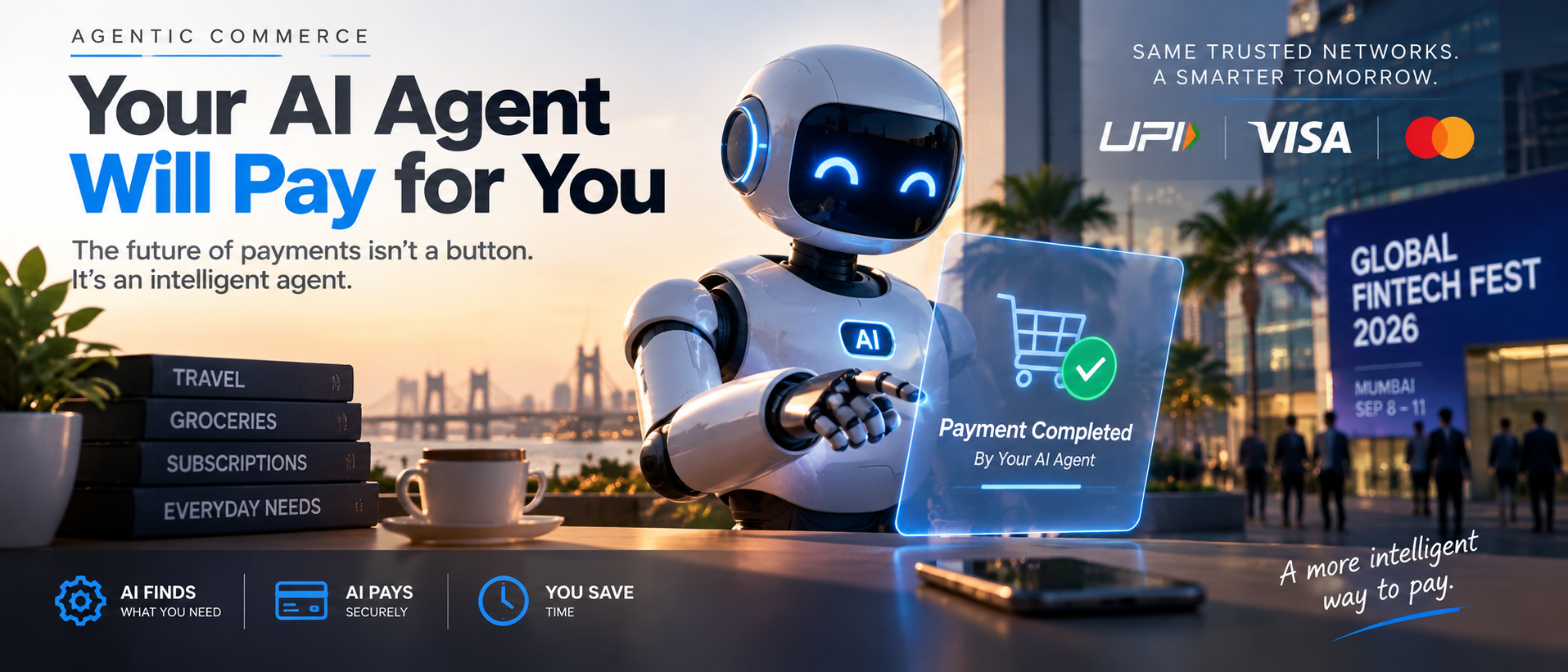
Banks are rebuilding UPI, Visa, and Mastercard to let AI agents pay on your behalf. Here's how the machine-to-machine money economy works.
Agentic commerce, AI agent payments, UPI agentic payments, Mastercard Agent Pay, Visa Intelligent Commerce, machine-to-machine payments, NPCI Unified Agent Protocol.
Agentic commerce, AI agent payments, UPI agentic payments, Mastercard Agent Pay, Visa Intelligent Commerce, machine-to-machine payments, NPCI Unified Agent Protocol.
Why You'll Never Click 'Pay Now' Again: The Machine-to-Machine Money Economy
Nearly half of U.S. shoppers — 47%, according to new Visa research — already use AI for at least one part of their shopping journey, from comparing prices to getting recommendations. Visa expects millions of consumers to let an AI agent actually complete a purchase by this year's holiday season. The checkout button isn't gone yet. But the industry building the rails underneath it is already planning for a world where you never touch it. VisaNewsroom
The shift has a name — agentic commerce — and it's the dominant theme at this year's Global Fintech Fest in Mumbai (September 8–11), where the official 2026 program is built around three foundational technologies: Agentic AI, tokenization, and quantum security. The organizers describe agentic systems as ones that can "sense, decide, and act in real time" inside a financial workflow, not just answer questions about one. Globalfintech
What "Agentic" Actually Means for Your Money
This isn't about a chatbot that finds you a coupon code. Visa's Intelligent Commerce and Mastercard's Agent Pay — both launched within a day of each other in April 2025 — are built to let a verified AI agent hold a scoped, tokenized version of your card, spend against a merchant category you've pre-approved, and complete checkout without you re-entering a CVV. Visa has already named Anthropic, OpenAI, Microsoft, and Perplexity as launch partners so a major AI assistant can trigger a Visa-tokenized payment through one standard integration. Eco
Mastercard has taken the concept further with Agent Pay for Machines, designed for payments between AI agents themselves — including microtransactions worth fractions of a cent, settled at machine speed, for things like metered API usage between one agent's service and another's. Mastercard
India Is Building the Most Ambitious Version of This
While Visa and Mastercard are layering agent trust onto existing card rails, India is doing something structurally different: making its national payment rail agent-native from the ground up. Reuters reported on September 1 that the National Payments Corporation of India (NPCI) is building a Unified Agent Protocol (UAP) that would let AI agents execute UPI payments without a human approving each one — running on a network that processed 24.51 billion transactions worth ₹29.82 trillion in August 2026 alone. Business Recorder
The protocol doesn't start from zero. It extends two mechanisms NPCI already runs: UPI Circle, which lets an account holder delegate payment authority to a secondary user (currently capped around ₹15,000 a month), and Reserve Pay, which lets a customer pre-block funds for future debits to a specific merchant (capped near ₹10,000 for up to 90 days). Under UAP, an AI agent would sit in that delegated slot instead of a person — spending against a limit you set once, rather than a button you tap every time. Those caps could reportedly be revisited specifically for agentic use, and the framework still needs RBI sign-off before launch. Startup Fortune
This isn't purely theoretical, either. Domestic fintech Pine Labs has already launched P3P, described as India's first agentic payment protocol built on UPI and live in production, while Mastercard completed what it called India's first authenticated agentic transaction in New Delhi in June 2026 with Axis Bank and RBL Bank as partner banks. Forkast

The Part Nobody Has Fully Solved Yet
The technology to let an AI initiate a payment already exists. The harder question — one every protocol in this space is still wrestling with — is liability: who's on the hook when an agent, tricked by a malicious prompt or a manipulated listing, pays for something you never intended to buy. NPCI's plan leans on spending caps, identity checks, and audit trails to contain the blast radius, but the actual liability split for a fooled agent is still being worked out. IBTimes
That's also why the first real-world use cases being tested are deliberately unglamorous: groceries, cab bookings, subscription renewals — repeat purchases with predictable price bands, not one-off big-ticket buys. It's a sensible place to start. Nobody wants their agent's first mistake to be a ₹40,000 flight booking gone wrong.
Why This Matters More in India Than Almost Anywhere Else
Most of the card-network story is happening on rails that already required a card and a checkout page. UPI doesn't have that constraint — it's a public rail that already reaches hundreds of millions of people, many of whom never had a "Pay Now" button experience built around a credit card in the first place. If NPCI's agent layer works, India doesn't just get a faster checkout. It gets one of the largest live experiments anywhere in what happens when the default way people pay for things stops being an action a human takes at all.
The button isn't dead yet. But the institutions building the plumbing underneath it are the ones telling you, plainly, that they don't expect you to need it much longer.
FAQ
Is agentic AI payment technology actually live anywhere yet, or is this still theoretical?
It's live in limited pilots. Mastercard completed an authenticated agentic transaction in Hong Kong (a ride-share booking via HSBC) and in New Delhi with Axis Bank and RBL Bank. Pine Labs' P3P protocol is already in production on UPI in India.
What stops an AI agent from overspending or getting scammed?
Current frameworks rely on scoped, tokenized credentials tied to a specific agent, merchant category, and consent policy, plus spending caps and audit trails. Liability rules for when an agent is deceived into an unwanted purchase are still being finalized industry-wide.
Does this replace UPI, Visa, or Mastercard — or work with them?
It works with them. Visa and Mastercard are extending their existing card networks with agent-aware layers (Intelligent Commerce and Agent Pay). NPCI's Unified Agent Protocol extends UPI's own existing delegation tools (UPI Circle, Reserve Pay) rather than replacing the rail itself.
When will this reach ordinary consumers at scale?
Visa expects millions of AI-agent-completed purchases by the 2026 holiday season in the U.S. In India, NPCI's Unified Agent Protocol still needs RBI approval, with the first live pilots expected to be showcased around the Global Fintech Fest (September 8–11, 2026).

Tushar Shrivas
B.Tech CS@ Shri Balaji Institute of Technology & Management
I write at Metaplugs — breaking down the latest in tech, economics, and business into simple, impactful stories for everyday readers. Passionate about software testing and global finance.