Back to News
News AlertWorld Money
China Is Injecting $54 Billion Into Its Financial System. What Is Beijing Really Trying to Fix?
T
Author
Tushar Shrivas
Published
September 7, 2026
Reading Time
6 MIN READ
Spread the Word
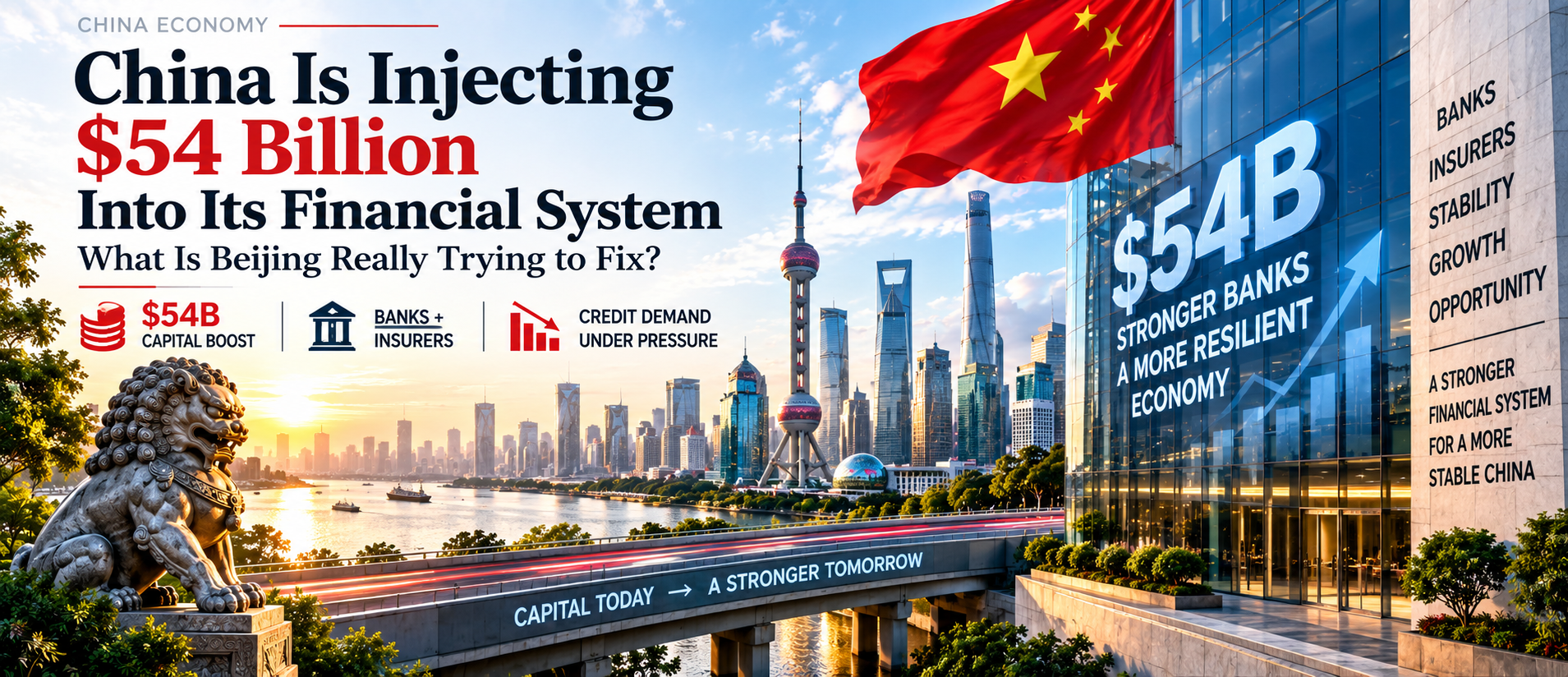
China is making a major push to strengthen its financial system, but the bigger question is whether stronger banks can solve a deeper problem: weak demand for credit.
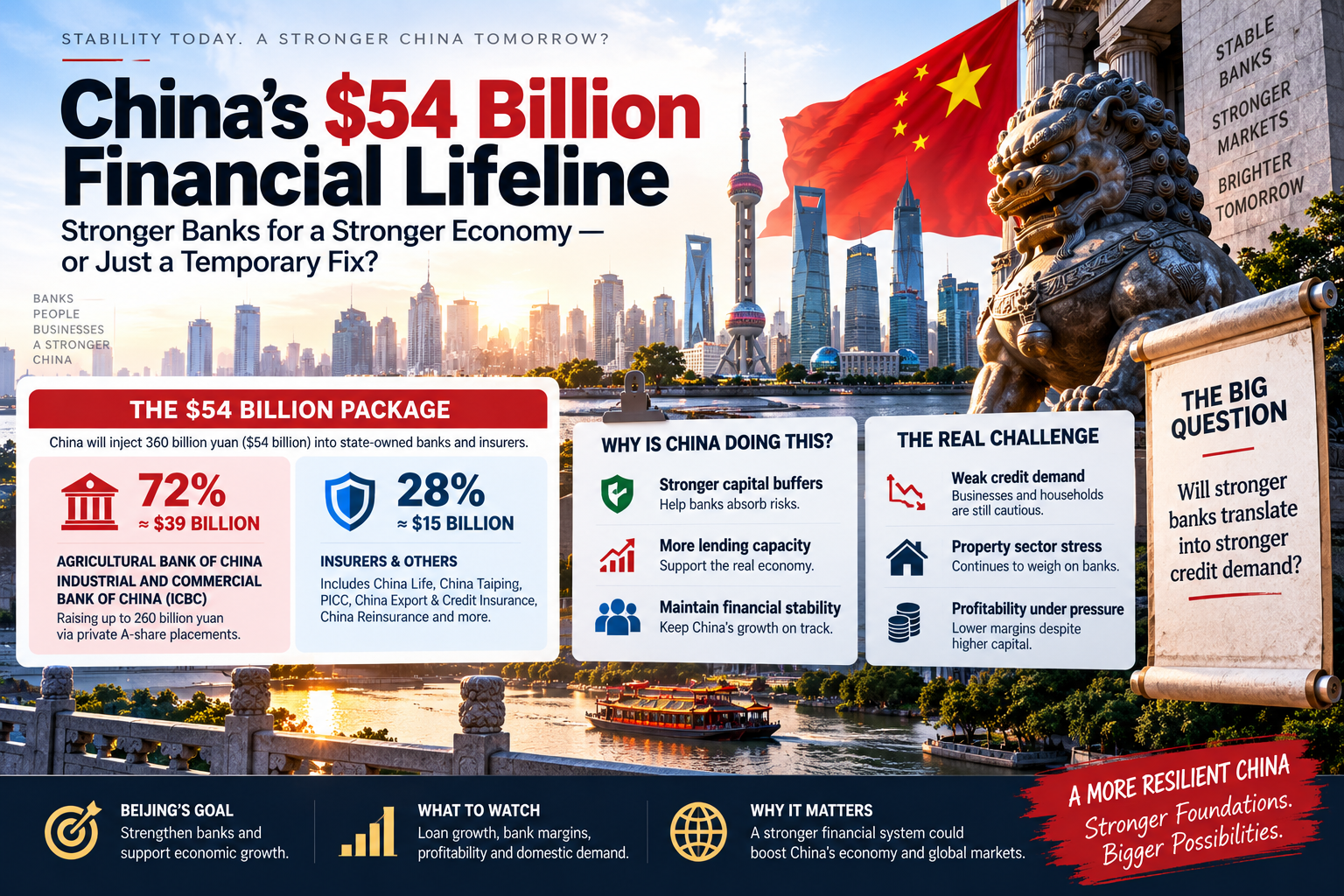
China's Finance Ministry announced Sunday it will lead a combined $54 billion (roughly 360 billion yuan) capital injection into state-owned banks and insurers. China Life Insurance Group will receive 35 billion yuan ($5.2 billion), while China Taiping Insurance Group will receive 7 billion yuan. Several smaller institutions — including the People's Insurance Company of China (up to 15 billion yuan), China Export & Credit Insurance Corp (10 billion yuan), China Reinsurance (3 billion yuan), and the Export-Import Bank of China (30 billion yuan) — round out the rest of the package.
The single largest piece, though, belongs to two banks: Agricultural Bank of China and Industrial and Commercial Bank of China (ICBC) plan to raise up to 260 billion yuan (~$39 billion) through private A-share placements — accounting for roughly 72% of the entire $54 billion package. The Ministry of Finance itself is subscribing for 130 billion yuan of AgBank's placement and 70 billion yuan of ICBC's, with the rest coming from state-linked entities like China National Tobacco. Both banks say every yuan raised will go straight into core Tier 1 capital.
Why China Is Strengthening Its Banks
The immediate objective is straightforward: stronger capital buffers give banks greater capacity to absorb losses and continue lending.
But China's financial system is facing a more complicated environment. The IMF's 2025 Article IV Consultation found that Chinese banks' profitability remains under pressure, with net interest margins and returns on assets continuing to weaken even as funding costs declined. Facing weak credit demand and low profitability, the IMF noted, financial institutions have increasingly shifted toward fixed-income investments instead of expanding traditional lending — with some leveraged trades now drawing supervisory scrutiny.
That distinction matters. A bank can have more capital and still struggle to generate strong returns if businesses and households are reluctant to borrow. The IMF has flagged weak private domestic demand as a broader structural challenge for China's economy, alongside property-sector weakness and high debt levels — with GDP growth projected to slow to 4.5% in 2026.
The $54 Billion Question: Capital or Credit?
This is where Beijing's latest move becomes more interesting.
The recapitalization can make banks more resilient and give them more room to support lending. But capital itself does not create borrowers. If companies don't see enough demand for their products, they may not want to take on additional debt. Likewise, households may remain cautious about borrowing while the property market and consumer confidence stay under pressure.
That means China's problem isn't simply a shortage of banking capital — it's also a demand problem inside the economy. So the real test isn't whether Beijing can strengthen its banks. It's whether that stronger capital base eventually produces stronger credit growth and economic activity.
Beijing Is Using Banks as a Growth Tool
China's largest state-owned banks are more than commercial lenders — they're also important channels through which Beijing supports strategic industries, infrastructure, and broader economic activity.
The latest capital-raising plans reflect that role. AgBank and ICBC said their new capital would be used entirely to replenish core Tier 1 capital, helping sustain credit expansion as Beijing continues to rely on state banks to support growth. That could give policymakers more room to support the economy without relying entirely on direct fiscal spending. But there's a limit: if businesses and households remain unwilling to borrow, additional banking capacity may not translate into a proportional increase in economic activity.
This isn't a one-off either — it builds on a 2024 regulatory directive instructing China's six largest commercial banks to reinforce capital buffers on a phased basis, and follows an earlier round in early 2025 when four other lenders, including Bank of China and Postal Savings Bank of China, received a combined $69 billion backed by sovereign notes.
The Bigger Risk Is Profitability
For investors, the next question is whether Chinese banks can earn acceptable returns on the additional capital.
Higher capital buffers improve financial stability, but weak lending demand can keep margins and profitability under pressure. The IMF also points to vulnerabilities connected to China's property sector and local-government financing vehicles, even while aggregate banking capital remains relatively strong. In other words, Beijing is buying financial resilience — but the recapitalization doesn't automatically remove the economic pressures weighing on banks.
What It Means for Global Investors
The $54 billion move matters beyond China's banking sector.
If stronger banks lead to higher credit growth, stronger corporate activity, and recovering domestic demand, the policy could support China's broader economy — eventually influencing Chinese equities, the yuan, commodities, and multinational companies exposed to Chinese demand. But if credit demand remains weak, investors may read the move differently: Beijing may still need to use the financial system aggressively, again and again, just to keep growth on track.
That's why investors should look beyond the headline number. The key indicators will be loan growth, bank margins, profitability, and domestic demand.
China has strengthened the financial system. The harder task is making the economy use it.
FAQ
Why is China injecting $54 billion into its financial system?
China is using the capital injections to strengthen state-owned banks and insurers, improve financial resilience, and give major institutions greater capacity to support economic activity.
Which Chinese banks are raising capital, and how much?
Agricultural Bank of China (up to 160 billion yuan) and Industrial and Commercial Bank of China (up to 100 billion yuan) together account for 260 billion yuan — about 72% of the entire $54 billion package — through private A-share placements to replenish core Tier 1 capital.
Is China's banking system in crisis?
Not necessarily. The IMF says aggregate capital remains relatively strong, but profitability, weak credit demand, property-sector risks, and local-government debt vulnerabilities remain important concerns.
Sources
Nikkei Asia / Reuters — China to pump $54bn into state banks, insurers in capital-boosting push, September 6, 2026
Xinhua — Major Chinese banks plan A-share placements to boost core capital, September 6, 2026
Bloomberg — AgBank, ICBC Plan Private Placements of Up to $38.7 Billion
South China Morning Post — China rolls out massive US$54b package for insurers, banks in financial powerhouse push
IMF — People's Republic of China: 2025 Article IV Consultation, Staff Report, February 2026

Tushar Shrivas
B.Tech CS@ Shri Balaji Institute of Technology & Management
I write at Metaplugs — breaking down the latest in tech, economics, and business into simple, impactful stories for everyday readers. Passionate about software testing and global finance.