Back to News
News AlertWorld Money
BRICS vs. the Dollar: Could a New Global Currency Really Challenge the U.S. Dollar?
T
Author
Tushar Shrivas
Published
September 2, 2026
Reading Time
6 MIN READ
Spread the Word
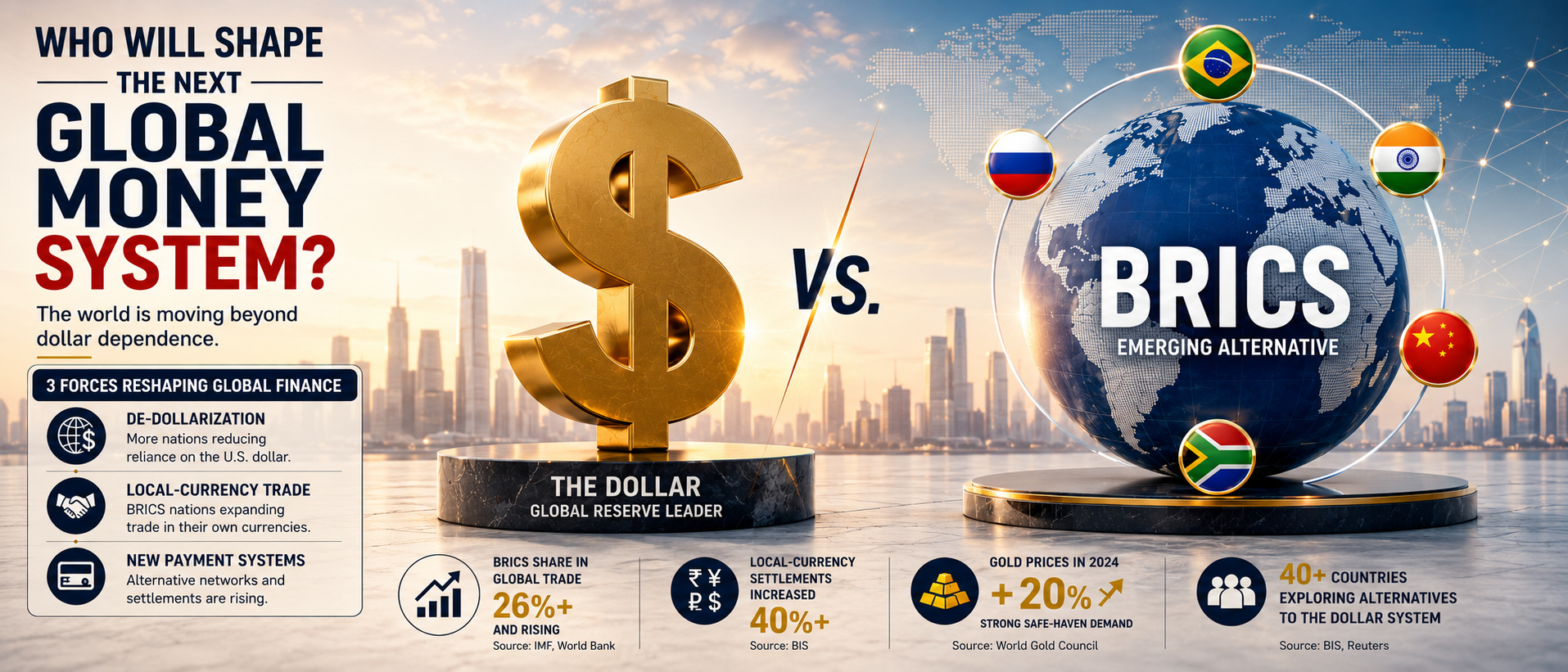
For decades, the U.S. dollar has been at the center of the global financial system. It dominates foreign-exchange markets, remains the world's leading reserve currency, and plays a major role in international trade.
In the first quarter of 2026, the dollar accounted for 57.13% of global foreign-exchange reserves, according to the International Monetary Fund (IMF). In 2025, the dollar was involved in 89.2% of global foreign-exchange transactions, according to the Bank for International Settlements (BIS).
But the rise of BRICS is raising a new question:
Could BRICS create a serious alternative to the U.S. dollar and accelerate global de-dollarization?
Could BRICS create a serious alternative to the U.S. dollar and accelerate global de-dollarization?
The answer may not depend on creating a single BRICS currency.
BRICS Is Not Simply Building a New Currency
The idea of a BRICS currency has attracted enormous attention, but the reality is more complicated.
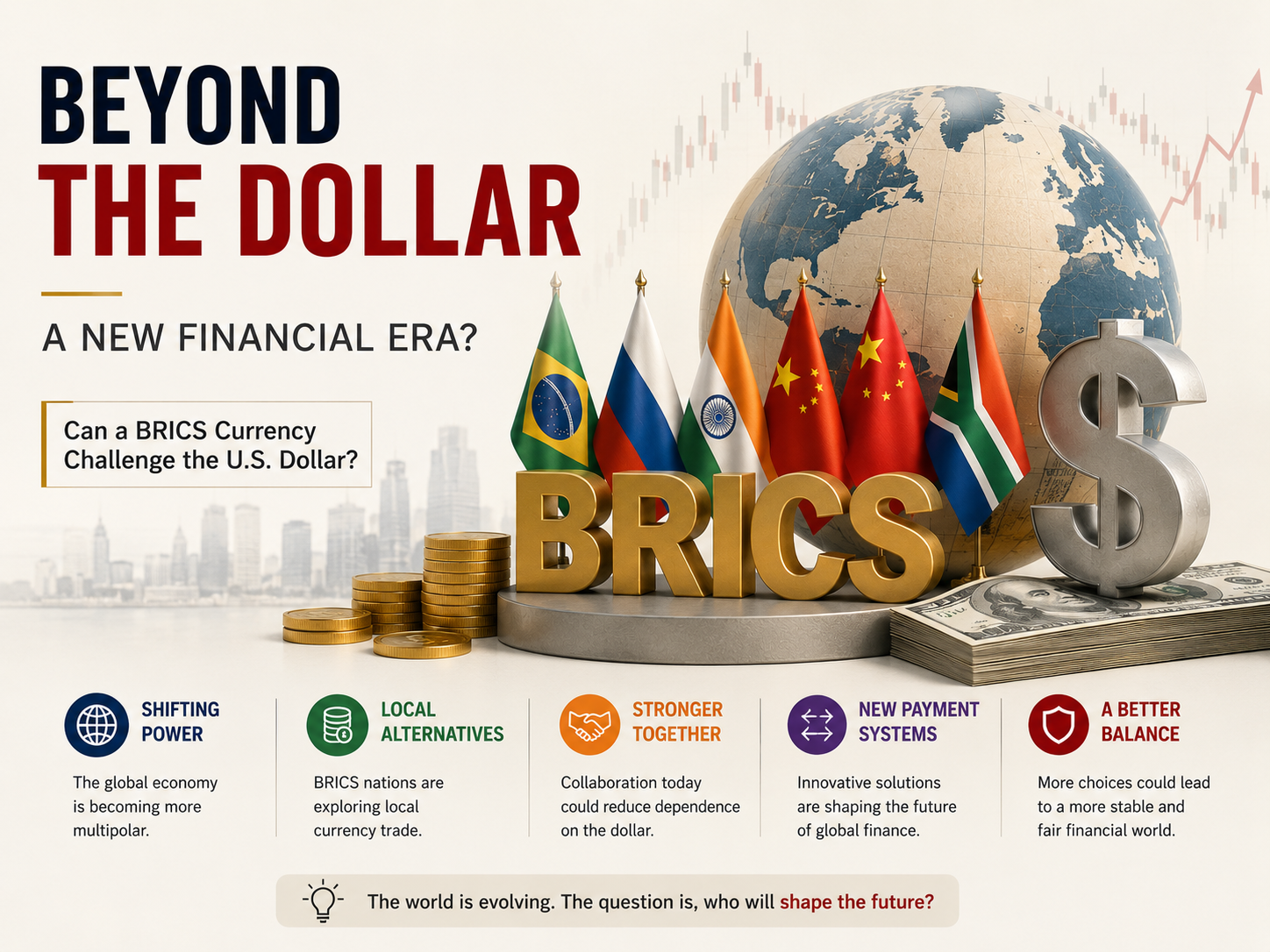
BRICS has not announced a single currency designed to replace the U.S. dollar. Instead, its official discussions have focused on greater use of local currencies, cross-border payments and financial infrastructure that could give member countries more alternatives.
The 2025 BRICS Rio Declaration supported continued work on the BRICS Cross-Border Payments Initiative and greater interoperability between members' payment systems. It also highlighted financing mechanisms using local currencies.
This distinction matters.
Replacing the dollar would require building an entirely new global financial system. Reducing dependence on the dollar only requires creating practical alternatives.
The second path is much more realistic.
The Real Battle: Cross-Border Payments
The most important part of the BRICS strategy may not be a new currency at all.
It could be payment infrastructure.
BRICS discussions have increasingly focused on improving cross-border payment connectivity and encouraging the use of local currencies. India, for example, has been pushing greater international use of the rupee while exploring stronger connections between payment systems.
In August 2026, RBI Governor Sanjay Malhotra said BRICS countries were discussing possible links between fast-payment systems and central-bank digital currencies.
Why does this matter?
Because a currency becomes more useful when businesses can easily pay, receive, convert and settle transactions with it.
If companies can trade directly using local currencies instead of converting through the dollar every time, the dollar's role as an intermediary could gradually decline.
That would not mean the dollar is collapsing. It would mean the global economy has more alternatives.
China and the Chinese Yuan
Among BRICS currencies, China's Chinese yuan has the strongest potential to gain greater international influence.
China is one of the world's largest trading economies, and the Chinese yuan's role in global foreign-exchange markets has been increasing.
According to the BIS, the Chinese yuan was involved in 8.5% of global FX transactions in 2025, compared with 7% in 2022.
However, there is a major gap between trading activity and reserve-currency status.
The Chinese yuan represented only 1.99% of global foreign-exchange reserves in Q1 2026, compared with 57.13% for the U.S. dollar.
Economic size alone does not make a currency a global reserve currency.
Investors and central banks also need deep financial markets, liquidity, stability and confidence in the financial system behind the currency.
India's Role in De-Dollarization
India's strategy is different. India does not necessarily need the Indian rupee to replace the dollar.
A more realistic goal is to make the rupee more useful in international trade.
If Indian companies can settle more imports and exports directly in rupees or partner currencies, they may become less dependent on the dollar as an intermediary.
That could increase India's financial flexibility while strengthening the international role of the rupee.
It also shows why BRICS does not necessarily need one common currency.
Different BRICS countries can use different currencies while pursuing the same broader goal: reducing unnecessary dependence on the dollar.
Why a BRICS Currency Would Be Difficult
The Dollar's Real Challenge
The Bottom Line
A single BRICS currency replacing the U.S. dollar is unlikely in the near future.
But that does not mean the global monetary system is standing still.
BRICS is working toward a system where countries have more choices in how they trade, settle payments and move money across borders. Its official agenda increasingly emphasizes local-currency financing and cross-border payment interoperability rather than creating one common currency.
And that may be the bigger story.
The future of global money may not be about one currency defeating another.
It may be about the world moving from a system dominated by one currency toward a more multipolar financial system.
The dollar may remain the dominant currency in global finance.
But if BRICS succeeds in making alternative currencies and payment systems easier, cheaper and more accessible, countries may gradually need the dollar less.
The dollar doesn't have to lose its crown for the world to stop depending on it as much.
FAQ
Is BRICS creating a new currency to replace the dollar?
No. BRICS is currently focusing more on local-currency trade, cross-border payments and financial-system interoperability than on creating one common currency.
Can BRICS challenge the U.S. dollar?
Yes, but gradually. The more realistic challenge is the growth of alternative currencies and payment systems rather than an immediate replacement of the dollar.
Will a BRICS currency replace the dollar?
A sudden replacement is unlikely. The more realistic outcome is a multipolar global financial system in which the dollar remains dominant while other currencies gain greater importance.
Sources
Sources
International Monetary Fund (IMF) — Currency Composition of Official Foreign Exchange Reserves (COFER), Q1 2026
Used for the dollar's 57.13% share and the Chinese yuan's 1.99% share of global official reserves.
Bank for International Settlements (BIS) — 2025 Triennial Central Bank Survey: Foreign Exchange Turnover
Used for the dollar's 89.2% share and the Chinese yuan's 8.5% share of global FX transactions.
BRICS Brazil — 2025 Rio de Janeiro Leaders' Declaration
Used for BRICS initiatives involving local currencies, cross-border payments and payment-system interoperability.
Bank for International Settlements (BIS) — Research on Chinese yuan internationalization.
Reuters — Reporting on BRICS discussions around cross-border payments and CBDCs, August 2026.

Tushar Shrivas
B.Tech CS@ Shri Balaji Institute of Technology & Management
I write at Metaplugs — breaking down the latest in tech, economics, and business into simple, impactful stories for everyday readers. Passionate about software testing and global finance.