Back to News
News AlertWorld Money
Why Your Next Credit Card Lights Up When You Tap to Pay
T
Author
Tushar Shrivas
Published
September 13, 2026
Reading Time
5 MIN READ
Spread the Word
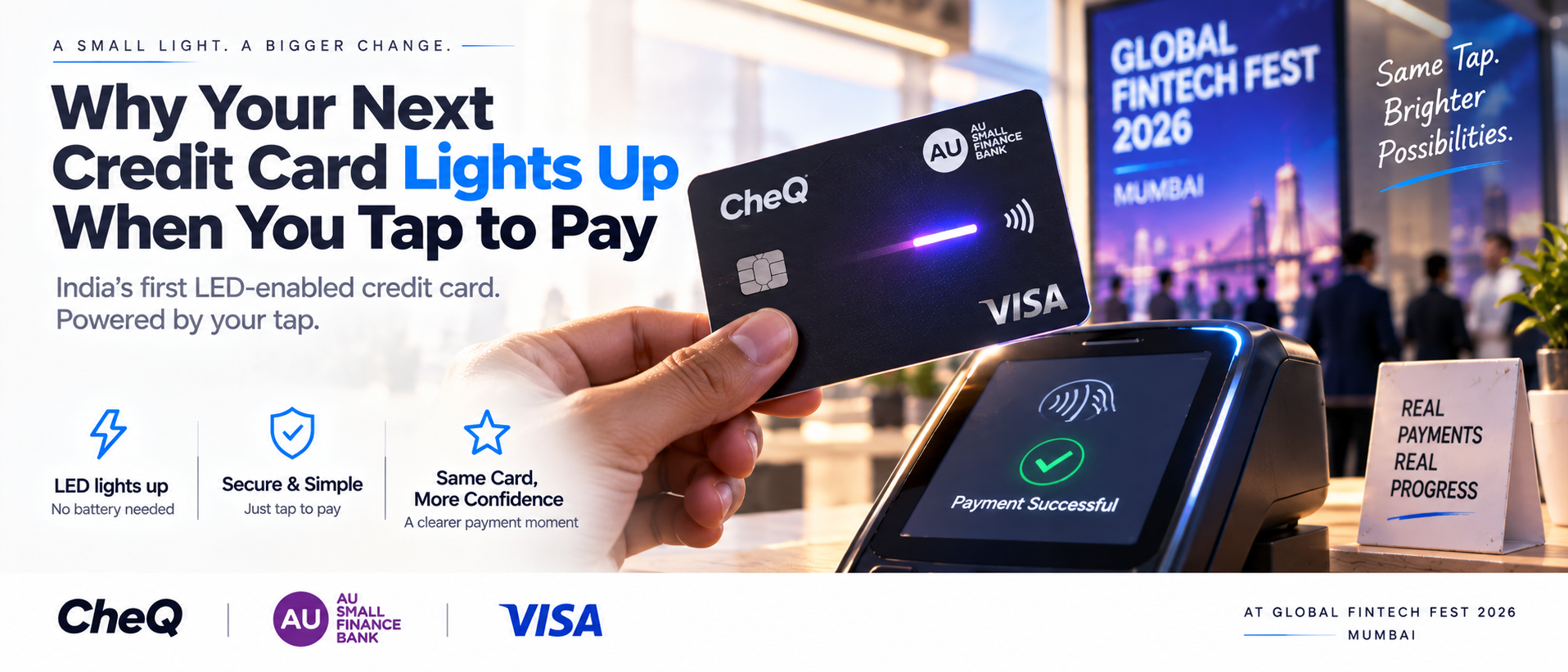
India's first LED-enabled credit card lights up using power drawn from the POS terminal itself — no battery.
CheQ AU Credit Card, AU Small Finance Bank Visa, contactless payment hardware, NFC-powered LED, Global Fintech Fest 2026, tap-to-pay India.
Why Your Next Credit Card Lights Up When You Spend: Inside the Tap-and-Pay Hardware War
Most people assume the future of money is completely invisible — software, tokens, an app on a phone. At Global Fintech Fest 2026, one product argued the opposite: that hardware still has a card left to play, literally.
Visa, AU Small Finance Bank, and CheQ used the Mumbai stage to showcase the CheQ AU Credit Card — described as India's first LED-enabled credit card — to a wider fintech audience. It's not a brand-new product, though: CheQ and AU SFB actually launched it back in April 2026, with applications opening on the CheQ app from April 28. What GFF 2026 marked was the card getting a bigger, more formal industry unveiling alongside Visa, several months into its real-world rollout. Retail Intel
How the LED Actually Works
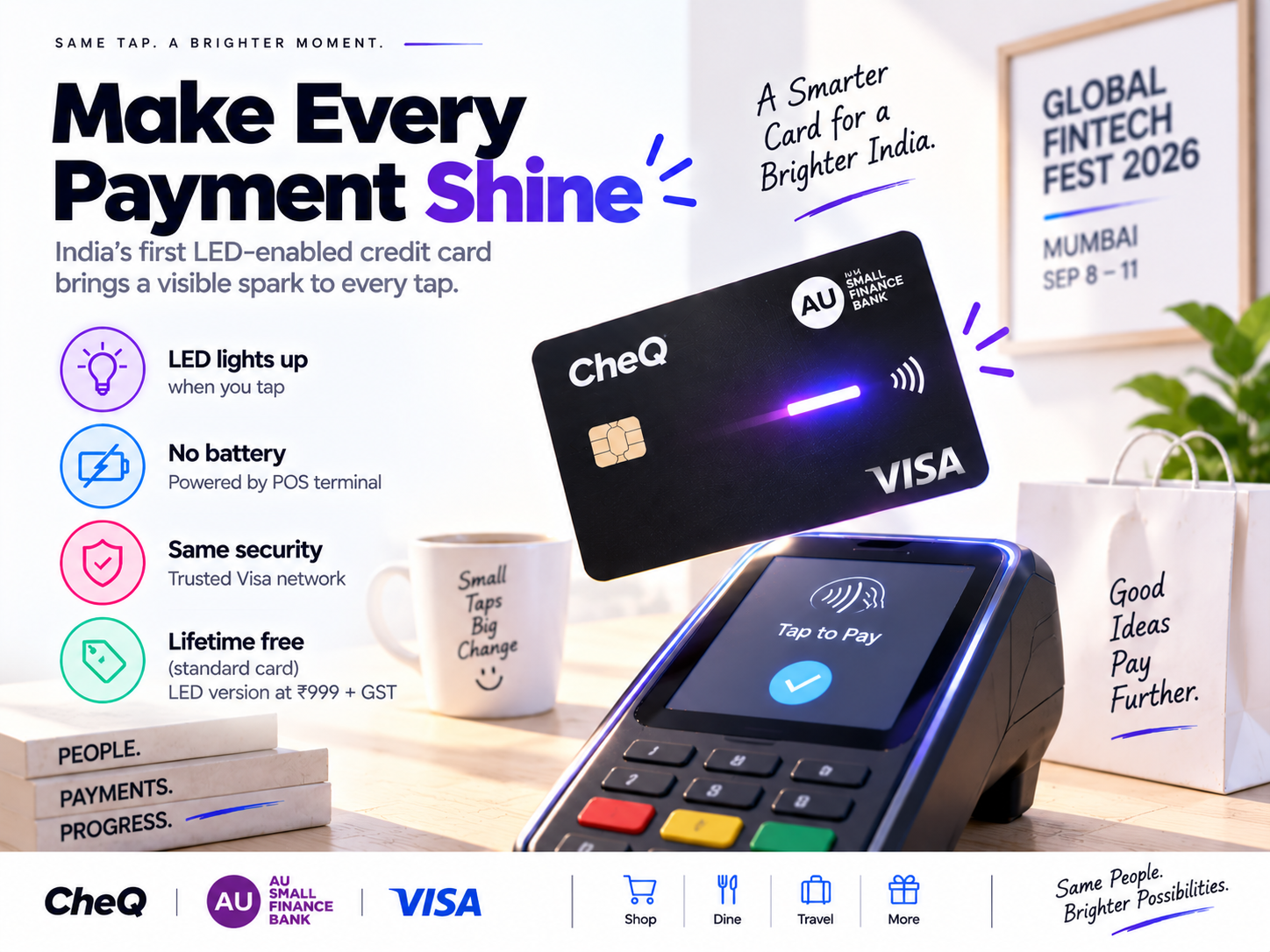
The mechanism is the interesting part. The card's embedded LED lights up during a tap-to-pay transaction, but it doesn't run on a battery — it draws power directly from the NFC field generated by the POS terminal itself during the contactless handshake, the same passive-induction principle used in some NFC tags and access cards. The light is essentially a byproduct of the transaction's own electromagnetic exchange, not a separate powered component. Elets BFSI
That design choice is also reflected in the pricing: the standard CheQ AU Credit Card is marketed as lifetime free — no joining fee, no annual fee — while the LED version carries a one-time ₹999 + GST fee, according to AU Bank's current product page. The card runs on a dual-network setup: every applicant gets both an LED-enabled Visa card and a standard RuPay card with a single application.
AU Small Finance Bank
AU Small Finance Bank
Why a Light Is Actually Solving a Real Problem
The pitch isn't just novelty, either. As contactless payments have scaled, checkout confirmation has increasingly depended on the terminal's own screen or a phone's buzz — easy to miss in a crowded checkout line, or when a tap is slow to register. A card with no feedback of its own leaves that entire confirmation moment to the terminal. The LED gives the card a role in that moment too — a visible, physical cue tied directly to the transaction. Whether it meaningfully reduces failed-tap confusion in practice isn't something the issuers have published data on yet; for now it's a plausible rationale for the feature, not a proven outcome.
CheQ's own framing supports this: founder and CEO Aditya Soni described the LED as "a small but deliberate shift to make the experience more visible and intuitive", built on top of a product informed by data from more than 15 million credit cards and 4 million users on CheQ's existing bill-payment platform. IBS Intelligence
The Bigger Bet
This is a small, deliberately unglamorous piece of hardware — a light, not a chip redesign or a biometric sensor. But it's a useful signal about where card issuers think the next round of differentiation actually lives. Software-based payment experiences (UPI, tokenized wallets, agentic checkout) are getting all the attention right now, and rightly so. But for the physical card itself, which still has to survive in a wallet next to five other look-alike cards, a tap that visibly confirms itself might matter more to daily habit-forming than another rewards tier ever could.
Whether the LED becomes a standard feature or a one-off gimmick will depend on something far less flashy than the light itself: whether it measurably reduces failed-tap complaints and repeat-tap friction at the point of sale. That data isn't public yet. But the fact that Visa, a bank, and a fintech all thought it was worth building — and worth re-announcing on a bigger stage five months later — suggests they think the answer will be yes.
FAQ
Is this really India's first LED-enabled credit card?
Yes, per the issuers — the CheQ AU Credit Card, launched by CheQ and AU Small Finance Bank in partnership with Visa, is described as India's first LED-enabled credit card.
Does the LED need a battery?
No. The LED draws power passively from the NFC field generated by the POS terminal during a contactless tap, the same way some NFC tags work without their own power source.
How much does the LED version cost?
The standard card is marketed as lifetime free — no joining fee, no annual fee. The LED version carries a one-time ₹999 + GST fee, according to AU Bank's current product page.
Was this actually launched at Global Fintech Fest 2026?
Not originally — CheQ and AU SFB launched the card in April 2026, with applications opening April 28. GFF 2026 was where Visa, AU SFB, and CheQ gave it a bigger, more formal industry showcase several months into its rollout.

Tushar Shrivas
B.Tech CS@ Shri Balaji Institute of Technology & Management
I write at Metaplugs — breaking down the latest in tech, economics, and business into simple, impactful stories for everyday readers. Passionate about software testing and global finance.