Back to News
News AlertWorld of Startup’s
BioStack Raises $9.5M to Build Medical AI Data Infrastructure
V
Author
Vicky Galfat
Published
November 1, 2026
Reading Time
10 MIN READ
Spread the Word
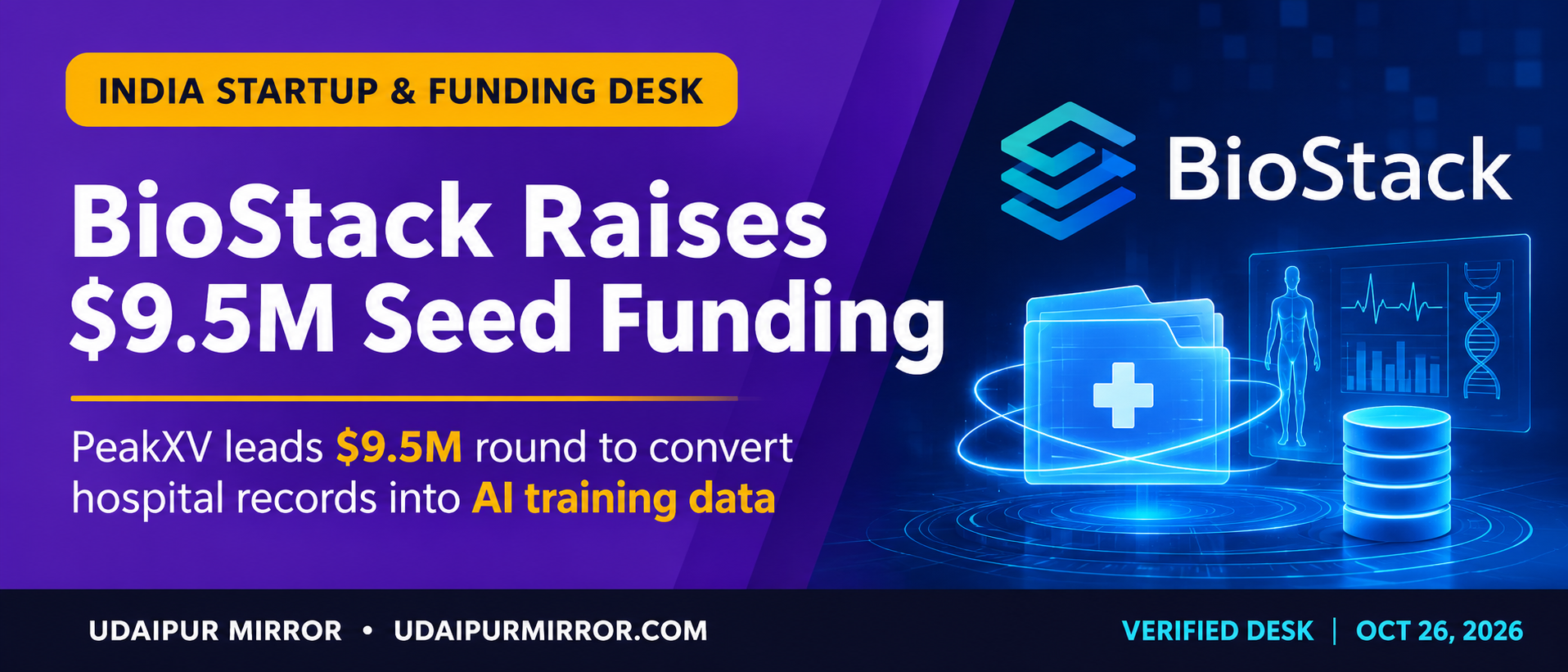
BioStack raises $9.5M in seed funding led by Peak XV to connect global clinical records and build multimodal datasets for healthcare AI.
What Happened?
Healthcare technology startup BioStack announced a $9.5 million seed funding round on October 22, 2026, led by Peak XV Partners. Other investors named in the announcement include Afore Capital, DCVC, Emerson Collective, SV Angel, Verdict Capital, Streamlined Ventures and Y Combinator. The company plans to use the funding to expand its international operations, develop its technology platform and strengthen its engineering and research teams. Economic Times
Founded in 2025 by Sanat Mishra and Parth Patwa, BioStack is building data infrastructure for healthcare and drug-discovery AI. Its platform aims to connect clinical information scattered across hospitals, healthcare providers and different technology systems. The company says its network spans the United States, India, Brazil and Argentina, with access to more than 100 million de-identified patient records. Inc42
The central idea is to solve a significant data problem in healthcare AI. Medical information is distributed across different systems, and an individual patient's clinical journey may involve medical scans, laboratory results, prescriptions, doctors' notes and treatment histories. BioStack wants to connect these different information sources into structured, longitudinal datasets that researchers and AI developers can use for model training, evaluation and medical research. YourStory's funding report
What Does the Source Say?
BioStack's announcement describes a data infrastructure network that brings together clinical information from multiple healthcare systems and countries. Its workflows connect medical notes, laboratory results, imaging, medications, treatments and patient outcomes. The company says it creates proprietary datasets from de-identified information collected through individual provider systems. BioStack's official announcement
The company also reports that its network includes more than 100 million de-identified patient records. Its announcement identifies several hundred thousand fragmented X-rays, MRI scans and CT scans that have been combined with other pathology and clinical records. These figures are company-reported and have not been independently audited in the public materials reviewed. Inc42
Understanding BioStack's Technology
BioStack's platform focuses on two important concepts: multimodal clinical data and longitudinal patient records. Multimodal data means combining different types of information instead of relying on a single data format. In healthcare, this may include electronic health records (EHRs), which contain digital medical histories, diagnoses and clinical documentation; medical imaging such as X-rays, CT scans and MRIs; laboratory results, including blood tests, pathology findings and other clinical measurements; treatment information such as prescriptions, medications, procedures and interventions; and patient outcomes, which provide information about what happened following diagnosis and treatment. These different sources provide complementary information about a patient's health. BioStack's platform is intended to connect them into datasets that can support medical AI development and research. Y Combinator's company profile
Longitudinal data adds another important dimension. Rather than examining a single medical appointment or scan, a longitudinal record captures relevant events over time. For example, a researcher studying a particular disease could benefit from connecting an imaging result with the corresponding diagnosis, laboratory measurements, prescribed treatment and subsequent clinical outcomes. This makes it possible to investigate relationships between medical findings, interventions and later outcomes. This is an illustrative example of the value of linked clinical information, not a claim that every BioStack record contains all these elements. The HealthTech Signal's BioStack analysis
From Clinical Records to Medical AI Training
BioStack is not primarily positioning itself as a company developing another general-purpose AI chatbot. Its focus is the data and training infrastructure that other AI developers and biotechnology companies can use.
According to Y Combinator's company profile, BioStack structures longitudinal multimodal information across imaging, electronic health records and experimental assays. Its platform is designed to package these datasets into machine-learning training environments for post-training and reinforcement learning. Y Combinator's BioStack profile
Reinforcement learning is a machine-learning approach in which a model learns through feedback about its actions. In a healthcare research environment, structured workflows and evaluation criteria could help researchers assess whether an AI system can interpret information, follow a defined process and produce appropriate outputs.
BioStack's stated direction includes supporting medical AI model development and evaluation, clinical research, disease modelling, biomarker discovery, patient stratification and treatment-response analysis. These are intended applications, not proof that the platform has independently demonstrated improvements in clinical decision-making. BioStack's announcement
Why Peak XV Is Interested
The investment also reflects the importance of data infrastructure in the healthcare AI ecosystem. Peak XV's Vice President Pushpak Kedia described access to high-quality, longitudinal clinical data as an important requirement for the next generation of medical AI. Peak XV's portfolio directory now lists BioStack as a seed-stage healthcare and AI company. Peak XV's portfolio
What Is Still Unknown?
Despite the funding announcement and reported network scale, several important questions remain.
First, BioStack has not publicly provided an independently audited breakdown of its 100 million patient records. The announcement identifies the types of medical information being connected, but it does not explain how many records contain multiple linked modalities, how complete the treatment histories are or how much of the network is immediately available for individual research projects. A large record count does not automatically mean a large, complete or research-ready dataset. The HealthTech Signal
Second, the company has not disclosed detailed financial information, including revenue, profitability, individual customer contracts or its valuation following the seed round. The funding announcement also does not provide a detailed breakdown of how the $9.5 million will be allocated between geographic expansion, engineering and research. Inc42
Data privacy is another important issue. BioStack operates across four countries and handles sensitive categories of clinical information. Its privacy policy explains that data processing depends on the company's role, applicable agreements and legal requirements. It also states that BioStack may act as a HIPAA business associate for particular services and may create, receive, license or commercialize appropriately de-identified datasets subject to applicable laws and contractual restrictions. The policy is not a HIPAA Notice of Privacy Practices or independent proof of regulatory certification. BioStack's Privacy Policy
The company has also not publicly provided detailed independent evaluations of the datasets' completeness, consistency, provenance or representativeness across countries and healthcare systems. These measurements matter because differences in documentation, clinical practices and patient populations can influence how well a medical AI model performs in different environments. BioStack's announcement
Why Does It Matter?
Healthcare AI depends heavily on the quality of its underlying information. A model trained primarily on isolated medical records may not have access to the connections between a patient's diagnosis, imaging results, treatments and subsequent outcomes. Linking these sources can create more useful research datasets and enable scientists to investigate medical questions that require information from different stages of a patient's clinical journey. BioStack's announcement
This creates opportunities in several areas of medical research.
In medical imaging, connected datasets could help researchers study how scan findings relate to diagnoses and treatment outcomes. In biotechnology, linking experimental findings with clinical information could support research into disease mechanisms and treatment responses. For AI developers, longitudinal datasets could provide material for training and evaluating systems that need to interpret more than one isolated medical input. These are potential applications described in BioStack's product direction, rather than established clinical outcomes. Y Combinator
The international footprint is another important part of the company's approach. Access to clinical information from the United States, India, Brazil and Argentina creates an opportunity to study differences in disease patterns, patient populations and healthcare delivery. However, geographic diversity alone does not eliminate bias. Researchers must still evaluate the quality, completeness and representativeness of individual datasets before relying on them to develop or assess medical AI systems. The HealthTech Signal
The funding is also relevant to healthcare data infrastructure startups. While many AI companies concentrate on developing larger or more capable models, companies such as BioStack are targeting the underlying information required to train, evaluate and improve those models. If this infrastructure becomes reliable and widely usable, it could become an important part of the medical AI supply chain. Peak XV's portfolio

Our Analysis
BioStack's $9.5 million seed round highlights a less visible but important part of the AI industry: the infrastructure needed to turn fragmented real-world information into usable training and research material.
The company's proposition addresses a genuine technical challenge. Medical data is created in different formats, stored across different healthcare systems and recorded at different points in a patient's treatment journey. Connecting these sources requires more than collecting files. It involves maintaining relationships between records, preserving clinical context, standardizing information and ensuring that the resulting datasets are suitable for their intended research purpose.
The most important question is therefore not whether BioStack can access 100 million records. It is how many of those records can be transformed into complete, properly governed and clinically meaningful datasets.
Consider two hypothetical research datasets. The first contains a million unrelated medical records with limited information about subsequent outcomes. The second contains fewer records but reliably connects imaging, laboratory results, treatment decisions and follow-up information. For a study investigating treatment response, the second dataset could be more useful despite being smaller. This illustrates why dataset quality, linkage and provenance matter as much as overall volume.
Privacy and data rights will be equally important to the business model. De-identification is an important safeguard, but it does not remove the need for appropriate permissions, contractual controls, retention policies and regulatory compliance. BioStack's own privacy policy acknowledges that permitted data use depends on the governing agreements and applicable legal requirements. Its ability to maintain trust with healthcare providers and data partners will therefore be central to its long-term position. BioStack's Privacy Policy
Another area to watch is whether BioStack can convert its data infrastructure into measurable value for customers. Independent dataset-quality assessments, documented research collaborations, repeat customer demand and evidence that its training environments improve model evaluation would provide stronger evidence of commercial and technical progress.
The larger takeaway: BioStack's seed round is not simply another investment in healthcare AI. It represents investment in the data infrastructure that medical AI developers need before building and evaluating more capable systems. Its long-term opportunity will depend on turning fragmented clinical information into high-quality, trustworthy and genuinely useful research datasets.
Sources and References
1BioStack Raises $9.5M to Turn Global Hospital Data into Multimodal Training Datasets for Medical AI
BioStack Privacy Policy
Healthcare Startups Funded by Y Combinator — BioStack Platforms
Portfolio Companies — Peak XV Partners
YC-Backed Healthtech Startup BioStack Raises $9.5 Million from Peak XV, DCVC, Others
BioStack Nets $9.5 Mn to Build Training Datasets for Medical AI
Healthtech Startup BioStack Raises $9.5M in Seed Funding Round Led by Peak XV, Others
Inside BioStack's $9.5M Seed Round: Building a Global Clinical Data Layer

Vicky Galfat
University of Mumbai/BCA
Learning, building, and exploring the world of technology one project at a time.