Back to News
News AlertWorld Money
BoE and FCA's Tokenisation Plan: Why London Is Going Digital
T
Author
Tushar Shrivas
Published
September 14, 2026
Reading Time
6 MIN READ
Spread the Word
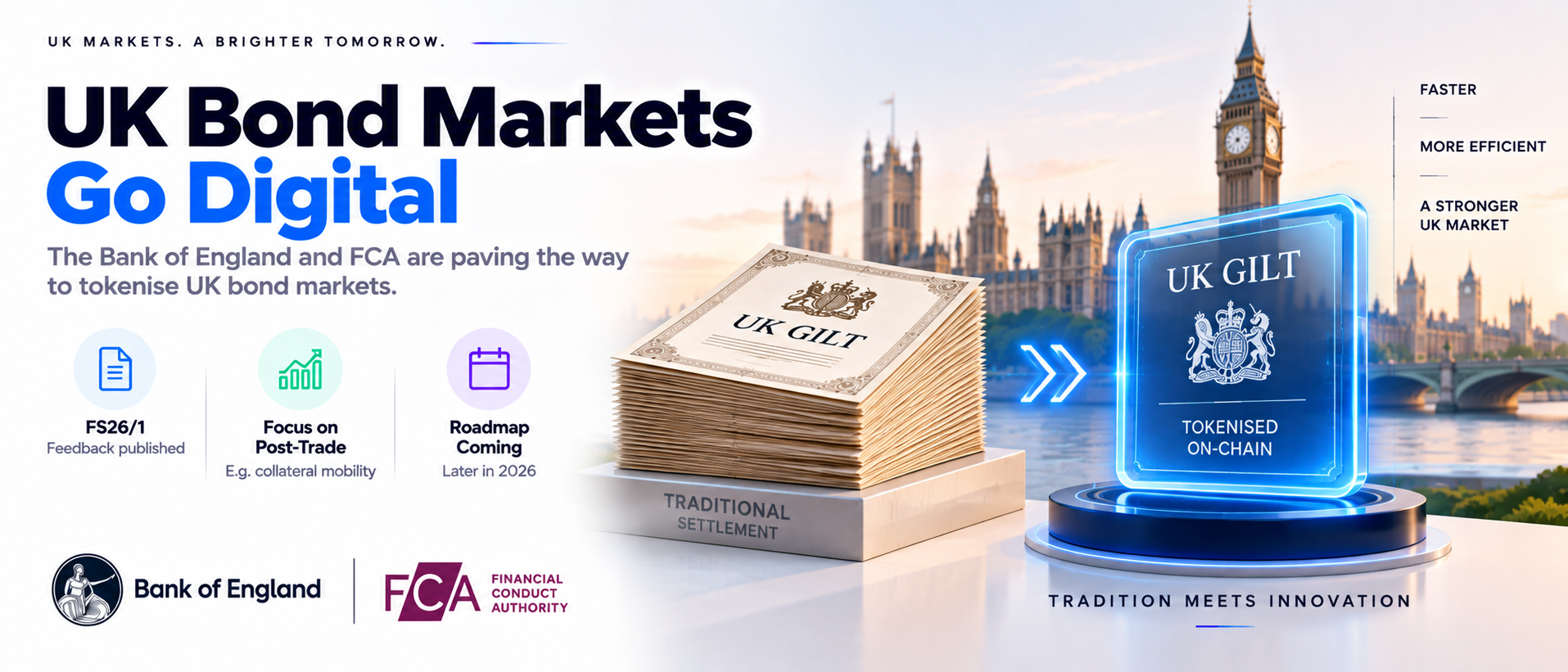
The Bank of England and FCA just laid out how UK bond and gilt markets will tokenise. Here's what FS26/1 actually says — and what it doesn't yet.
FCA FS26/1, tokenised gilts, wholesale market tokenisation, Digital Securities Sandbox, DIGIT digital gilt, RTGS CHAPS settlement hours, UK wholesale markets digital
The Bank of England and FCA Just Mapped Out How UK Bond Markets Go Digital
For centuries, UK government debt has cleared through layers of intermediaries and multi-day settlement cycles. This week, the Bank of England and the Financial Conduct Authority took a real step toward changing that — though it's worth being precise about exactly what step it was.
On September 14, the FCA and Bank of England published FS26/1, a joint feedback statement responding to the 123 submissions they received after asking industry, in May 2026, how UK wholesale markets should approach tokenisation — the practice of representing assets like bonds, equities, and fund units as digital tokens on distributed ledger technology. FCA — FS26/1
It's important to be precise about what this document actually is. FS26/1 is not itself the tokenisation roadmap — it's the regulators' summary of what industry told them, plus a set of principles that will shape a joint roadmap the FCA and Bank of England say they'll publish "later in 2026." The trillion-pound shift toward on-chain settlement hasn't been announced yet; what's been announced is the groundwork the regulators say they'll build it on. Feedback Statement FS26/1
What Industry Actually Told Regulators
Respondents were clear about where they see the real opportunity, and it's narrower than "replacing clearinghouses." The feedback overwhelmingly pointed to post-trade processes — specifically, collateral mobility — as the area tokenisation could improve most. One cited data point stood out: market participants currently hold an average of 7% excess collateral as a buffer against settlement friction, capital that tokenisation could, in principle, free up by making collateral move faster and more transparently between counterparties. Linklaters
Tokenised money market funds also came up frequently, mainly from buy-side firms, alongside a genuine industry request: greater regulatory certainty before firms commit serious capital to building tokenised infrastructure. Respondents also welcomed the regulators' insistence that there must be an accountable person for every regulated activity carried out through tokenised instruments — though some warned this requirement could make participation harder for smaller firms in practice.
The Infrastructure Already Being Built Alongside This
FS26/1 doesn't exist in isolation — it sits on top of infrastructure work that's already underway. The Bank and FCA are currently working with 16 firms on live issuance and settlement of tokenised assets through the UK's Digital Securities Sandbox, a regulatory testing environment that lets firms experiment with tokenised instruments under real but bounded conditions. Bank of England
That sandbox work is also feeding a specific, concrete project: HM Treasury's pilot issuance of a digital gilt instrument, known as DIGIT — the UK government's own live test of issuing sovereign debt in tokenised form, rather than a theoretical proposal. TradeInformer
Alongside FS26/1, the Bank of England also published a separate consultation on extending the operating hours of RTGS (its Real-Time Gross Settlement system) and CHAPS (the UK's high-value payment system), describing this as a staged approach toward near-24/7 settlement — not full real-time settlement immediately, but a deliberate, incremental widening of the hours the system operates. FCA
What's Still Ahead, Not Already Done
The regulators are also opening a new, separate consultation on tokenised gold — a direct response to feedback they received — and plan to consult on rules for how firms must safeguard tokenised cryptoasset holdings in the first half of 2027. FCA — FS26/1: Tokenisation in wholesale markets
Sarah Breeden, the Bank of England's deputy governor for financial stability, framed the moment carefully rather than triumphantly: "The Bank and FCA have done a huge amount to enable the responsible adoption of tokenisation... The task now is for public and private sectors together to build on these strong foundations, moving from pilots to production." That's a description of ongoing work, not a finished transformation.
Why It Still Matters, Even at This Stage
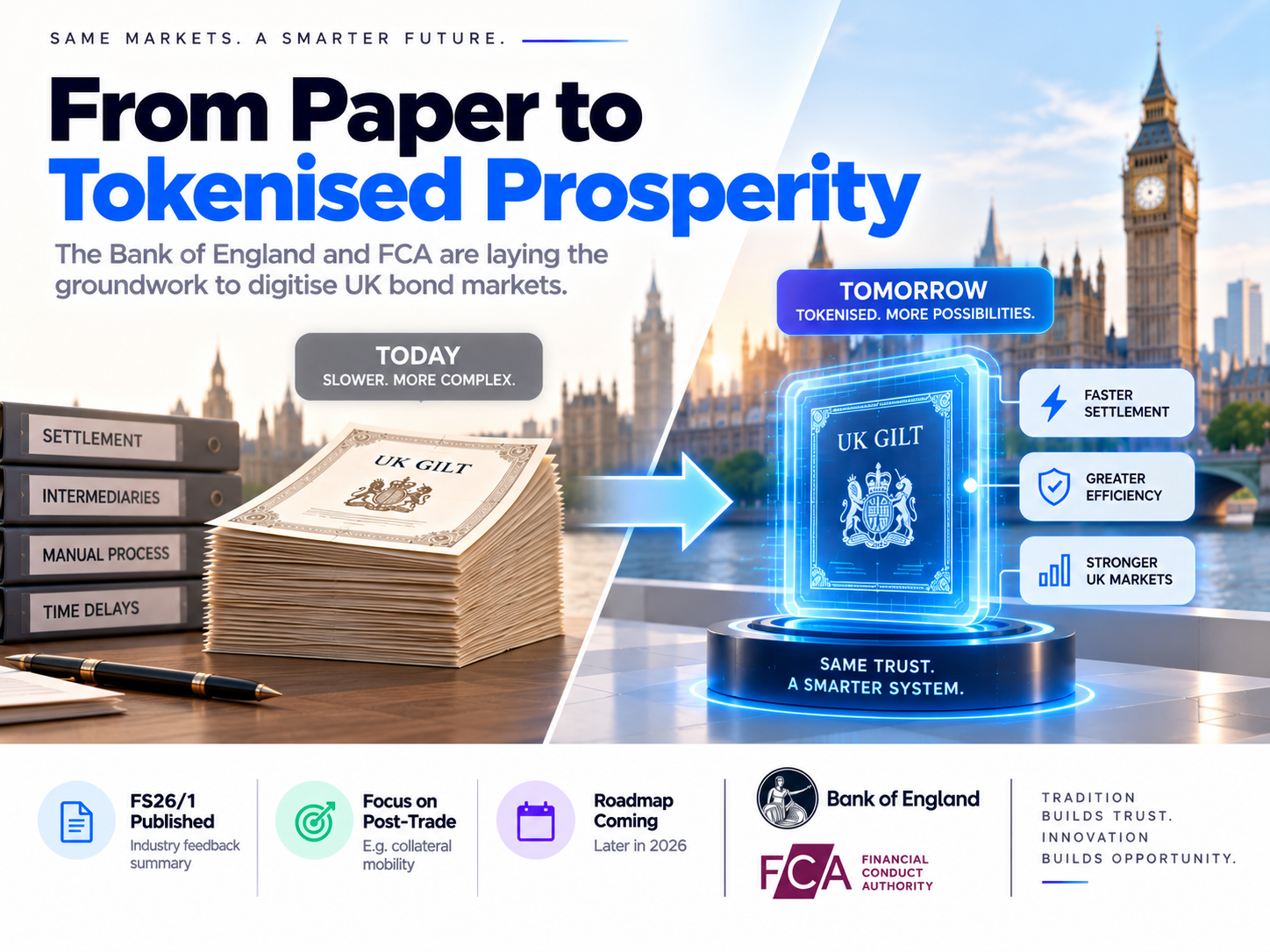
None of this means the story is overhyped — it means it's earlier than a "trillions moving on-chain today" headline would suggest. A coordinated conduct regulator and central bank publicly aligning on principles, backed by a live sandbox with 16 participating firms and an actual sovereign digital-gilt pilot, is a genuinely unusual level of regulatory commitment compared to how most jurisdictions are approaching this. The retail-facing benefits in the original pitch — cheaper fractional bond access, real-time interest distribution, an end to T+2 settlement lags — are plausible downstream effects of this infrastructure eventually working. They're not something FS26/1 promises will happen, or says when.
The actual roadmap — the document that will say what changes and by when — is still coming later this year. This week's announcement was regulators showing their work, not cutting the ribbon.
FAQ
Did the Bank of England and FCA just release the UK's tokenisation roadmap?
Not exactly. FS26/1 is a feedback statement summarizing 123 industry responses and setting out regulatory principles — the actual joint tokenisation roadmap is still to be published "later in 2026."
What did industry say tokenisation is best for?
Respondents overwhelmingly pointed to post-trade processes, especially collateral mobility, as the biggest opportunity — not a wholesale replacement of clearinghouses.
Is anything actually live yet?
Yes, on a limited scale. The Bank and FCA are working with 16 firms on live tokenised asset issuance and settlement through the Digital Securities Sandbox, and HM Treasury is running a pilot digital gilt issuance called DIGIT.
Will retail investors see fractional bond trading and instant settlement soon?
Not immediately. Those are plausible long-term benefits of this infrastructure, but FS26/1 doesn't set a timeline for retail-facing products — the near-term work is regulatory groundwork and wholesale-market infrastructure.

Tushar Shrivas
B.Tech CS@ Shri Balaji Institute of Technology & Management
I write at Metaplugs — breaking down the latest in tech, economics, and business into simple, impactful stories for everyday readers. Passionate about software testing and global finance.