Back to News
News AlertWorld Money
Central Banks Reverse Course: Hikes Return as Iran War Fuels Inflation
V
Author
Vicky Galfat
Published
October 4, 2026
Reading Time
5 MIN READ
Spread the Word
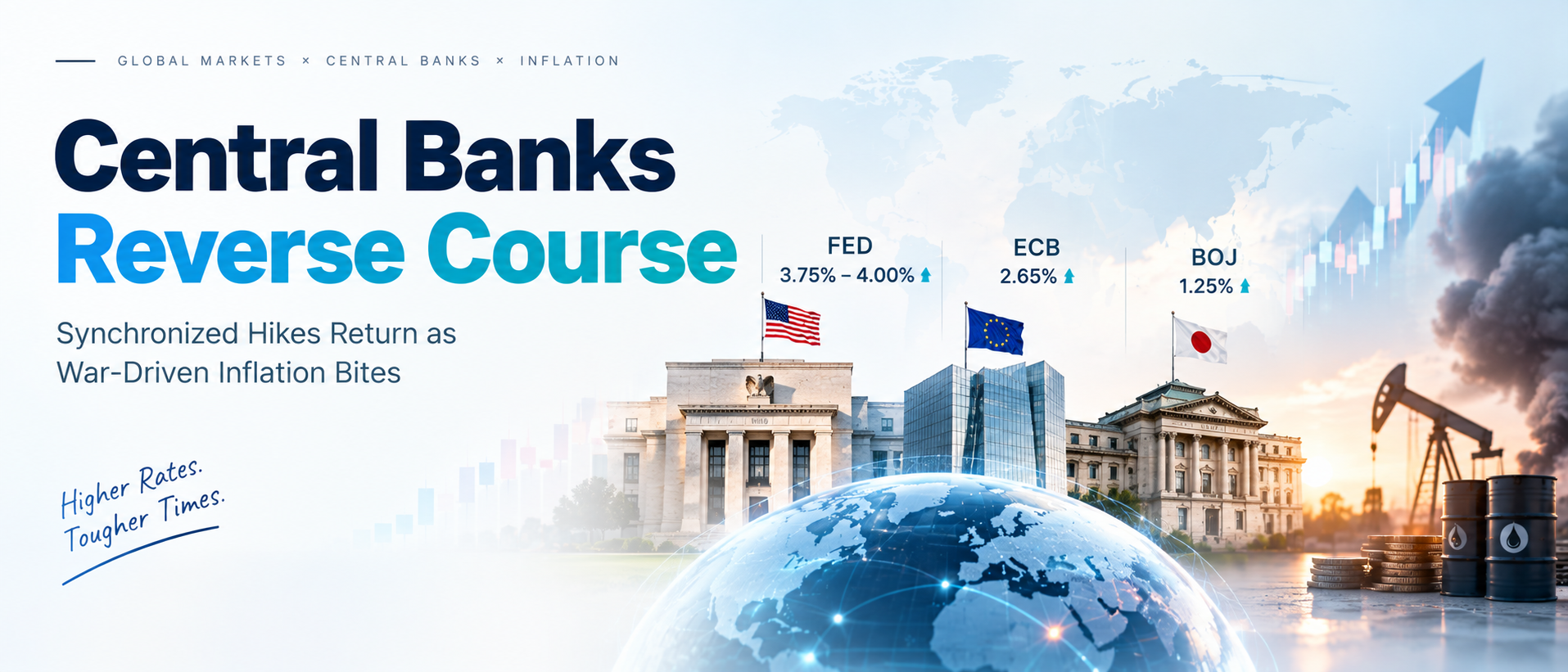
The Fed hiked to 3.75-4.00% and the ECB to 2.65% in September, reversing 2025's cutting cycle as Iran war inflation forces a global tightening pivot.
Federal Reserve rate hike 2026, ECB interest rate 2026, Bank of Japan rate hike, central bank tightening 2026, Kevin Warsh Fed chair, Iran war inflation, global interest rates 2026, Brazil Selic rate, Turkey interest rate
Federal Reserve rate hike 2026, ECB interest rate 2026, Bank of Japan rate hike, central bank tightening 2026, Kevin Warsh Fed chair, Iran war inflation, global interest rates 2026, Brazil Selic rate, Turkey interest rate
Central Banks Reverse Course: Synchronized Hikes Return as War-Driven Inflation Bites
Barely a year ago, markets were pricing in a smooth, synchronized global easing cycle. In September 2026, that script flipped. The Federal Reserve, the European Central Bank, and the Bank of Japan have all raised rates in the same quarter — not cut them — as a geopolitical inflation shock forces the world's most important central banks back into tightening mode at the same time.
The Fed's Unexpected Pivot Under a New Chair
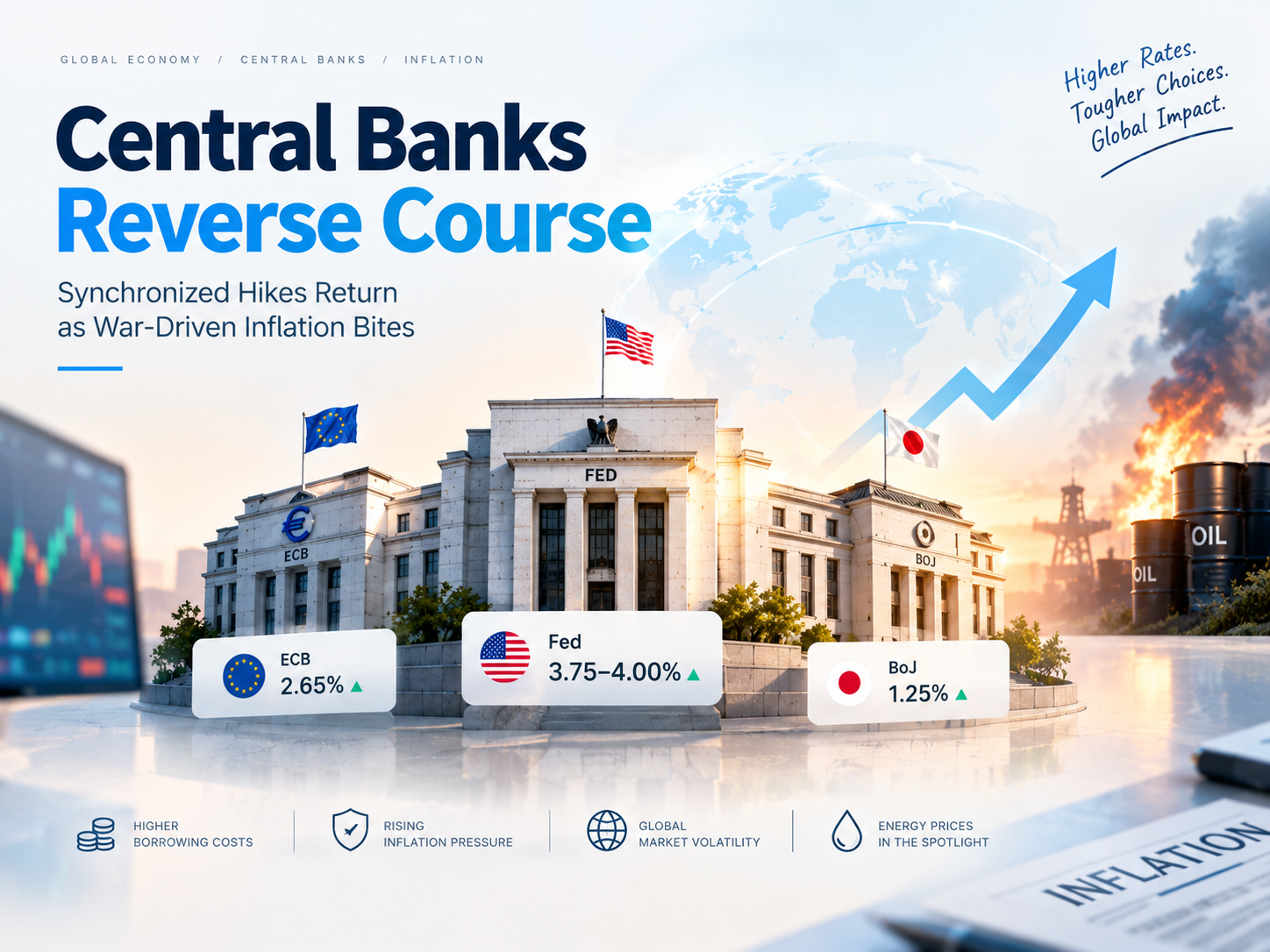
The Federal Open Market Committee voted 12-0 on September 16 to raise the federal funds target range a quarter point to 3.75%–4.00%, up from 3.50%–3.75%, where it had sat since a cut last December. It is the Fed's first rate increase in more than three years, and it came under new Chair Kevin Warsh, who replaced Jerome Powell earlier this year. Sixteen of 19 FOMC members now expect at least one more hike before year-end, a sharp reversal from June projections that still showed appetite for cuts. Warsh pointed to the economy's resilience and "bumpy geopolitics" since the committee's July meeting as reasons to "remove a dose of accommodation," while core PCE inflation climbed from 3.0% in December 2025 to 3.3% by July 2026.
The ECB Follows the Same Script
The European Central Bank moved in lockstep, raising its main refinancing rate to 2.65% and its deposit facility rate to 2.50% at its September 10 meeting — its second hike since the Iran war began. The ECB had previously held rates steady for five consecutive meetings near multi-year lows, but policymakers cited intensifying inflationary pressure from the conflict and kept their 2026 inflation forecast at 3.0%, above target, while revising 2027 and 2028 projections higher as well.
Japan's Hikes Were Already Underway
The Bank of Japan is the one institution that was already tightening before the latest shock hit. It raised its policy rate to 1.25% on September 18 — its second hike of 2026, following an earlier move in June — continuing a gradual normalization push after years of near-zero rates. Persistent domestic inflation and corporate governance reforms have kept the BOJ on a hiking path even as Japanese 10-year government bond yields climb toward multi-decade highs, widening the policy gap with the Fed and ECB rather than closing it.
Why an Oil War Is Rewriting Rate Expectations
The common thread across all three hikes is the same conflict: the US-Iran war has pushed up energy prices globally, and energy costs feed directly into headline and core inflation everywhere from Frankfurt to Ankara. Turkey's central bank, which cut its policy rate from 38% to 37% back in January, has now held that rate for five consecutive meetings, explicitly citing the war's effect on energy costs as a reason to pause further easing despite inflation still running above 30%. Brazil's central bank has similarly kept its Selic rate steady at 13.75% after years of aggressive tightening, wary of unwinding progress against inflation while global conditions remain unsettled.
What This Means for Borrowers, Savers, and Markets
For consumers and businesses, the practical effect is straightforward: borrowing costs that many expected to fall through 2026 are now holding steady or rising instead. Mortgage rates, corporate debt costs, and credit card APRs tied to benchmark rates are unlikely to ease soon, and currency markets are already adjusting — the dollar's bull case has reportedly shifted from Fed rate expectations toward fears about European growth, while the yen has struggled to recover ground lost earlier in the year.
The bigger question is how long this synchronized tightening holds. The Fed's own dot plot points to further hikes into 2027, the ECB faces a closely watched October 29 decision where markets currently price an 87% chance of a hold, and the BOJ's next move will hinge on whether Tokyo inflation data due this month strengthens the case for a third hike this year. If the Iran war drags on and energy prices stay elevated, 2026 may be remembered as the year central banks had to abandon their easing plans altogether — and investors are still working out what that means for growth heading into 2027.
V
Vicky Galfat
University of Mumbai/Major
Learning, building, and exploring the world of technology one project at a time.