Back to News
News AlertWorld Money
India's GDP Growth Seen at 7.3% in Q2 FY27: Here's What It Means
T
Author
Tushar Shrivas
Published
October 1, 2026
Reading Time
5 MIN READ
Spread the Word
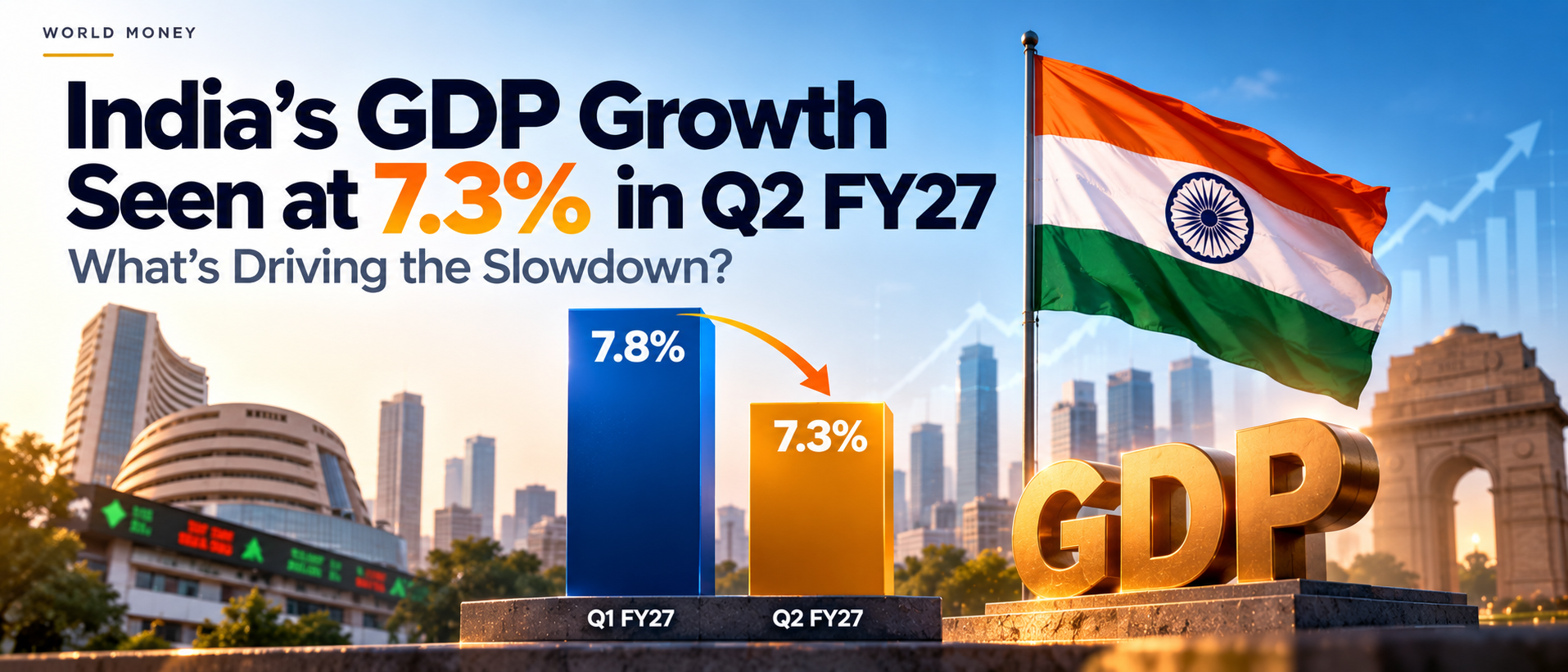
Finance Ministry projects 7.3% Q2 FY27 GDP growth, down from 7.8% in Q1. Domestic demand holds, but global risks and oil prices pose challenges.
India 7.3% GDP Q2, Finance Ministry Monthly Economic Review, FY27 economic outlook, India growth slowdown, global trade risks, oil prices inflation
India's GDP Growth Seen at 7.3% in Q2 FY27: What's Driving the Slowdown
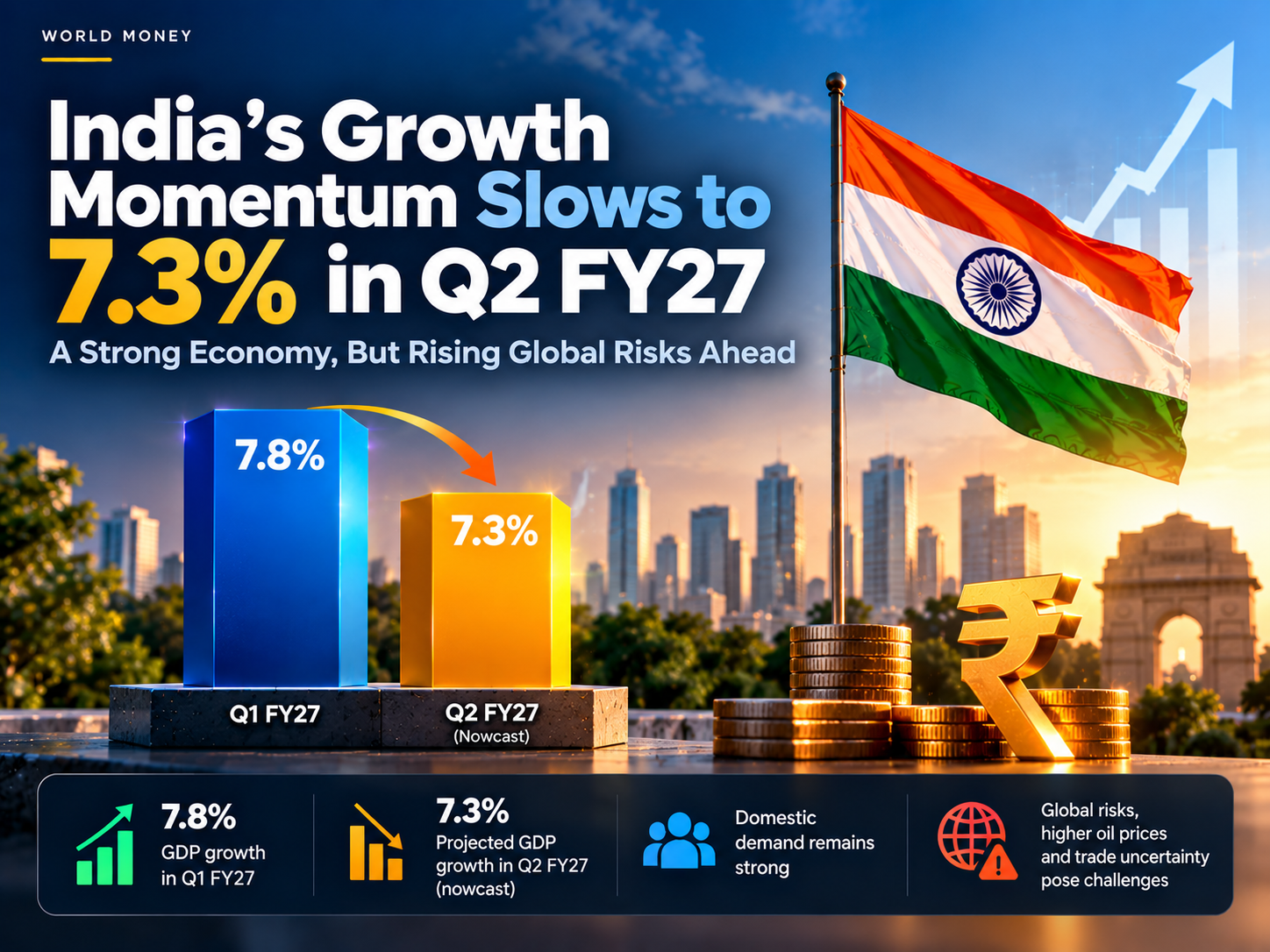
India's economy is maintaining strong momentum, but growth is expected to moderate slightly in the second quarter of FY27. On October 1, the Finance Ministry's September Monthly Economic Review projected real GDP growth of 7.3% for Q2 FY27, compared with the 7.8% recorded in Q1. Importantly, the 7.3% figure is a nowcast, not the final GDP number; official Q2 GDP data is scheduled to be released on November 30. BFSI
The moderation reflects a more complicated growth environment rather than a sharp domestic slowdown. The Finance Ministry said growth momentum has extended into Q2, although at a more measured pace. For investors, the important question is whether India's domestic growth engine can remain strong enough to offset rising oil prices, tighter global financial conditions and trade uncertainty.
DDindia
What's Holding Growth Up
Resilient domestic demand remains one of the biggest supports for India's economy. The Finance Ministry's review pointed to continued investment momentum, with healthy electricity and fuel consumption, sustained bank-credit expansion and stronger production of capital and infrastructure goods indicating that economic activity remains firm. Services activity also strengthened in August, supported by new business and employment. NewsOnAir
India also entered FY27 from a strong position. Real GDP expanded 7.8% in Q1 FY27, giving the economy a strong starting point for the year. The latest 7.3% nowcast therefore represents moderation rather than a collapse in growth. The challenge is whether that momentum can survive a less favourable global environment during the rest of the fiscal year. MoneyControl
What's Weakening: The External Picture
The slowdown is becoming visible in some high-frequency indicators. The Finance Ministry said e-way bill generation and manufacturing activity moderated during the early part of Q2, although services activity strengthened. This suggests that economic momentum is continuing, but not uniformly across all parts of the economy.
The bigger concern is outside India's borders. The Finance Ministry highlighted higher oil prices, rising global bond yields, tighter financial conditions, geopolitical tensions and trade uncertainty as important risks. For India, expensive crude can increase the country's import bill and inflation pressures, while higher global interest rates can make it harder to attract foreign capital. Reuters
The Investor Sentiment Question
The global environment is particularly important for India's financial markets. The Finance Ministry warned that India faces a stiff challenge in attracting capital as other countries compete aggressively for investment in areas such as AI infrastructure and new manufacturing capacity. Foreign investors therefore have more destinations competing for their money at a time when global financial conditions are becoming less supportive.
At the same time, India's domestic fundamentals remain an important counterweight. The Finance Ministry said the country's intrinsic growth potential should continue to attract investor attention as some of the current global uncertainties eventually ease. It also stressed that India needs stronger governance and greater competition to build a more productive and manufacturing-oriented economy. TheIndianExpress
What This Means for the Rest of FY27
A 7.3% Q2 growth projection is still strong, but the direction of the economy matters more than the headline number alone. If domestic consumption and investment remain resilient, India could continue to outperform many major economies. But persistent oil-price volatility, higher global yields, trade tensions and geopolitical disruptions could put pressure on growth, inflation, the rupee and capital flows simultaneously.
The immediate question is therefore not whether India is growing—it clearly is—but whether the economy can maintain its pace while the global environment becomes more difficult. The Finance Ministry's latest assessment sends a balanced message: India's growth engine remains strong, but it cannot be taken for granted.
For World Money, that is the bigger takeaway. India's 7.3% Q2 projection shows that domestic economic momentum remains powerful, but the next phase of growth will increasingly depend on how the country manages external shocks, attracts global capital and keeps investment and productivity moving forward.
FAQ
Is 7.3% GDP growth good for India?
Yes. A 7.3% real-growth projection would still represent strong expansion, although it would be slower than the 7.8% recorded in Q1 FY27. Importantly, 7.3% is currently a Finance Ministry nowcast, not the final Q2 GDP figure.
What is causing the moderation from Q1 to Q2?
The Finance Ministry says growth momentum has continued but at a more measured pace. At the same time, higher oil prices, tighter global financial conditions, trade uncertainty and geopolitical risks are creating additional pressure.
Has India's Q2 GDP officially been released?
No. The 7.3% figure is a Finance Ministry nowcast. Official GDP data for July–September is scheduled for release on November 30, 2026.
What does this mean for investors?
India's domestic growth remains a positive factor, but global oil prices, interest rates, capital flows, trade policy and geopolitical developments could influence Indian assets and the rupee. The Finance Ministry has specifically warned that attracting capital could become more challenging in the current global environment.
Is the Indian economy actually slowing down?
There is some moderation, but the available evidence does not indicate a sharp slowdown. Q1 growth was 7.8%, while the Finance Ministry's Q2 nowcast is 7.3%, with domestic demand and investment still providing support.

Tushar Shrivas
B.Tech CS@ Shri Balaji Institute of Technology & Management
I write at Metaplugs — breaking down the latest in tech, economics, and business into simple, impactful stories for everyday readers. Passionate about software testing and global finance.