Back to News
News AlertWorld Unicorn
China Dominates 2026 "Embodied AI" Robotics Unicorns; Voice & App AI Scale Rapidly
V
Author
Vishal Sable
Published
August 2, 2026
Reading Time
5 MIN READ
Spread the Word
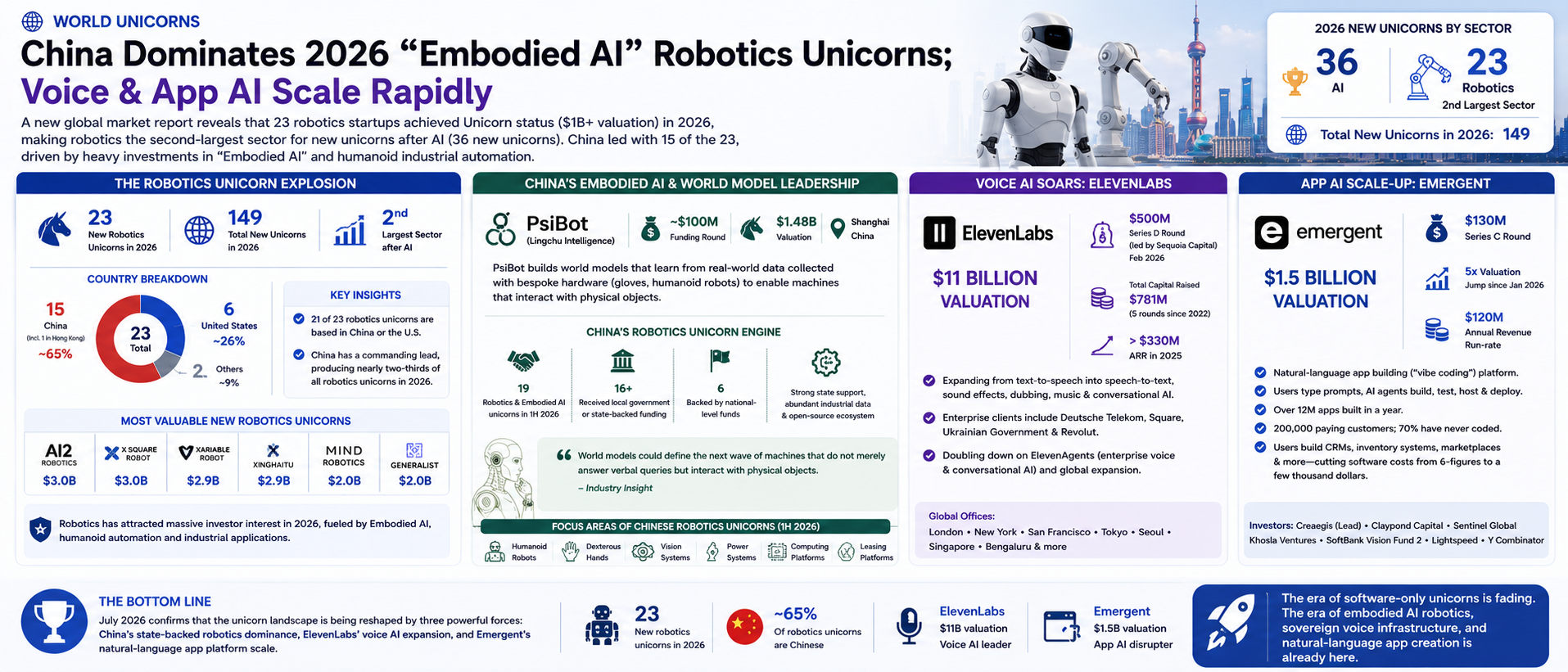
A new global market report has revealed that 23 robotics startups achieved Unicorn status ($1B+ valuation) in 2026, making robotics the second-largest sector for new unicorns after AI (36 new unicorns). China led the wave by producing 15 of the 23 new robotics unicorns, driven by heavy investments in "Embodied AI" and humanoid industrial automation. The robotics sector has attracted significant investor interest in 2026, with 23 private robotics companies surpassing the $1 billion valuation threshold.
The Robotics Unicorn Explosion
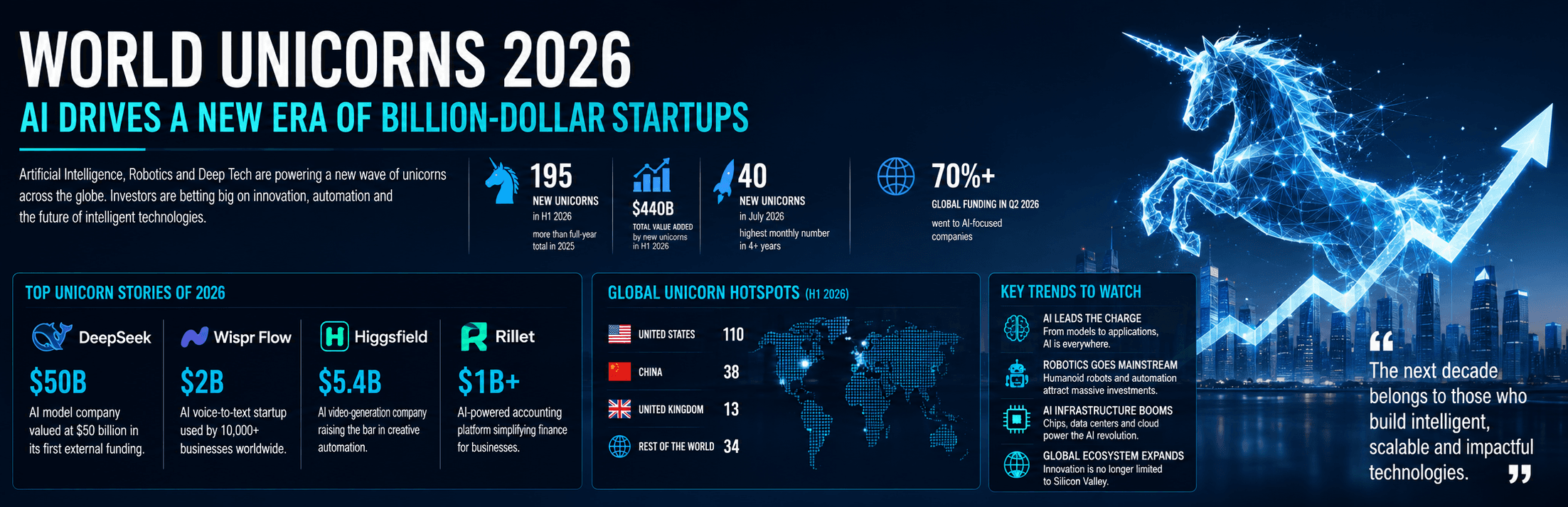
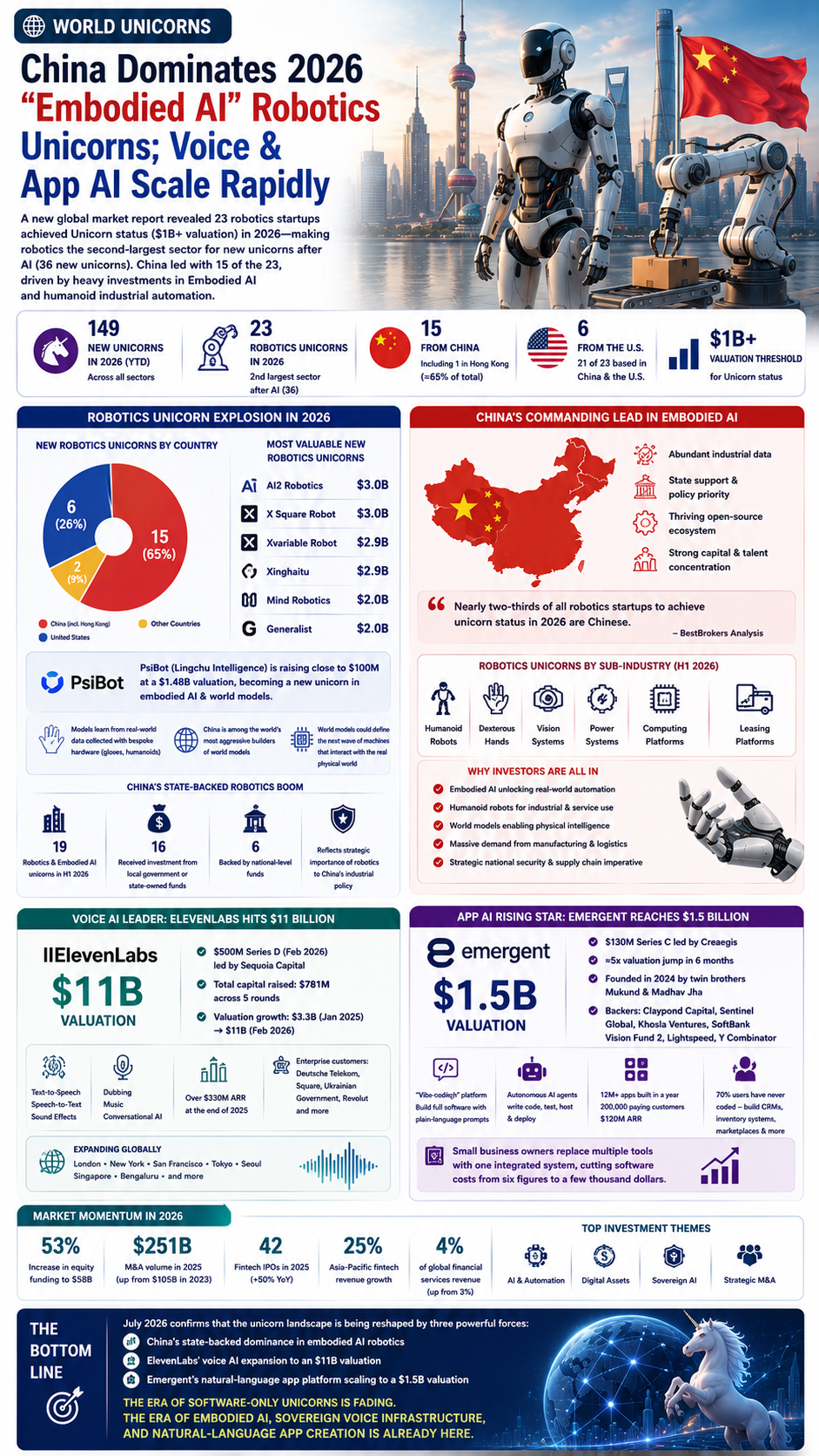
According to an analysis by BestBrokers using Crunchbase, PitchBook, and other sources, a total of 149 startups have reached unicorn status so far in 2026. The robotics industry has produced 23 new billion-dollar startups this year, more than any sector except AI. China and the United States account for the vast majority of these new robotics unicorns, with 21 of the 23 based in the two countries. China has established a commanding lead, producing 15 of them (including one in Hong Kong), compared with six in the United States. As a result, nearly two-thirds of all robotics startups to achieve unicorn status in 2026 are Chinese. The most valuable newly minted robotics unicorns include AI2 Robotics ($3.0B), X Square Robot ($3.0B), Xvariable Robot ($2.9B), Xinghaitu ($2.9B), Mind Robotics ($2.0B), and Generalist ($2.0B).
Chinese startup PsiBot (also known as Lingchu Intelligence) is raising close to US$100 million at a US$1.48 billion valuation, becoming a new unicorn in the emerging field of embodied AI and world models. Founded in Shanghai by Viktor Wang and other AI and robotics veterans, PsiBot's models learn from real-world data collected with bespoke hardware, such as gloves and humanoid robots. Chinese companies are among the world's most aggressive builders of world models, banking on state support, abundant industrial data and a thriving open-source ecosystem. The promise is that world models could define the next wave of machines that do not merely answer verbal queries but interact with physical objects.
According to IT Juzi unicorn data, 19 robotics and embodied AI companies achieved unicorn status in the first half of 2026 alone, spanning humanoid robots, dexterous hands, vision systems, power systems, computing platforms, and leasing platforms. At least 16 of these 19 companies received investment from local government or state-owned capital funds. National-level funds have backed six new unicorns, reflecting the strategic importance of robotics to China's industrial policy.
Voice AI & App AI Scale Rapidly
Voice AI platform ElevenLabs achieved an **$11 billion valuation** following its $500 million Series D round led by Sequoia Capital in February 2026. The company, founded in 2022, has expanded from text-to-speech into speech-to-text, sound effects, dubbing, music, and conversational AI. ElevenLabs closed 2025 with over $330 million in ARR, driven by rapid enterprise adoption from companies including Deutsche Telekom, Square, the Ukrainian Government, and Revolut. The funding is being used to double down on ElevenAgents, its enterprise platform for voice and conversational AI, and to expand internationally across London, New York, San Francisco, Tokyo, Seoul, Singapore, Bengaluru, and other cities. The latest funding brings total capital raised to $781 million across five rounds since its founding. ElevenLabs' valuation has escalated from $3.3 billion in January 2025 to $11 billion in February 2026, reflecting investor conviction in its role as a core voice infrastructure provider for enterprises.
Natural-language app building platform Emergent continues its rapid rise on the private leaderboard after hitting unicorn status. The "vibe coding" platform raised a $130 million Series C at a $1.5 billion valuation, about five times its valuation in January. Founded in 2024 by twin brothers Mukund and Madhav Jha, Emergent lets people build full software by typing plain-language prompts. Autonomous AI agents write the code, then handle hosting, testing, and deployment. Over 12 million apps have been built on the platform in a year, and the company has 200,000 paying customers with a $120 million annual revenue run-rate. Users—70% of whom have never coded—build CRMs, inventory systems, and marketplaces. Small business owners have replaced multiple tools with one integrated system, cutting software costs from six figures to a few thousand dollars. Creaegis led the round, with Claypond Capital and Sentinel Global co-leading, and earlier backers Khosla Ventures, SoftBank's Vision Fund 2, Lightspeed, and Y Combinator returning.
The Bottom Line
July 2026 confirms that the unicorn landscape is being reshaped by three powerful forces: China's state-backed dominance in embodied AI robotics, ElevenLabs' voice AI expansion to an $11 billion valuation, and Emergent's natural-language app building platform scaling to a $1.5 billion valuation. The robotics sector alone has produced 23 new unicorns in 2026—nearly two-thirds of them Chinese—as the US-China technology rivalry intensifies around physical AI and world models. The era of software-only unicorns is fading. The era of embodied AI robotics, sovereign voice infrastructure, and natural-language app creation is already here.

Vishal Sable
B.Tech AD @ shri balaji institute of technology and management
Engineering and tech journalist. I love exploring the impact of emerging technologies on global defense, sovereignty, and everyday life. Always looking for the real story behind the headlines.