Back to News
News AlertWorld Unicorn
China Dominates Robotics Unicorns; Europe Mints "Humanoid" as Global Leaderboard Shifts
V
Author
Vishal Sable
Published
August 4, 2026
Reading Time
6 MIN READ
Spread the Word
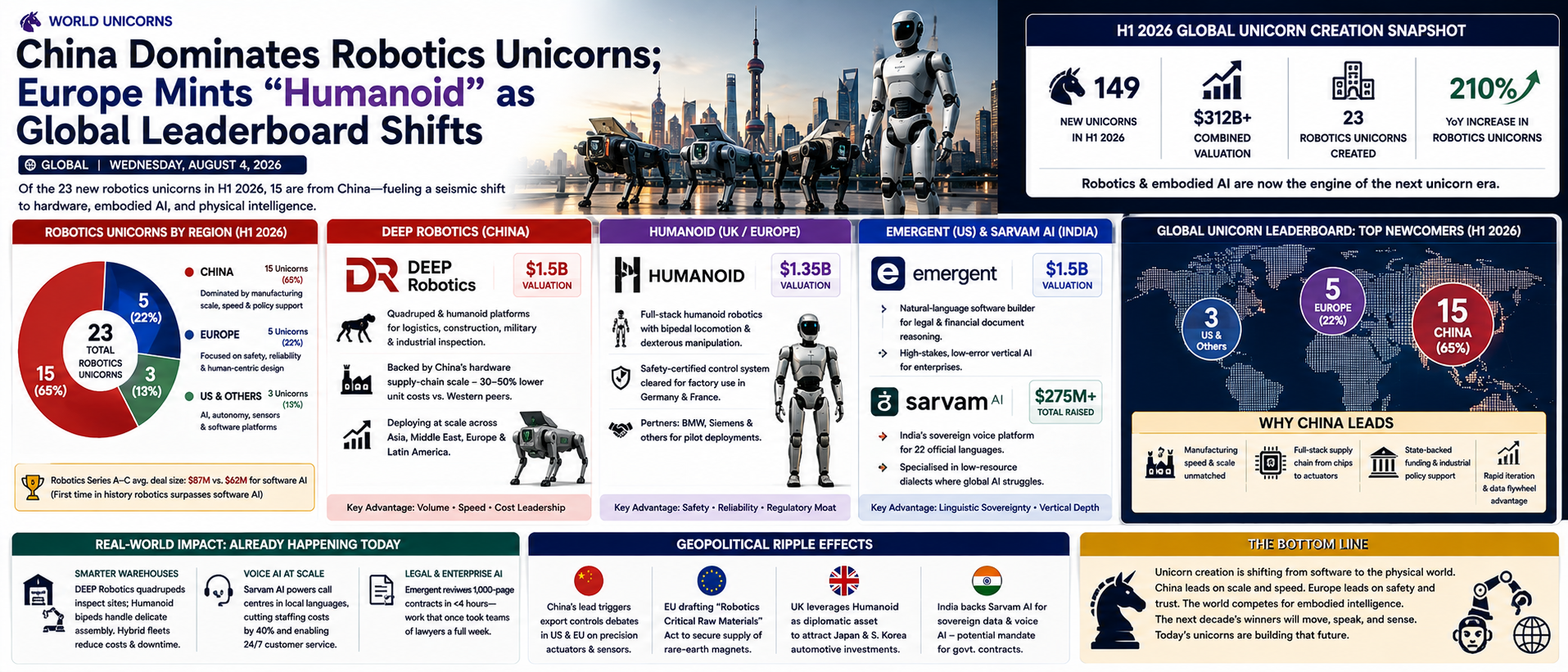
The global unicorn leaderboard has undergone a seismic reordering, and the geography of billion-dollar startups is now firmly rooted in hardware, not software. Of the 23 newly minted robotics unicorns that emerged in the first half of 2026, a staggering 15 hail from China, underscoring the country's unparalleled advantage in high-volume manufacturing, supply-chain density, and state-backed industrial policy. Leading this charge is DEEP Robotics, which secured a $1.5 billion valuation after a series of funding rounds that propelled its quadruped and humanoid-platform sales across logistics, construction, and military surveillance sectors. The Chinese cohort is not merely a statistical anomaly; it reflects a deliberate national strategy to dominate embodied AI from the component level upward, with provinces like Guangdong and Zhejiang effectively acting as giant accelerators that can prototype, test, and scale new robotic form factors in weeks rather than years. This manufacturing muscle allows Chinese unicorns to undercut Western rivals on unit costs by 30 to 50 percent while simultaneously iterating hardware revisions at a pace that legacy industrial players cannot match, creating a virtuous cycle of volume, data collection, and algorithmic refinement that reinforces their lead.
Yet Europe has not been entirely eclipsed. London-based Humanoid has broken through as the continent's first pure-play humanoid robotics unicorn, closing its Series C at a $1.35 billion valuation and proving that European engineering and ethical-AI branding can command premium multiples even against Asian volume players. Humanoid's differentiation lies in its full-stack approach to bipedal locomotion and dexterous manipulation, combined with a safety-certified control system that has already passed preliminary regulatory reviews for factory-floor deployment in Germany and France. The company's ability to secure partnerships with BMW and Siemens for pilot programmes gave investors confidence that its £500,000-per-unit price point could scale down to sub-£200,000 within three generations, making humanoid general-purpose labour economically viable for medium-sized enterprises. This milestone positions Europe not as a follower but as a niche leader in high-reliability, human-safe robotics, carving out a segment where Chinese cost advantages are tempered by stringent European workplace-safety directives and data-sovereignty requirements that favour local incumbents.
Beyond robotics, the global private leaderboard showcases other standout performers that reflect the broader diversification of unicorn creation. Natural-language software builder Emergent achieved a $1.5 billion valuation by offering enterprise-grade language models that specialise in legal and financial document reasoning, eschewing generalist chatbots for high-stakes, low-error verticals where each token carries regulatory weight. Meanwhile, Sarvam AI, India's sovereign voice-platform champion, has raised a cumulative $275 million across its funding rounds, positioning itself as the default speech-to-text and text-to-speech infrastructure for India's 22 official languages, with a particular emphasis on low-resource dialects that global models like Whisper and Gemini handle poorly. Sarvam's success underscores a crucial trend: while robotics captures headlines, there remains substantial venture appetite for geographically tailored AI that addresses linguistic and cultural fragmentation, especially in emerging markets where voice interfaces are the primary digital access point for hundreds of millions of users. These three companies—Emergent, Sarvam AI, and Humanoid—represent the non-Chinese pole of innovation, each leveraging distinct moats that cannot be easily replicated by the manufacturing behemoths of East Asia.
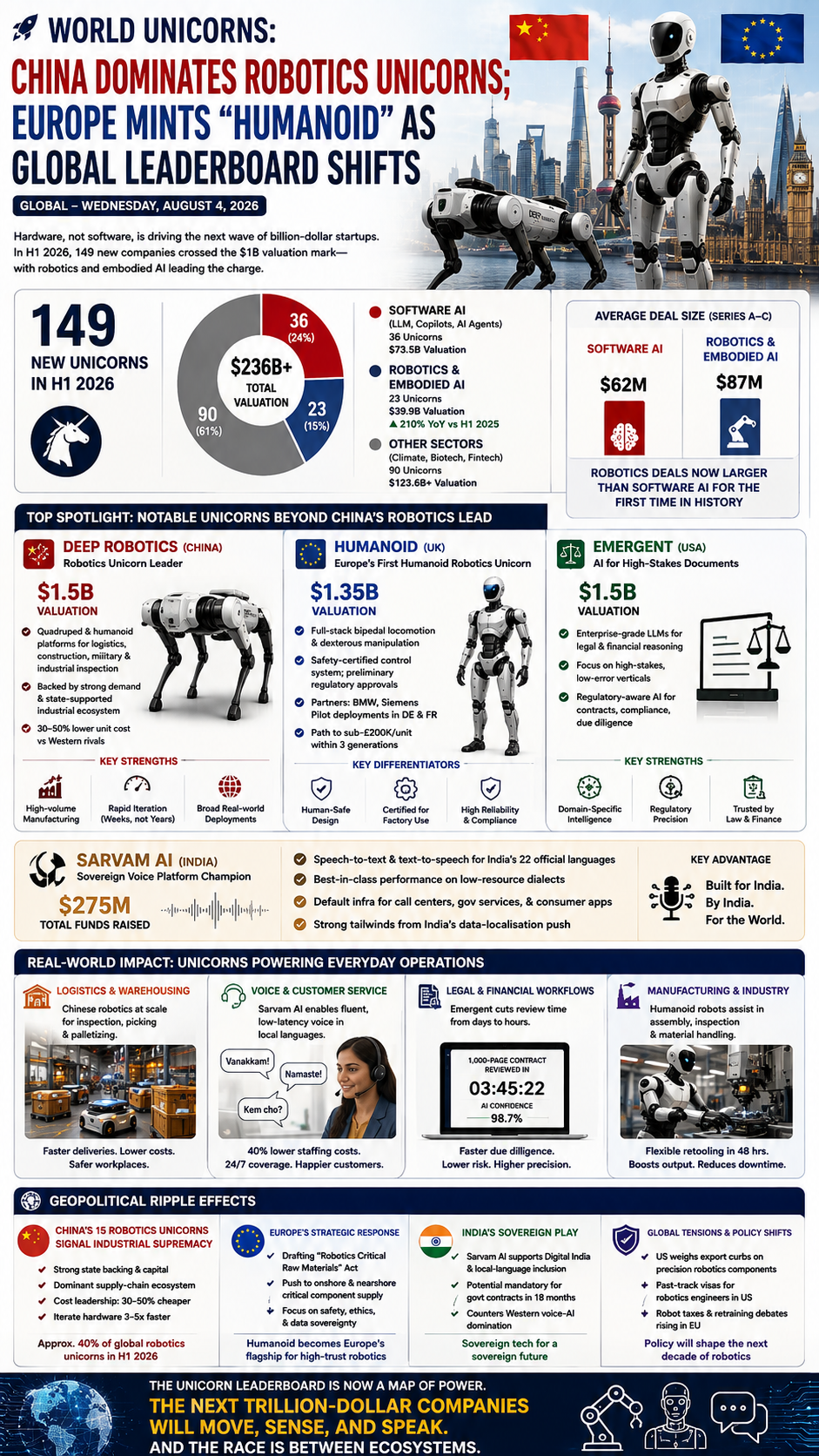
For the average business owner or consumer, the implications of this unicorn distribution are already filtering into daily operations. A warehouse manager in Rotterdam can now lease a fleet of DEEP Robotics quadruped inspectors for €8,000 per unit per year, while simultaneously trialling a single Humanoid bipedal assistant for delicate assembly tasks at €120,000 annually, creating a hybrid robotic workforce that blends Chinese affordability with European precision. A Mumbai-based call-centre operator can deploy Sarvam AI's voice engines to handle customer queries in Tamil or Marathi with near-human fluency, reducing staffing costs by 40 percent while expanding service hours to 24/7 coverage. And a London law firm can subscribe to Emergent's document-analysis suite to review thousand-page merger contracts in under four hours, a task that previously required a team of junior associates for a full week. These are not futuristic projections but live deployments, funded by the very unicorn valuations announced today, and they are reshaping the calculus of labour, logistics, and legal services across multiple time zones.
Geopolitically, China's 15-unicorn robotics tally has triggered alarm in Washington and Brussels, where policymakers are debating new export controls on precision actuators, torque sensors, and real-time operating systems that underpin these machines. The European Union is reportedly drafting a "Robotics Critical Raw Materials" act to reduce dependency on Chinese rare-earth magnets, while the US Department of Defense has flagged DEEP Robotics' surveillance variants as potential national-security concerns, though commercial sales continue unabated in allied markets. Conversely, London-based Humanoid has become a diplomatic asset for the UK, which is leveraging its unicorn status to attract Japanese and South Korean automotive investments, positioning itself as a neutral ground between US software prowess and Chinese hardware scale. India's Sarvam AI, meanwhile, has attracted interest from the Indian Ministry of Electronics and IT, which sees the startup as a bulwark against Western-dominated voice-AI platforms that might not align with domestic data-localisation laws, offering a sovereign alternative that could become mandatory for government contracts within the next 18 months.
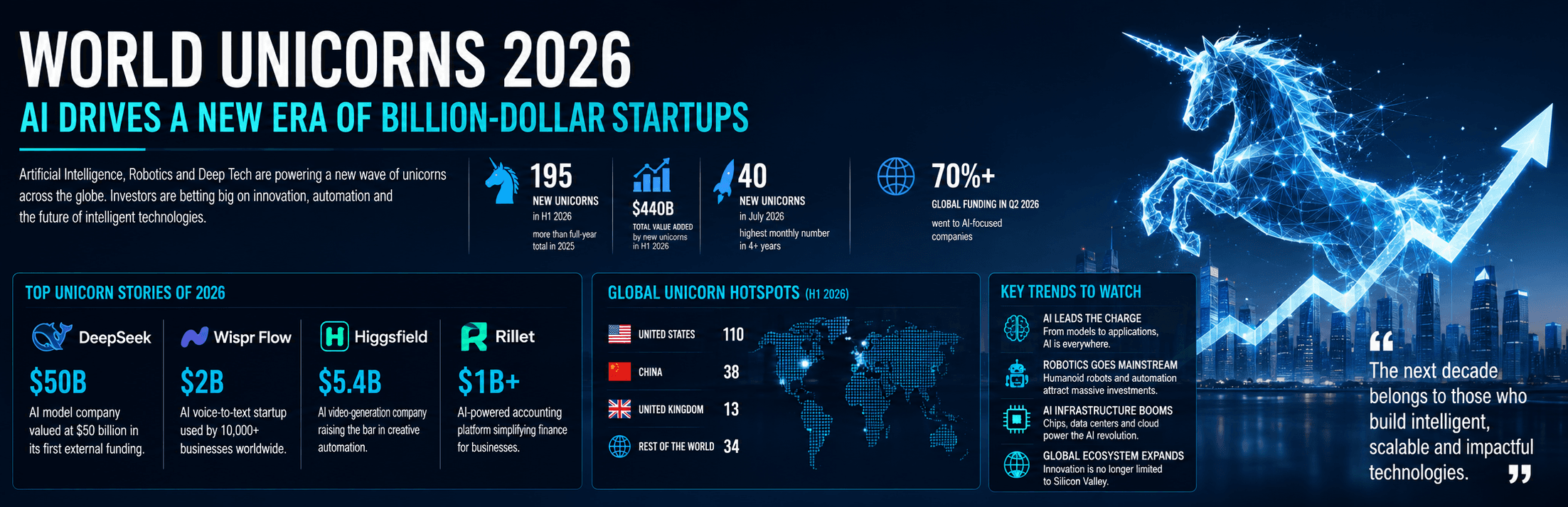
As the second half of 2026 unfolds, the unicorn leaderboard is no longer a simple ranking of valuations but a strategic map of industrial power, linguistic sovereignty, and manufacturing competitiveness. The 149 new unicorns may be distributed across sectors, but the robotics concentration in China and the humanoid breakthrough in Europe tell a clear story: the next generation of billion-dollar companies will be defined by their ability to move, speak, and sense in the physical world, and the nations that host them are already rewriting trade, defence, and labour policies to secure their place in that order. Investors continue to chase these startups with unabated fervour, but the real race is now between ecosystems, not just individual founders, and the outcome will determine which economic blocs control the embodied intelligence of the 2030s.

Vishal Sable
B.Tech AD @ shri balaji institute of technology and management
Engineering and tech journalist. I love exploring the impact of emerging technologies on global defense, sovereignty, and everyday life. Always looking for the real story behind the headlines.