Back to News
News AlertWorld Unicorn
Defense, Fusion, and Hardware Join the Billion-Dollar Club
V
Author
Vishal Sable
Published
July 18, 2026
Reading Time
5 MIN READ
Spread the Word
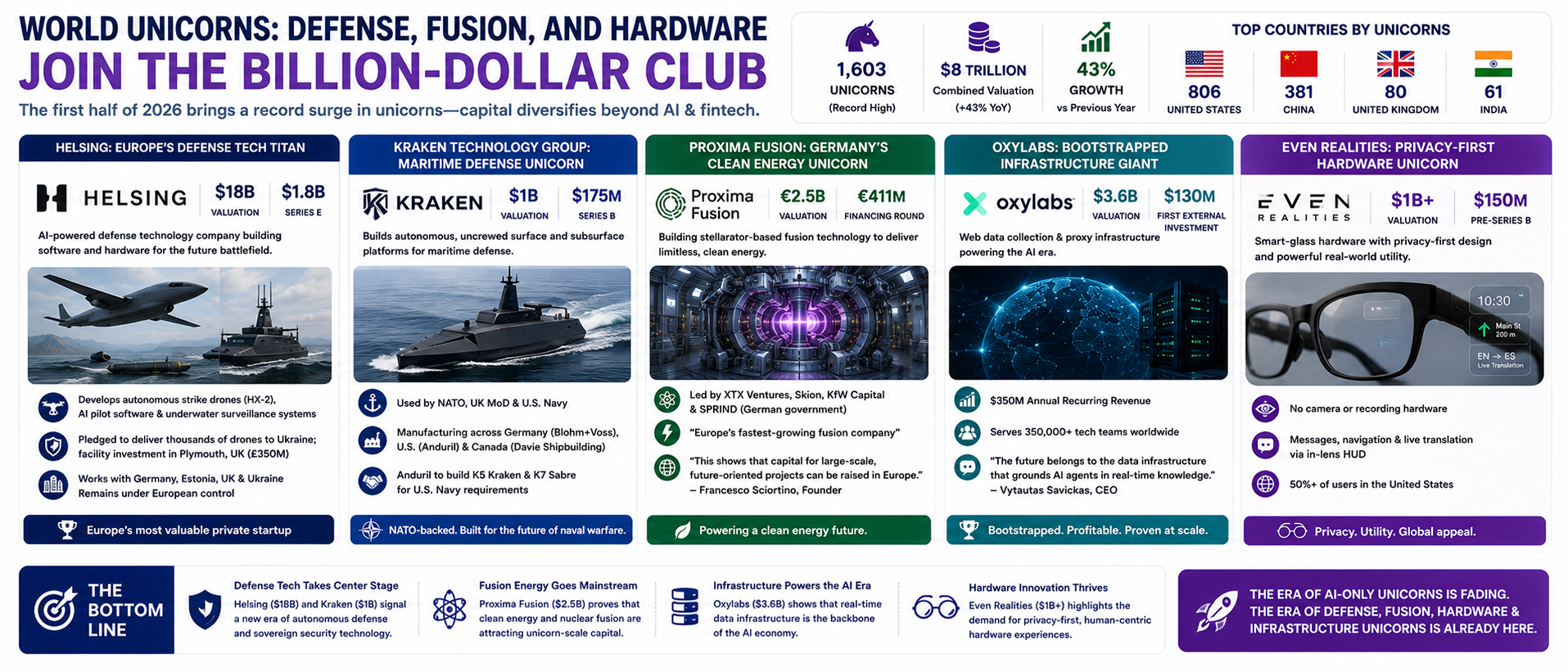
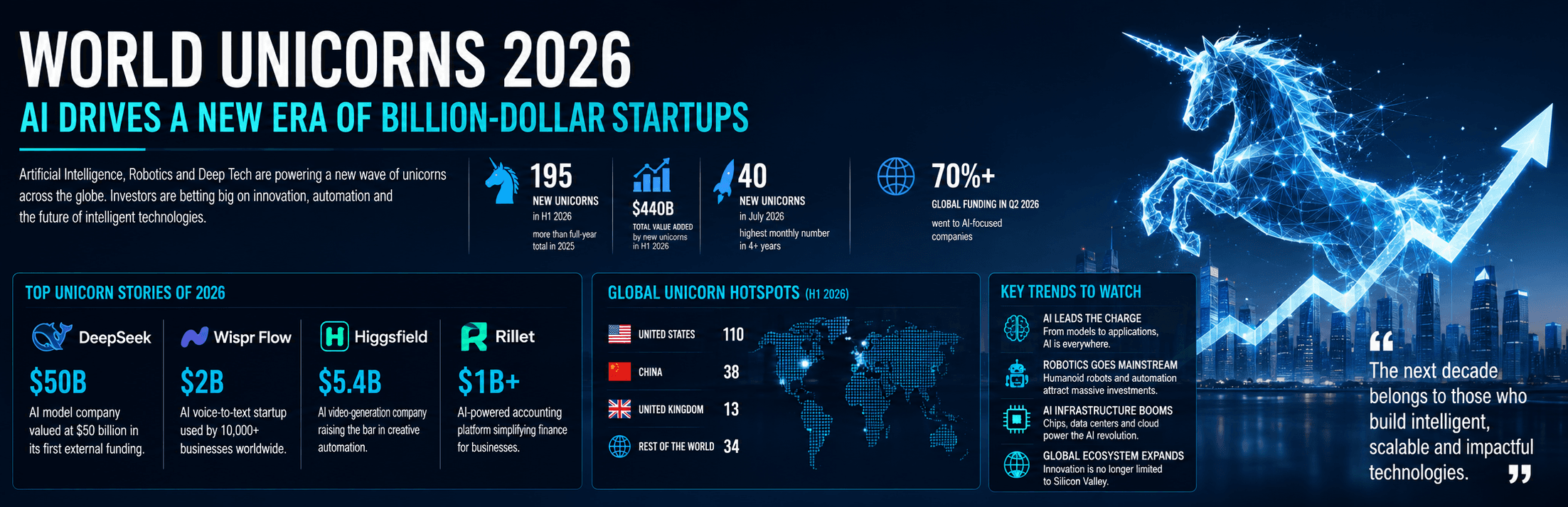
The private $1 Billion "Unicorn Club" is expanding at a record pace, but the capital is no longer flowing exclusively to AI labs and fintech apps. The first half of 2026 has witnessed a dramatic diversification of the unicorn landscape, with defense technology, nuclear fusion, and consumer hardware joining the ranks of the world's most valuable private companies. According to the Hurun Global Unicorn Index 2026, the world now hosts a record 1,603 unicorns with a combined valuation of $8 trillion—up 43% from the previous year. The United States leads with 806 unicorns, followed by China at 381, while the United Kingdom has surged to third place with 80 unicorns, overtaking India's 61.
Helsing: Europe's Defense Tech Titan
German defense technology standout Helsing has cemented its position as Europe's most valuable private startup, raising $1.8 billion in a Series E funding round at an $18 billion valuation. The round, backed by new and existing investors including Dragoneer Investment Group, Lightspeed Venture Partners, Iconiq, Goldman Sachs Alternatives, and JPMorganChase, ranks among the largest funding rounds ever raised by a European startup. Founded in 2021, Helsing initially focused on battlefield AI software before expanding aggressively into hardware over the past two years. The company now develops autonomous strike drones, AI pilot software, and underwater surveillance systems alongside its original software platform. Helsing has unveiled its HX-2 autonomous strike drone, pledged to deliver thousands of drones to Ukraine, and recently announced plans for a manufacturing facility in Plymouth as part of a £350 million investment in the UK to produce its AI-powered underwater surveillance gliders. The company works with governments including Germany, Estonia, the UK, and Ukraine, while remaining under European control.
Kraken Technology Group: Maritime Defense Unicorn
London-based maritime defense startup Kraken Technology Group officially achieved unicorn status on July 9, closing a $175 million Series B funding round at a $1 billion valuation. The round was led by Digital Transformation Capital Partners and included investors such as Rheinmetall and the NATO Innovation Fund. Kraken builds fully autonomous, uncrewed surface and subsurface maritime defense platforms used by NATO, the UK Ministry of Defence, and the US Navy. The company's manufacturing footprint now stretches across Rheinmetall's Blohm+Voss shipyard in Germany, Anduril Industries facilities in the United States, and Inocea Group's Davie Shipbuilding operation in Canada, giving Kraken domestic production capability across three separate NATO countries. In April 2026, Anduril Industries announced it would manufacture two new Kraken-designed vessels, the K5 Kraken and K7 Sabre, at its own U.S. facilities to meet U.S. Navy requirements.
Proxima Fusion: Germany's Clean Energy Unicorn
Munich-based Proxima Fusion cracked the unicorn threshold after a new financing round of €411 million, valuing the startup at around €2.5 billion. The round was led by London's XTX Ventures together with Germany's Skion, KfW Capital from the state German economic development bank, and the Federal Agency for Disruptive Innovation SPRIND. Proxima specializes in magnet- or stellarator-based fusion and describes itself as "Europe's fastest-growing fusion company". Proxima founder Francesco Sciortino framed the milestone in strategic terms: "This shows that capital for large-scale, future-oriented projects no longer can only be raised in the US – Europe can do that, too". The unicorn status signals growing investor confidence in fusion energy as a viable, scalable clean energy source.
Oxylabs: Bootstrapped Infrastructure Giant
Vilnius-based web data collection and proxy infrastructure company Oxylabs has raised its first-ever external investment, securing $130 million from Warburg Pincus at a valuation of $3.6 billion. The company, founded in 2015, has never before accepted outside capital, making it one of the few bootstrapped unicorns to achieve a multi-billion-dollar valuation without traditional VC funding. Oxylabs is recording $350 million in annual recurring revenue and serves over 350,000 tech teams worldwide. CEO Vytautas Savickas framed the investment in the context of the AI era: "As AI agents begin to navigate the web far more than humans ever have, the future belongs to the data infrastructure that grounds these systems in real-time, interruption-free knowledge". The valuation makes Oxylabs Lithuania's second most valuable unicorn, behind Vinted.
Even Realities: Privacy-First Hardware Unicorn
Shenzhen-based smart-glass hardware maker Even Realities raised $150 million in a pre-Series B round at a post-money valuation of more than $1 billion, becoming a unicorn less than three years after its founding. The round was co-led by Meituan Longzhu and Meituan Strategic Investment, with Tencent and other existing shareholders participating. The company's flagship Even G2 smart glasses have no camera or recording hardware, instead sending messages, navigation, and live translation through a heads-up display embedded in the lenses. More than half of its user base is in the United States, a remarkable feat for a Chinese hardware startup.
The Bottom Line
July 2026 marks a historic diversification of the unicorn landscape. Helsing's $18 billion valuation and $1.8 billion raise cement defense technology as a dominant category alongside foundational AI labs. Kraken's $1 billion valuation and NATO-backed investor roster signal that autonomous maritime systems are commanding premium private market value. Proxima Fusion's €2.5 billion valuation demonstrates that clean energy and nuclear fusion are attracting institutional capital at unicorn scale. Oxylabs' $3.6 billion valuation proves that bootstrapped infrastructure companies built on sustainable revenue models can achieve multi-billion-dollar valuations without traditional VC hype. Even Realities' $1 billion milestone confirms that hardware innovation, particularly in privacy-first consumer tech, remains a powerful unicorn driver. The era of AI-only unicorns is fading. The era of defense, fusion, hardware, and infrastructure unicorns—built on defensible technology and global demand—is already here.

Vishal Sable
B.Tech AD @ shri balaji institute of technology and management
Engineering and tech journalist. I love exploring the impact of emerging technologies on global defense, sovereignty, and everyday life. Always looking for the real story behind the headlines.