Back to News
News AlertWorld Unicorn
Fintech and Defense Ecosystems Feed the Next Wave of Billion-Dollar Leaders
V
Author
Vishal Sable
Published
July 21, 2026
Reading Time
4 MIN READ
Spread the Word
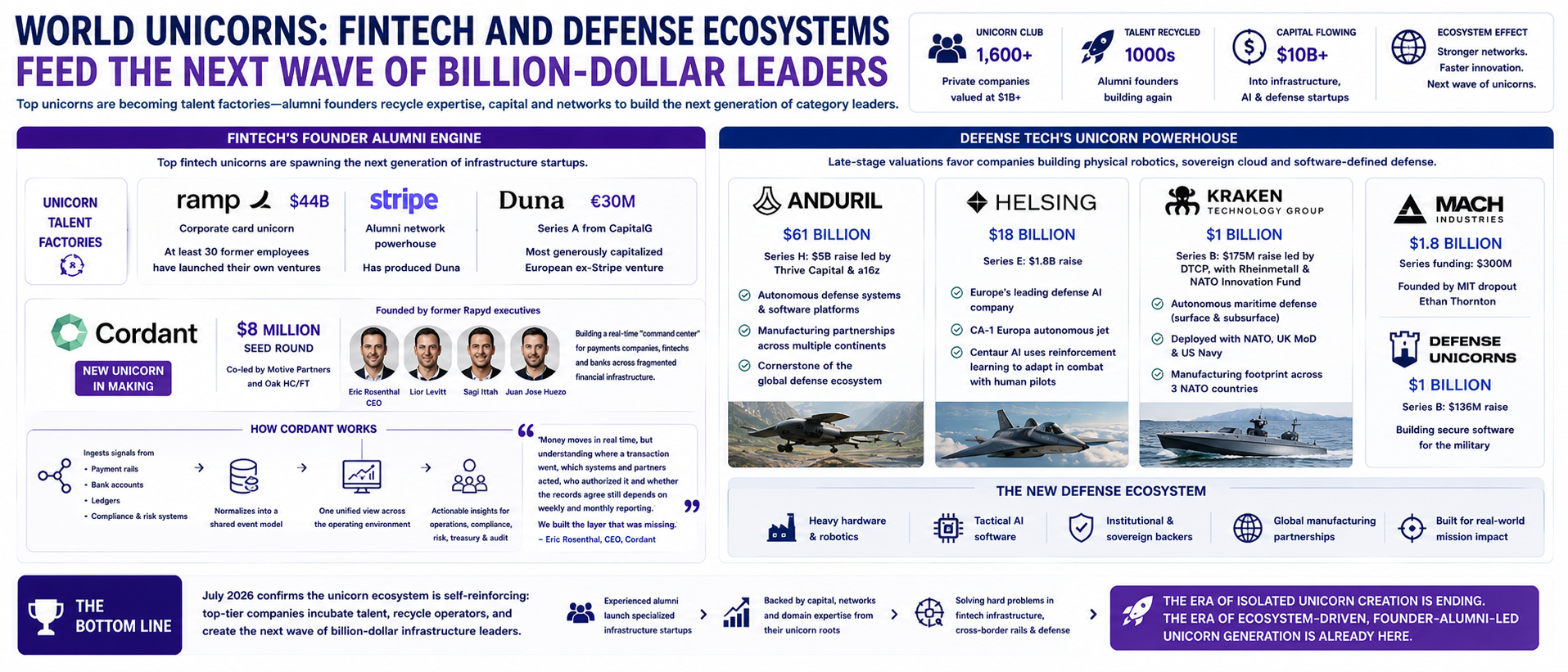
The private $1 Billion "Unicorn Club" is seeing strong recycled leadership. Founders and alumni from top-tier unicorns are launching specialized sub-tier infrastructure startups to service the parent ecosystems, creating a self-reinforcing cycle of talent, capital, and operational expertise.
Fintech's Founder Alumni Engine
The fintech sector has become a formidable talent factory. Ramp, the $44 billion corporate card titan, has emerged as an unexpected founder factory, with at least 30 former employees launching their own ventures since leaving the company. Stripe's alumni network has produced Duna, which secured €30 million in Series A funding from CapitalG, Alphabet's growth fund, marking it as the most generously capitalized European venture to emerge from Stripe's alumni network. The most recent example is Cordant, which emerged from stealth on July 21 with an $8 million seed round co-led by Motive Partners and Oak HC/FT. Founded by former Rapyd executives Eric Rosenthal, Lior Levitt, Sagi Ittah, and Juan Jose Huezo—who previously led commercial strategy, product, engineering, and sales at the payments infrastructure unicorn—Cordant is building a real-time "command center" for payments companies, fintechs, and banks operating across fragmented financial infrastructure. The platform ingests signals from payment rails, bank accounts, ledgers, compliance and risk systems, and normalizes them into a shared event model, giving teams one unified view of what is happening across their operating environment. "Money moves in real time, but understanding where a transaction went, which systems and partners acted, who authorized it and whether the records agree still depends on weekly and monthly reporting," said CEO Eric Rosenthal. "We built the layer that was missing".
Defense Tech's Unicorn Powerhouse
Late-stage valuations heavily favor companies building physical robotics mechatronics, sovereign cloud infrastructure, and software-defined defense platforms. Anduril Industries, the defense tech unicorn valued at $61 billion after a $5 billion Series H raise led by Thrive Capital and Andreessen Horowitz, has become a cornerstone of the defense ecosystem, with its manufacturing partnerships now spanning multiple continents. Helsing, Europe's leading defense AI company, raised $1.8 billion in a Series E funding round at an $18 billion valuation—making it not only Germany's most valuable startup but also the most valuable defense startup in Europe. The company's flagship autonomous jet aircraft, the CA-1 Europa, is powered by an AI architecture called Centaur that uses reinforcement learning to adapt to volatile field combat alongside human pilots.
Kraken Technology Group, a British maritime defense startup, closed a $175 million Series B round on July 9, 2026, achieving a $1 billion valuation. The round was led by Digital Transformation Capital Partners and included investors such as Rheinmetall and the NATO Innovation Fund. Kraken builds fully autonomous, uncrewed surface and subsurface maritime defense platforms already deployed in support of NATO, the UK Ministry of Defence, and the US Navy. The company's manufacturing footprint now spans Rheinmetall's Blohm+Voss shipyard in Germany, Anduril Industries facilities in the United States, and Inocea Group's Davie Shipbuilding operation in Canada—giving Kraken domestic production capability across three separate NATO countries. The defense sector's momentum continues with Mach Industries, founded by MIT dropout Ethan Thornton, securing $300 million at a $1.8 billion valuation, while Defense Unicorns—a builder of secure software for the military—raised a $136 million Series B at a $1 billion valuation. The pattern is unmistakable: the most valuable private startups of 2026 are those fusing heavy hardware and robotics with tactical AI software, backed by institutional defense and sovereign entities.
The Bottom Line
July 2026 confirms that the unicorn ecosystem has entered a mature phase where top-tier companies function as talent incubators, recycling experienced operators back into the market to build the next layer of infrastructure. The era of isolated unicorn creation is ending. The era of ecosystem-driven, founder-alumni-led unicorn generation—spanning fintech infrastructure, sovereign cloud, and software-defined defense—is already here.

Vishal Sable
B.Tech AD @ shri balaji institute of technology and management
Engineering and tech journalist. I love exploring the impact of emerging technologies on global defense, sovereignty, and everyday life. Always looking for the real story behind the headlines.