Back to News
News AlertWorld AI Tech
GitHub's New Coding Agent Grades Its Own Homework — And It's a Preview of Where "Writing Code" Is Headed
S
Author
Saumya Dawande
Published
September 16, 2026
Reading Time
4 MIN READ
Spread the Word
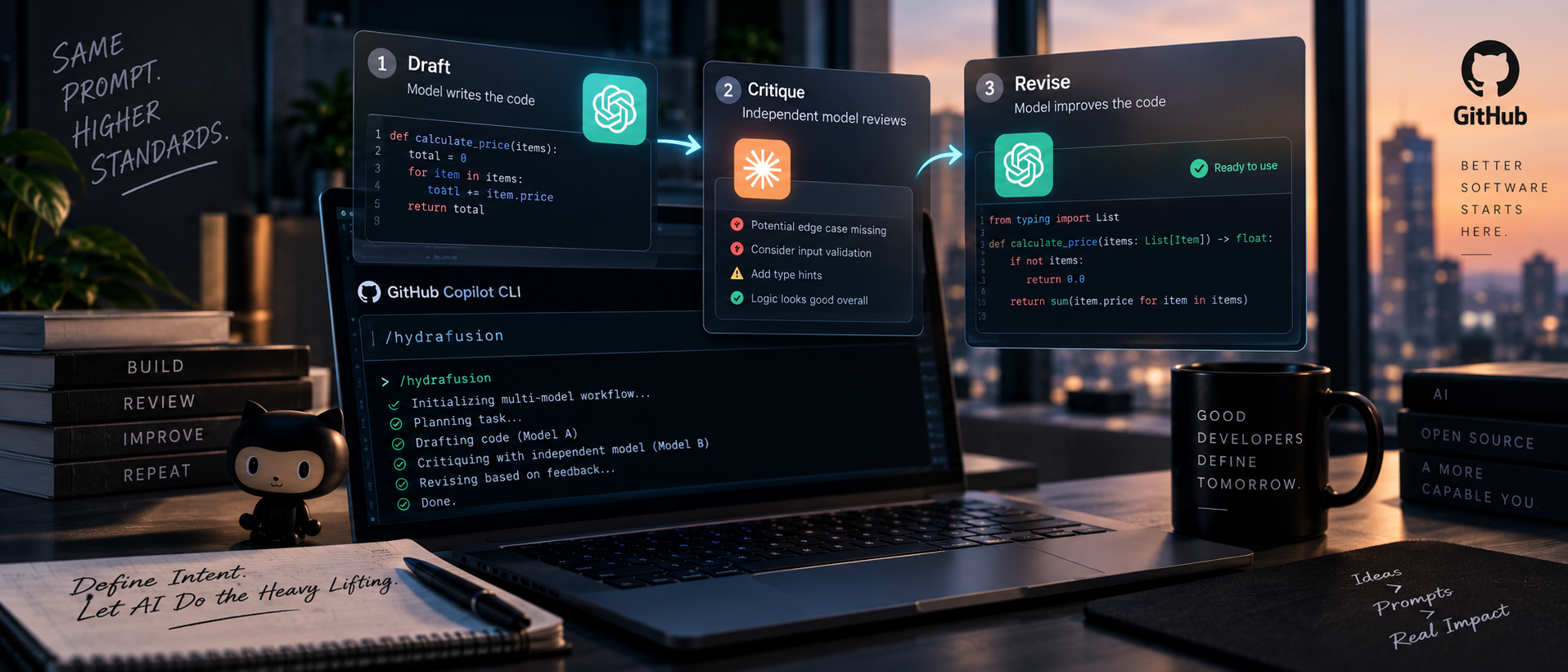
GitHub just shipped a coding agent that drafts, critiques, and revises its own work — real evidence the industry is shifting from typing code to defining intent.
On September 4, GitHub quietly shipped something that looks less like a coding assistant and more like a small engineering team compressed into one command-line tool. Project HydraFusion, live now as a research preview in GitHub Copilot CLI, doesn't just answer a prompt with one model — it decides, task by task, whether to hand the work to a single model, have a cheap model try first and escalate only if needed, or have one model draft the code while a second model from a different provider reviews it and sends it back for revision. GitHub Blog , GitHub Community Discussion
That third mode — GitHub calls it "Critique" — is the interesting one: one model writes the code, an independent model from a different family reviews it with read-only access, and the original model revises based on that feedback before the developer ever sees the output. In GitHub's own controlled benchmarks, this orchestration approach beat or matched Claude Opus 5 while cutting estimated token costs substantially: a 4.9-percentage-point quality improvement at 67% lower cost on TerminalBench 2.1, and near-parity with Opus 5 at 36% lower cost on the tougher, repository-scale DeepSWE benchmark. It's available to every Copilot subscription tier through the `/experimental` command, billed at the standard rate of whatever underlying models it uses.ITBrief Australia ,InfoQ

HydraFusion isn't happening in isolation — it's the latest, most visible entry in a shift the industry has been calling spec-driven development, not "intent-driven development," though the underlying idea your draft was reaching for is real: the terminology matters here because it's what people are actually searching and building tools around. The movement traces back to GitHub's own Spec Kit, open-sourced in September 2025, which flipped the traditional workflow so a written specification — not the code — becomes the source of truth, and an AI agent generates, tests, and revises code against it. Spec Kit has since crossed roughly 107,000 GitHub stars, and AWS built an entire IDE, Kiro, around the same premise: describe the feature, and the agent converts it into a formal requirements document using EARS notation, a structured syntax originally developed for safety-critical aerospace systems. Lovex, DevToolLab
The reason this matters more than a typical dev-tool release is what it says about where the bottleneck in AI coding actually sits. A year ago, the open question was whether an agent could write working code at all. HydraFusion's benchmark numbers, and the broader adoption of spec-first frameworks, suggest that question is largely settled for well-scoped tasks. The harder problem now is whether the agent knows what you actually meant — and both GitHub's multi-model critique loop and the wider spec-driven movement are, in different ways, answers to that same problem: build in a second pass, human or machine, that checks the output against intent before it ships.GitHub Blog
None of this makes the human role obsolete — GitHub is explicit that HydraFusion is still an early research preview, tuned for single-prompt tasks handed off in "autopilot mode," with longer multi-turn sessions still a work in progress. The engineer's job shifts, but it doesn't disappear: instead of typing every line, the work becomes writing the specification precisely enough, and reviewing the critique loop closely enough, that an agent's confident-sounding output can actually be trusted. For developers in India building against Copilot, Kiro, or Spec Kit right now, that's less a threat than a hiring signal — the people getting the most out of these tools aren't the fastest typists, they're the ones who can write a spec an agent can't misread.Medium — Iones Walter
The open question HydraFusion doesn't answer yet is the one that decides whether any of this scales past a demo: multi-model critique loops and formal specs both add a review step before code ships, but neither one guarantees the reviewer — human or machine — actually catches what matters. Cheaper, faster, and self-checking isn't the same as correct. Whether "spec-driven" agentic coding closes that gap, or just moves the point where mistakes slip through, is what the next year of adoption will actually test.

Saumya Dawande
B.Tech AIML @ oriental institute of science technology bhopal
Engineering and tech journalist. I love exploring the impact of emerging technologies on global defense, sovereignty, and everyday life. Always looking for the real story behind the headlines.