LATEST NEWS
The Universal Modder: Why Claude’s New "Game Mashups" Are Terrifying Developers
October 10, 2026 4M
Back to News
News AlertWorld AI Tech
Governing AI by Label and Tier: Le Chonk, EU Watermarks, Claude Cyber Access
V
Author
Vicky Galfat
Published
October 12, 2026
Reading Time
4 MIN READ
Spread the Word
Mistral's 1T-parameter Le Chonk, OpenAI's EU text watermark and Anthropic's tiered cyber access show AI is now governed by label and by tier.
Mistral Large 4, Le Chonk, open-weight AI model, European AI sovereignty, OpenAI text watermark EU, EU AI Act Article 50, SynthID Detector, Anthropic Cyber Verification Program, Claude Mythos, AI cybersecurity access tiers.
Governing AI by Label and by Tier: Mistral's Le Chonk, EU Watermarks and Claude's Cyber Access Levels
Mistral Large 4, Le Chonk, open-weight AI model, European AI sovereignty, OpenAI text watermark EU, EU AI Act Article 50, SynthID Detector, Anthropic Cyber Verification Program, Claude Mythos, AI cybersecurity access tiers.
Governing AI by Label and by Tier: Mistral's Le Chonk, EU Watermarks and Claude's Cyber Access Levels
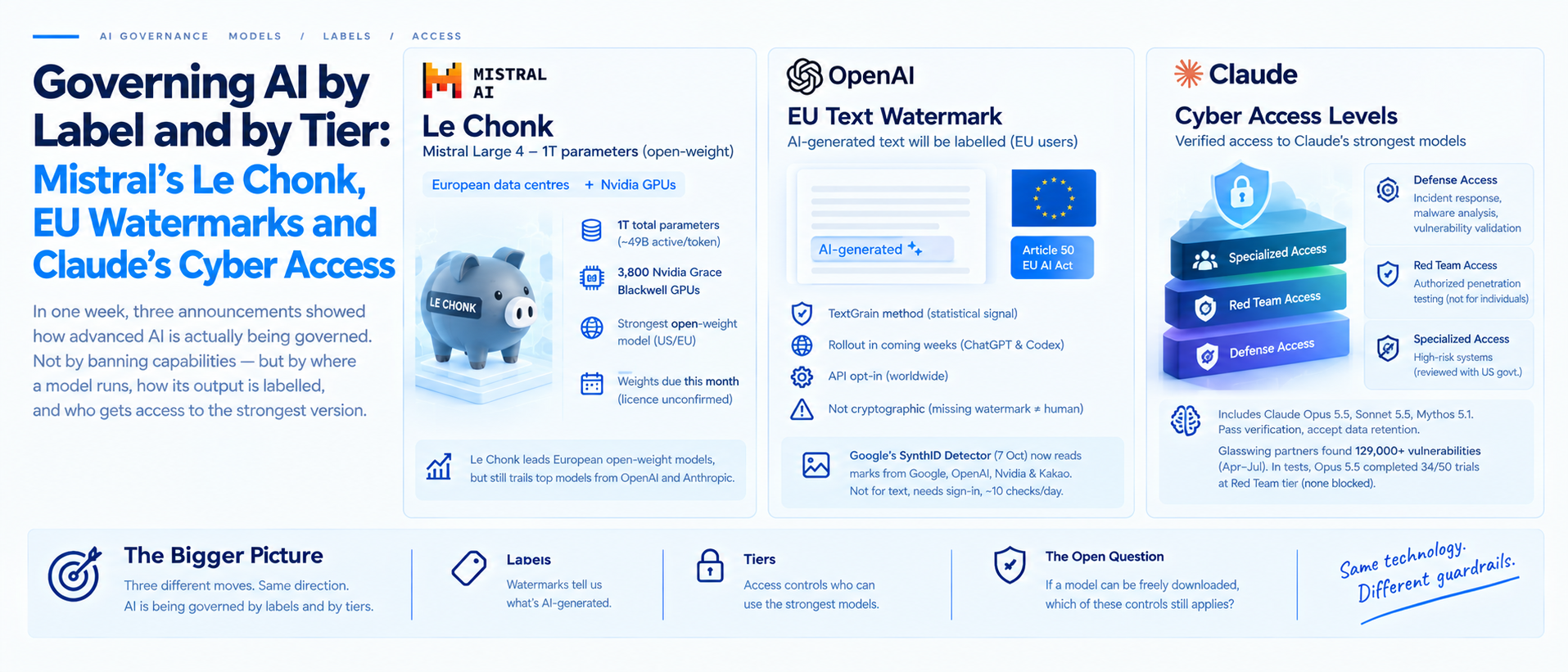
In one week, three announcements showed how advanced AI is actually being governed. Nobody banned a capability. Instead, companies sorted it: by where a model runs, by how its output is labelled, and by who is allowed to unlock the strongest version.
Le Chonk: Sovereignty With an American Chip Inside
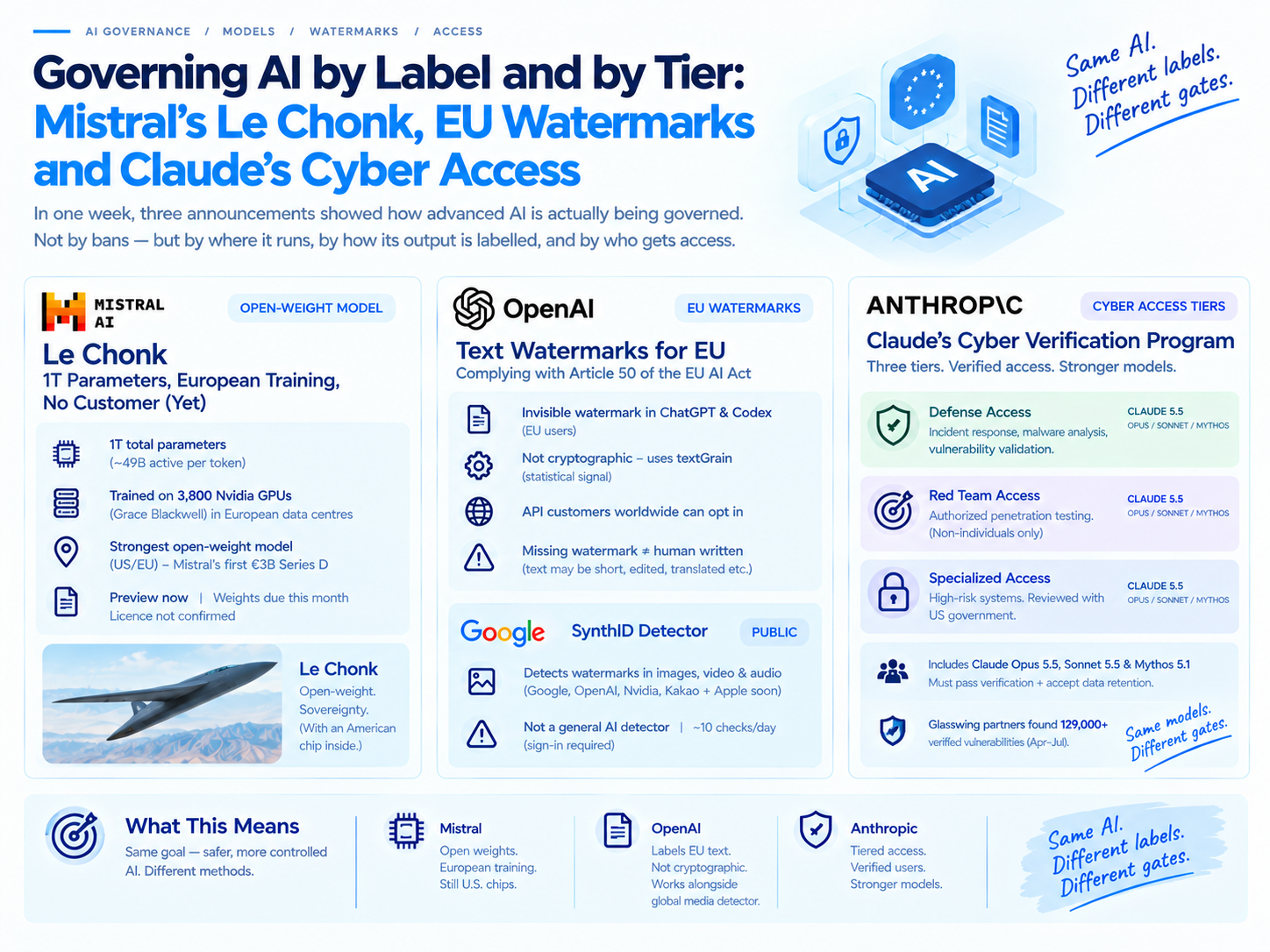
On 6 October, Mistral AI opened a public preview of Mistral Large 4, nicknamed Le Chonk. It is a mixture-of-experts model with about 1 trillion parameters in total, roughly 49 billion of them active per token. Mistral trained it on 3,800 Nvidia Grace Blackwell GPUs in its own European data centres, calls it the strongest open-weight model from the US or Europe, and says it is the first milestone funded by its €3 billion Series D.
Two caveats matter for anyone repeating the headline. First, this is a preview: the weights are promised by the end of the month, and the licence has not been confirmed. Second, the sovereignty claim covers where the model is trained and served, not whose silicon it runs on. Independent testing by Artificial Analysis, reported by The Register, also puts Le Chonk well behind the flagship models from OpenAI and Anthropic, even though it beats the best US open-weight model.
Watermarks Move From Pledge to Product
OpenAI said on 5 October that it will add an invisible watermark to eligible ChatGPT and Codex text for EU users over the coming weeks, to meet Article 50 of the AI Act, which requires AI-generated content to be machine-readable as such. Despite some descriptions, it is not cryptographic. OpenAI's textGrain method adds a statistical signal to the model's word choices, and API customers worldwide can opt in. OpenAI itself cautions that a missing watermark does not prove a human wrote something, since text may be short, edited, translated or produced by another tool. Anthropic began watermarking its output in August.
For images, video and audio, Google opened its public SynthID Detector on 7 October. It now reads marks from Google, OpenAI, Nvidia and Kakao, with Apple to follow. It does not cover text, and it is not a general AI detector: media without a supported watermark may pass unflagged. Reporting also says it requires sign-in and limits users to roughly 10 checks a day.
Claude's Cyber Access Tiers
Rather than a sandbox, Anthropic's 6 October announcement expanded its Cyber Verification Program into three tiers and folded Project Glasswing into it. Defense Access covers incident response, malware analysis and vulnerability validation. Red Team Access adds authorized penetration testing, open to organizations such as in-house red teams and security firms but not individuals. Specialized Access, for organizations testing high-risk systems, is reviewed together with the US government. Every tier includes Claude Opus 5.5, Sonnet 5.5 and Mythos 5.1, and members must pass verification and accept data retention so Anthropic can monitor for misuse.
Anthropic says Glasswing partners found at least 129,000 verified software vulnerabilities between April and July. In its own test, Opus 5.5 completed 34 of 50 trials at the Red Team tier with none blocked, though real-time blocks reportedly remain for ransomware and widespread-disruption scenarios. Because Anthropic makes Claude, treat these as company figures.
Where the Three Stories Meet
Mistral is also selling Le Chonk on cybersecurity, reporting 93% on the Cybench benchmark. It is offering early access to cybersecurity specialists and public bodies, reportedly with lighter moderation. Anthropic gates comparable capability behind verified identity. The difference is distribution: Mistral's weights are due out this month, and tiered access works only while a model stays on its maker's servers. A downloaded copy carries whatever safeguards its operator chooses to keep.
That leaves the question this week's announcements do not answer. Watermarks label output, and tiers control access to hosted models, but if a trillion-parameter model with strong cyber benchmarks is freely downloadable, which of those controls still applies?

Vicky Galfat
University of Mumbai/BCA
Learning, building, and exploring the world of technology one project at a time.