Back to News
News AlertWorld Money
Nobel Economics Prize 2026: Hall and Woodford's Impact
T
Author
Tushar Shrivas
Published
October 13, 2026
Reading Time
8 MIN READ
Spread the Word
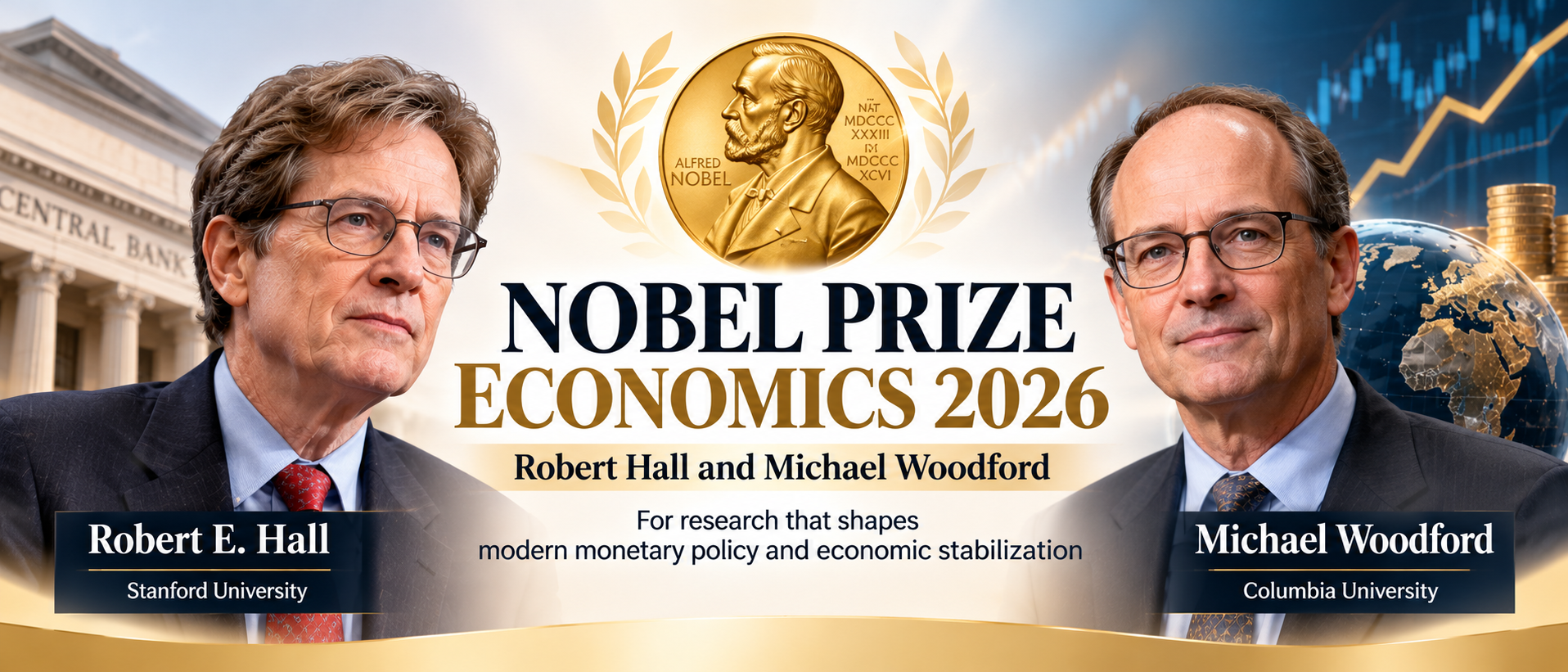
Robert Hall and Michael Woodford win the 2026 Economics Nobel for research shaping economic stabilization, monetary policy and central-bank decisions.
Robert Hall Michael Woodford, New Keynesian economics, monetary policy models, interest rates and inflation, macroeconomic stabilization, central bank policy
Nobel Prize Economics 2026: How Hall and Woodford Helped Shape Modern Economic Policy
As central banks navigate inflation, uncertain growth and volatile energy prices, two American economists have received the 2026 Nobel Memorial Prize in Economic Sciences for research that reshaped how economists understand economic fluctuations and stabilization policy.
Robert E. Hall of Stanford University and Michael Woodford of Columbia University were recognized for their work on the **microeconomic foundations of macroeconomic stabilization**. Their research connects the decisions made by individual households and businesses with broader economic outcomes, helping policymakers understand how monetary and fiscal measures can influence inflation, consumption and economic growth.
The award comes at a time when governments and central banks face difficult decisions about borrowing costs, price stability and economic resilience. The research recognized by the Nobel committee provides an important theoretical foundation for evaluating how policy decisions affect the wider economy. Royal Swedish Academy of Sciences
The Intellectual Shift: From Macroeconomic Trends to Individual Decisions
Traditional macroeconomic models often relied on statistical relationships between broad indicators such as inflation, production and consumption. Hall and Woodford contributed to a different approach: building economic models around the decisions of individual households and businesses.
This approach, known as microfoundations, examines how people make decisions about spending, saving and work, and how businesses decide what to produce and how to set prices. When these decisions are combined across an economy, they help explain wider patterns such as recessions, inflation and changes in economic growth.
The shift matters because people do not always respond to policy changes in predictable ways. A reduction in interest rates, for example, may encourage borrowing and spending, but the effect depends on household expectations, financial circumstances and businesses' willingness to invest.
The Nobel committee said the laureates' work provided a stable theoretical foundation for economic models now used by central banks and governments around the world.
How Their Research Helps Explain Interest-Rate Decisions
Central banks change policy interest rates to influence borrowing, spending, investment and inflation. Yet the effect of a rate decision depends on more than the size of the change itself. Expectations about future economic conditions can influence what households and businesses do today.
For example, lower interest rates can make borrowing more attractive and reduce the incentive to save. Higher rates can make credit more expensive and encourage some households to postpone large purchases. Businesses also consider expected demand and financing costs before deciding whether to expand operations.
Economic models built on microeconomic foundations help policymakers analyze these relationships and assess the potential consequences of different decisions. They provide a structured way to examine how a policy change might influence output, employment and inflation, although models cannot eliminate uncertainty or guarantee accurate forecasts.
The significance of Hall and Woodford's research is that it helped strengthen the theoretical basis for this kind of analysis. It did not give central banks a single formula that automatically determines the correct interest rate in every situation. Reuters
Robert Hall's Contribution: Understanding Household Consumption
Robert E. Hall's research has explored how households make consumption decisions and how those decisions respond to changes in income and expectations about the future. Household spending is an important part of economic activity, so understanding its drivers helps economists assess how the economy may respond to policy changes and financial shocks.
A household that expects its income to remain stable may continue spending even after a temporary drop in earnings. Another household facing uncertainty, high debt or limited savings may cut spending quickly. These differences matter because the same economic shock can affect consumers in very different ways.
Hall's work on consumption helped provide a foundation for models that examine how expectations of future income influence present-day spending. This is relevant to policymakers assessing whether a tax change, an interest-rate adjustment or a decline in confidence is likely to increase or reduce demand.
The practical lesson is that household behavior cannot always be predicted by looking at current income alone. Expectations, financial constraints and individual circumstances also matter. Stanford University
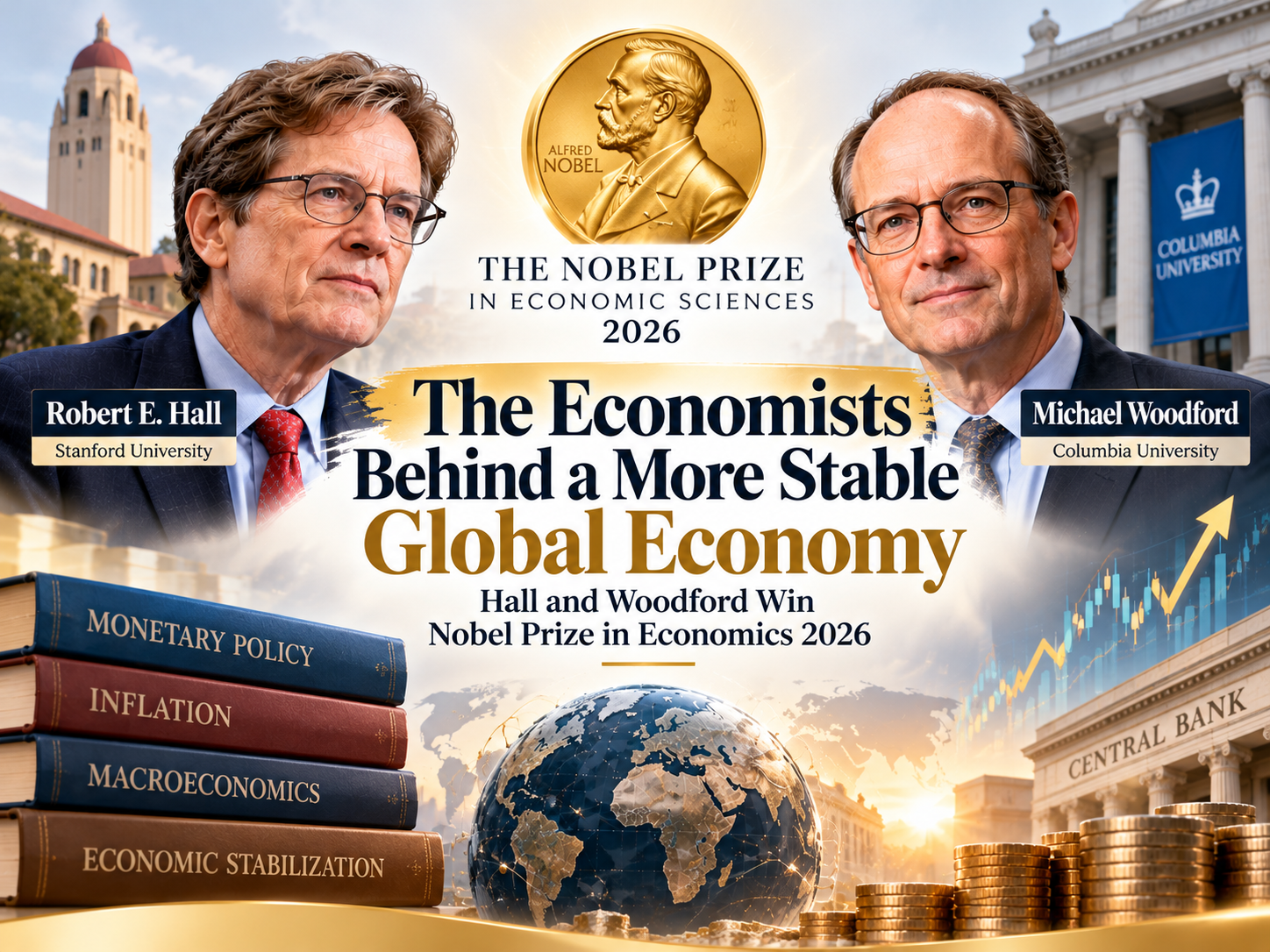
Why the Award Matters in Today's Economic Environment
The Nobel committee's recognition is particularly relevant when policymakers must respond to economic shocks. Sudden increases in energy prices, shifts in household spending or changes in business confidence can affect inflation and growth at the same time.
An energy-price shock, for example, can raise production and transport costs while reducing the amount households can spend on other goods and services. Policymakers must consider whether inflationary pressure is likely to persist, how demand may respond and whether policy changes could weaken economic activity further.
Models built on microeconomic foundations help economists analyze these interconnected effects. They can inform discussions about the likely consequences of different policy choices, while leaving room for judgment when the economy behaves differently from past experience.
The award does not mean that Hall and Woodford predicted every recent crisis or that their models can eliminate recessions. Instead, it recognizes research that improved the theoretical tools available to understand economic fluctuations and evaluate stabilization measures. Associated Press
What This Means for Investors and Financial Technology
For investors, the research offers a useful way to think about how expectations influence financial markets. Bond yields, stock valuations and currency movements can respond not only to current economic data but also to expectations about future interest rates, inflation and growth.
If investors expect interest rates to remain elevated, government and corporate borrowing costs may stay under pressure. Higher discount rates can also affect how investors value future corporate earnings. These are general market relationships, not a guarantee that any specific asset will rise or fall after an economic announcement.
Financial institutions use economic data, statistical models and market analysis to inform investment and risk-management decisions. Macroeconomic research can contribute to that analytical process, but it should not be confused with the specific algorithms used by high-frequency trading systems or automated wealth-management platforms.
The Nobel award does not establish that Hall and Woodford's models directly power these technologies. Their work is primarily important as a theoretical foundation for understanding economic behavior and stabilization policy. American Economic Association
The Bottom Line
The Bottom Line
The 2026 Nobel Memorial Prize in Economic Sciences recognizes Robert E. Hall and Michael Woodford for research that strengthened the theoretical foundations of modern economic stabilization policy. Their work helps explain how household and business decisions, expectations and government policies interact to influence inflation, spending and economic growth.
The award does not predict where interest rates or financial markets will move next. Instead, it highlights why policymakers need to understand the links between individual behavior and the wider economy when responding to shocks.
For World Money readers, the key takeaway is straightforward: interest-rate decisions are not based on inflation figures alone. Expectations, household spending, business behavior and confidence also influence how economies respond to shocks—and how markets interpret the next policy move.
FAQ
Who won the 2026 Nobel Prize in Economic Sciences?
Robert E. Hall of Stanford University and Michael Woodford of Columbia University received the 2026 prize for their work on the microeconomic foundations of macroeconomic stabilization.
Why did Hall and Woodford receive the Nobel Prize?
Their research helped develop economic models that connect household and business decisions with economy-wide outcomes. These models have improved the theoretical basis for analyzing economic fluctuations and stabilization policies.
How does their research relate to interest rates?
Their work contributes to understanding how expectations, consumption and business decisions interact with monetary policy. These relationships help economists analyze how interest-rate changes may influence spending, inflation and economic activity.
Will the Nobel Prize cause central banks to change interest rates?
No. The award recognizes academic research and does not itself change monetary policy. Central banks continue to make decisions based on inflation, employment, economic growth and other relevant conditions.
Does their research directly power algorithmic trading systems?
The award does not establish that their research directly powers specific trading systems. Their work provides theoretical foundations for understanding economic behavior and stabilization policy; financial firms use a variety of models and data in their analysis.
Why is this Nobel Prize relevant to investors?
The research highlights how expectations about future economic conditions and policy can influence spending, interest rates and market behavior. Investors can use this perspective to interpret economic news, while recognizing that no model can predict financial markets with certainty.

Tushar Shrivas
B.Tech CS@ Shri Balaji Institute of Technology & Management
I write at Metaplugs — breaking down the latest in tech, economics, and business into simple, impactful stories for everyday readers. Passionate about software testing and global finance.