Back to News
News AlertWorld Money
'Winter Is Coming': IMF Warns Debt Could Hit 100% of GDP
T
Author
Tushar Shrivas
Published
October 11, 2026
Reading Time
6 MIN READ
Spread the Word
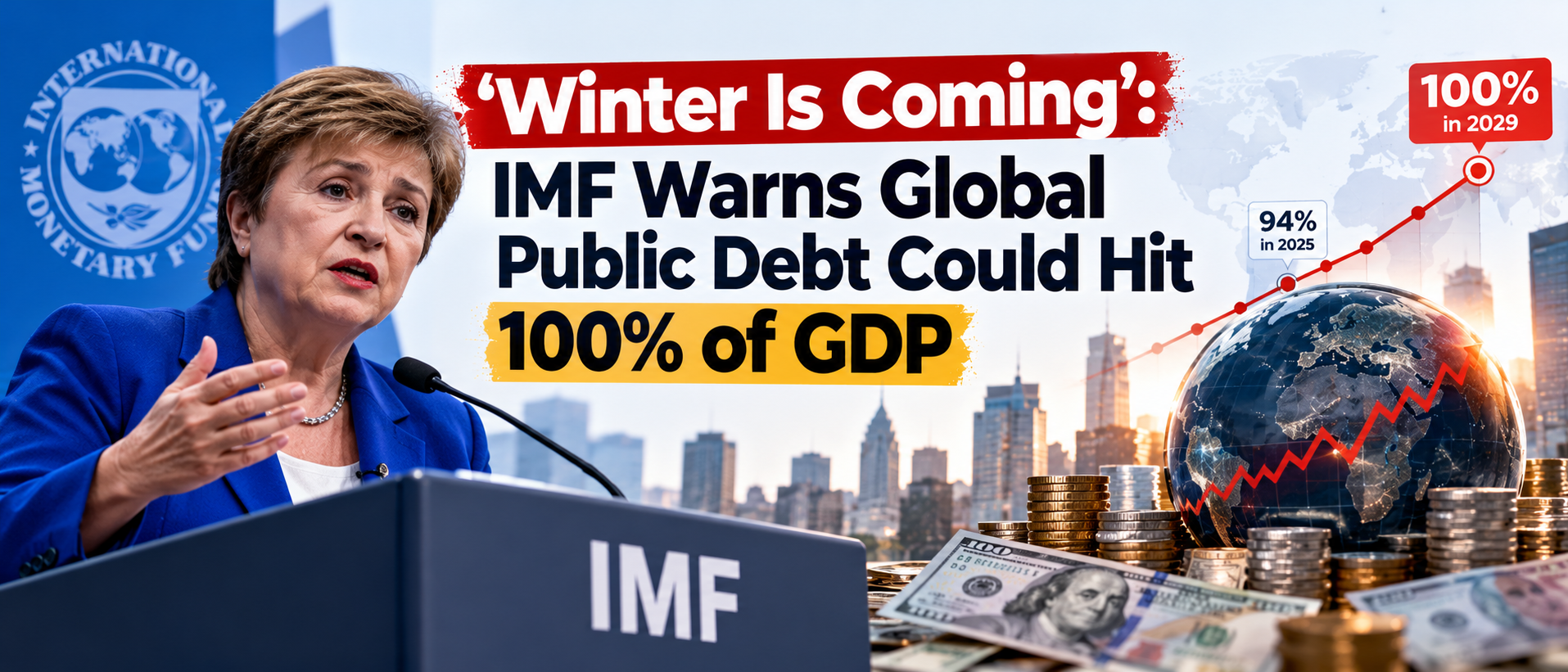
The IMF warns global public debt could reach 100% of GDP by 2029. Here's what rising debt, bond yields and inflation mean for markets.
global debt to GDP 2029, Kristalina Georgieva, IMF debt warning 2026, US Treasury yields, global bond market, inflation and interest rates, sovereign debt risk
global debt to GDP 2029, Kristalina Georgieva, IMF debt warning 2026, US Treasury yields, global bond market, inflation and interest rates, sovereign debt risk
'Winter Is Coming': IMF Warns Global Public Debt Could Hit 100% of World GDP
Global public debt is approaching the size of the world's annual economic output, raising concerns about government finances, borrowing costs and financial-market stability. IMF Managing Director Kristalina Georgieva used the phrase “winter is coming” in a warning about the risks facing the global economy, including high debt, rising bond yields and energy-price pressures.
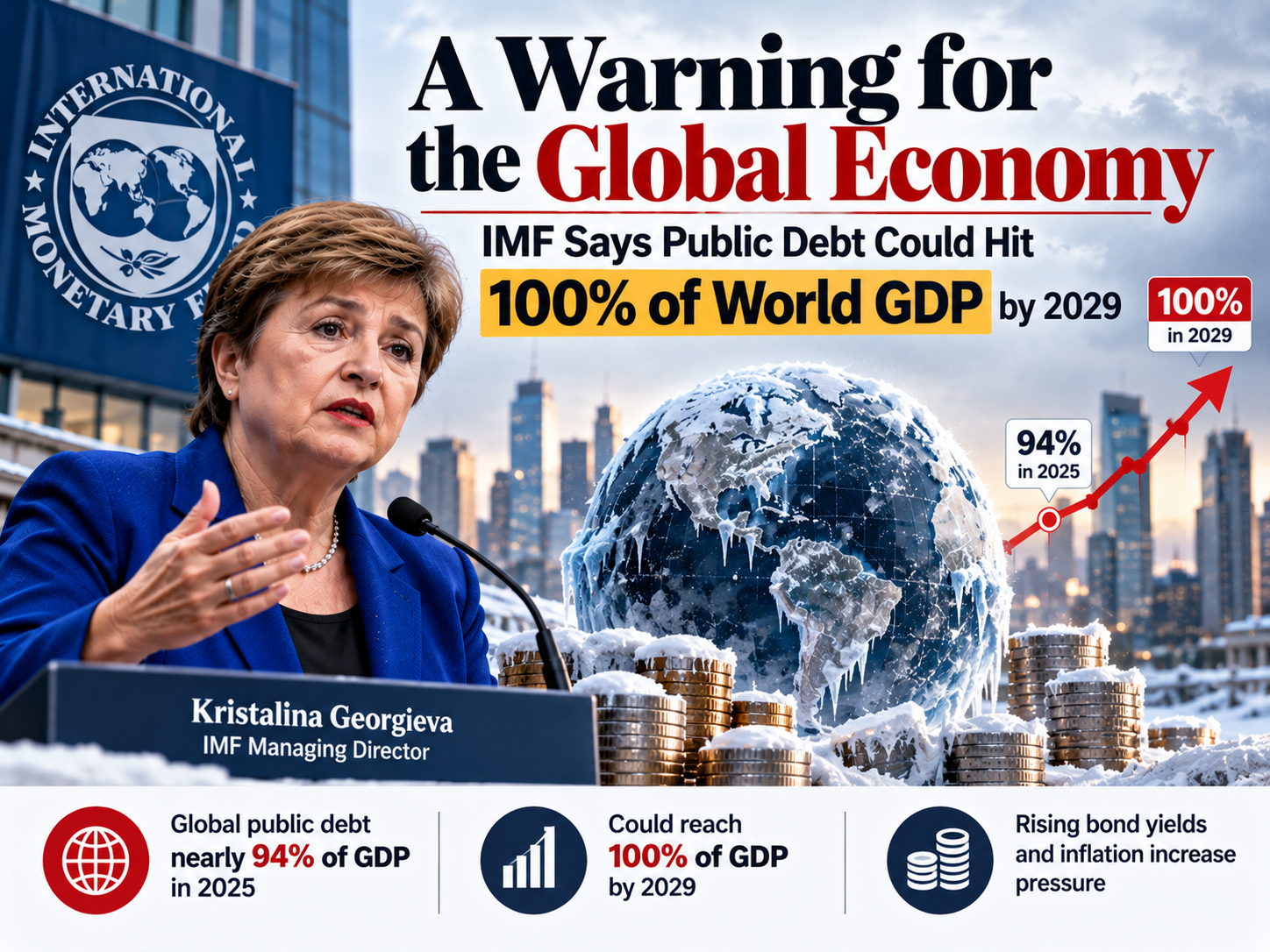
The key figure requires context: the IMF's April 2026 Fiscal Monitor estimated global public debt at nearly 94% of GDP in 2025 and projected it to reach 100% by 2029. The threshold has not been confirmed as already crossed. The forecast highlights how persistent deficits and growing interest expenses could put additional pressure on public finances. IMF
Why the IMF Is Warning About Global Debt
Public debt allows governments to fund infrastructure, healthcare, defence and other public services. The challenge emerges when borrowing rises faster than the economy's ability to support it, especially if interest payments consume an increasing share of government revenue. The IMF says mounting spending pressures and rising interest burdens are adding to fiscal strain across countries. IMF
The risks are not evenly distributed. Countries with large debt burdens and limited fiscal flexibility can be particularly exposed when investors demand higher returns to lend. The IMF has also highlighted structural changes in sovereign debt markets, including the growing role of leveraged non-bank financial intermediaries and a weakening of the US Treasury's traditional safety premium.
How Rising Bond Yields Affect Borrowing Costs
Government bond yields help set reference prices for borrowing across financial markets. When yields rise, governments may pay more to refinance maturing debt, while businesses and households can face higher financing costs depending on the type of loan and the credit risk involved. The impact can build over time as older, lower-cost debt is replaced with new borrowing. Reuters
Georgieva has warned that elevated bond yields are increasing governments' interest bills and intensifying pressure on already-constrained budgets. Higher yields do not automatically prevent central banks from cutting policy rates, however. Central banks still assess inflation, employment and broader economic conditions before deciding whether rates should rise, fall or remain unchanged. Financial Times
Energy Prices Add to the Fiscal Pressure
Energy Prices Add to the Fiscal Pressure
The Middle East conflict has created additional uncertainty for energy supplies and prices. Higher fuel costs can affect transport, manufacturing and food production, while governments may face pressure to support households and businesses exposed to sudden price increases. Such measures can provide short-term relief but may also add to public spending.
The combination of energy shocks and high debt makes economic policy more difficult. Governments must consider how to protect vulnerable groups without creating additional fiscal risks, while central banks must assess whether higher energy costs will feed into broader inflation. The IMF has warned that these effects will differ across countries, with energy-importing economies facing particular challenges.
What This Means for Businesses and Investors
For businesses, higher benchmark yields can increase the cost of loans, corporate bonds and refinancing. Companies planning major investments may need to reassess financing costs and cash-flow assumptions if borrowing remains expensive. The actual impact depends on the company's debt structure, creditworthiness and exposure to changes in interest rates.
For investors, rising yields can put downward pressure on the market prices of existing fixed-rate bonds, while newly issued bonds may offer higher returns. Equity valuations can also be affected when investors use higher discount rates to value future earnings. These relationships are not automatic predictions of market direction; inflation expectations, economic growth and credit conditions also matter.
Could DeFi and Tokenized Assets Benefit?
Decentralized finance (DeFi), tokenized real-world assets and private credit are developing parts of the financial ecosystem. Tokenization can represent claims on assets digitally, while DeFi protocols automate certain transactions and private-credit markets provide financing outside public bond markets. However, the IMF's debt warning alone does not prove that companies are moving treasury funds into these products.
These alternatives also carry risks, including liquidity constraints, credit losses, custody issues, smart-contract vulnerabilities and regulatory uncertainty. Corporate treasury teams need to assess capital preservation, liquidity, compliance and counterparty risk before using any yield-bearing product. A higher advertised yield does not automatically make an investment safer or more suitable.
The Bottom Line
The IMF's warning points to a growing fiscal challenge, not proof that a global financial crisis is inevitable. Global public debt was nearly 94% of GDP in 2025 and is projected to reach 100% by 2029. For businesses and investors, the practical priority is to track borrowing costs, inflation and government finances together rather than assuming interest rates will quickly return to lower levels.
FAQ
Has global public debt already crossed 100% of GDP?
The IMF estimated global public debt at nearly 94% of GDP in 2025 and projected it to reach 100% by 2029. The 100% figure is a forecast.
Does the warning mean central banks cannot cut interest rates?
No. Inflation and bond-market conditions may constrain rate cuts, but central banks make policy decisions based on their mandates and economic data. The IMF warning does not guarantee that rates will stay high throughout 2026 and 2027.
Why do rising bond yields matter?
Higher yields can increase government refinancing costs and influence borrowing rates for companies and households. They can also affect bond prices and how investors value future earnings.
Does this mean DeFi will replace government bonds?
No. The IMF warning does not establish such a shift. DeFi and tokenized assets have distinct risks and should not be presented as automatic replacements for sovereign bonds.

Tushar Shrivas
B.Tech CS@ Shri Balaji Institute of Technology & Management
I write at Metaplugs — breaking down the latest in tech, economics, and business into simple, impactful stories for everyday readers. Passionate about software testing and global finance.