Back to News
News AlertWorld AI Tech
Salesforce Just Put Job Titles on Its AI Agents — And That's the Real Sign the Chatbot Era Is Over
S
Author
Saumya Dawande
Published
September 14, 2026
Reading Time
4 MIN READ
Spread the Word
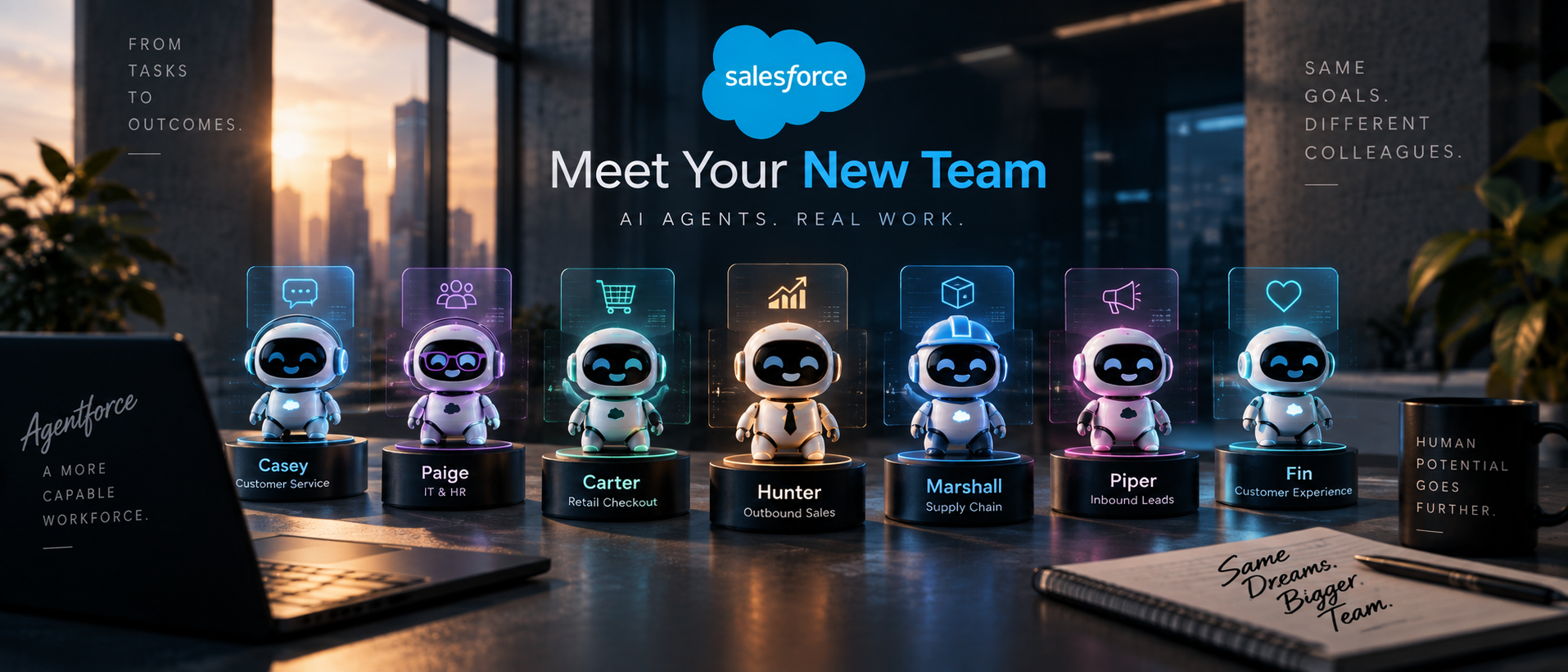
Salesforce just gave its AI agents names, job titles, and a runtime that can run a sales pipeline for weeks without a human checking in.
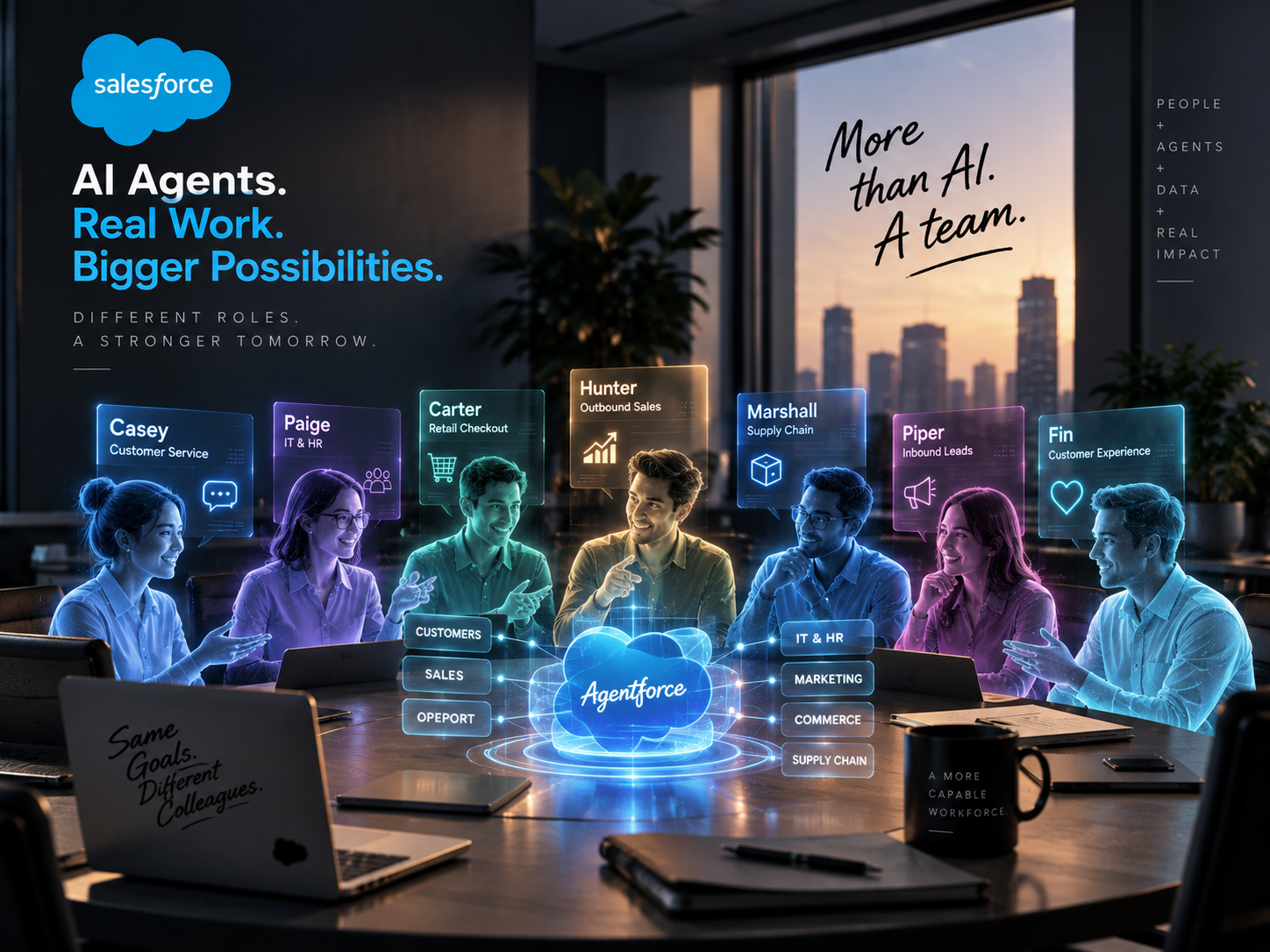
On September 11, days before its Dreamforce conference, Salesforce didn't launch a new chatbot feature. It launched seven employees. Casey, Paige, Carter, Hunter, Marshall, Piper, and Fin are AI agents, each built for one specific job — customer service, IT and HR requests, retail checkout, outbound sales, supply chain, inbound lead qualification, and customer experience — and Salesforce is selling them the way it would sell headcount, not software features. Technobezz , Startup Fortune
Six of the seven are already generally available. The genuinely new piece is Hunter, the outbound sales agent, still in pilot ahead of a November rollout because it runs on what Salesforce calls a long-horizon runtime — infrastructure built to keep an agent working toward a goal for weeks at a time instead of resetting after every chat session. That's a real technical shift from "answer this prompt" to "own this outcome," and it's paired with Multi-Agent Orchestration, now generally available, which routes work between the seven agents automatically instead of requiring a human to hand off tasks between them. Salesforce says the platform has already delivered 7 billion "agentic work units" through Agentforce and Slack, 3.2 billion of them in the second quarter alone. Technobezz , Let's Data Science
The most interesting data point in the launch isn't even about a Salesforce customer — it's about Anthropic. Fin, the customer-experience agent Salesforce picked up through its Intercom acquisition, reportedly resolves 79% of Anthropic's own support conversations without a human ever stepping in. That's notable precisely because Anthropic is an AI lab, not a company that would tolerate a weak product just to look good in a case study — it's one of the more credible signals yet that agentic support tools have crossed from "assists a human agent" to "replaces the first line of one" in production, not just in a demo.Startup Fortune
Salesforce didn't ship this in a vacuum. Since December 2025, most of the industry — Anthropic, OpenAI, Google, Microsoft, AWS, and dozens of others — has been aligning under the Agentic AI Foundation, a Linux Foundation initiative hosted alongside Anthropic's Model Context Protocol, which now counts more than 10,000 public servers connecting AI models to outside tools and data. That's the plumbing layer making moves like Salesforce's possible: agents that can reliably reach into a CRM, a support inbox, or a supply-chain system without every integration being custom-built from scratch. Salesforce paired its own launch with something from that same governance conversation — a six-pillar framework it calls the Trusted Enterprise AI Harness, plus an "AI Control Plane" meant to monitor and govern agents across a company, including ones not built on Salesforce at all. Linux Foundation, Kurums
That governance layer exists because the risk is real, not theoretical. The same week Salesforce was naming its agents, security vendors CrowdStrike, Proofpoint, and Tenable all shipped new products specifically built to vet and monitor AI agents before letting them near production systems — a direct response to incidents like "GitSpawn," a set of vulnerabilities researchers found spanning seven different coding agents, including some of the most widely used ones on the market. Giving an agent the authority to independently touch a CRM, a codebase, or a customer's account for weeks at a stretch is exactly the kind of access that turns a coding mistake into a business incident. The Autonomous Edge
Salesforce didn't disclose pricing for any of the seven agents, so the honest test of this shift hasn't happened yet — it starts once real customers put Hunter on a live sales pipeline for a month and see whether "long-horizon" means reliably useful or just longer before something goes wrong unsupervised. The chatbot era isn't dead because a vendor said so in a press release. It'll be dead when enterprises stop asking whether an agent can finish a task, and start asking whether they trust it to finish the right one.

Saumya Dawande
B.Tech AIML @ oriental institute of science technology bhopal
Engineering and tech journalist. I love exploring the impact of emerging technologies on global defense, sovereignty, and everyday life. Always looking for the real story behind the headlines.