Back to News
News AlertWorld Unicorn
Space and Real-Estate PropTech Take Center Stage
V
Author
Vishal Sable
Published
July 6, 2026
Reading Time
4 MIN READ
Spread the Word
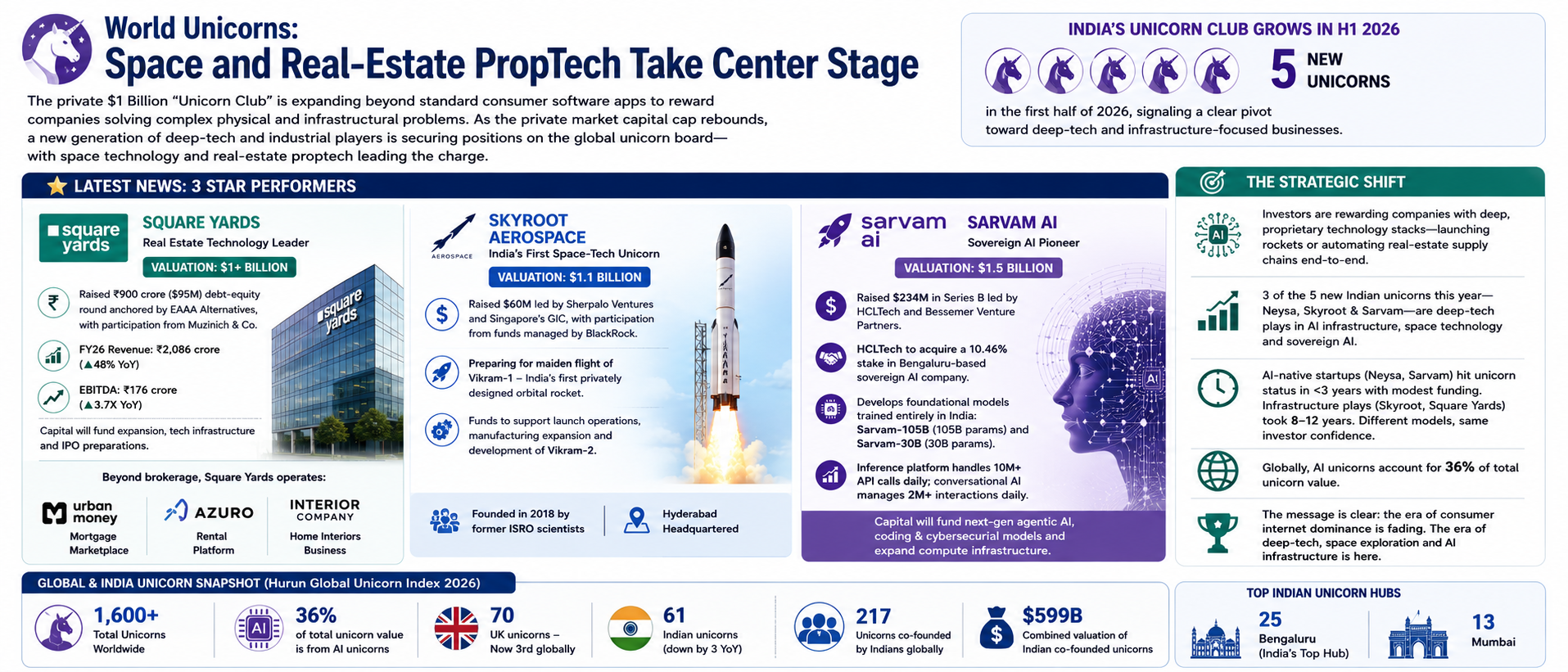
The private $1 Billion "Unicorn Club" is expanding beyond standard consumer software apps to reward companies solving complex physical and infrastructural problems. As the private market capital cap rebounds, a new generation of deep-tech and industrial players is securing positions on the global unicorn board—with space technology and real-estate proptech leading the charge.
The Latest News
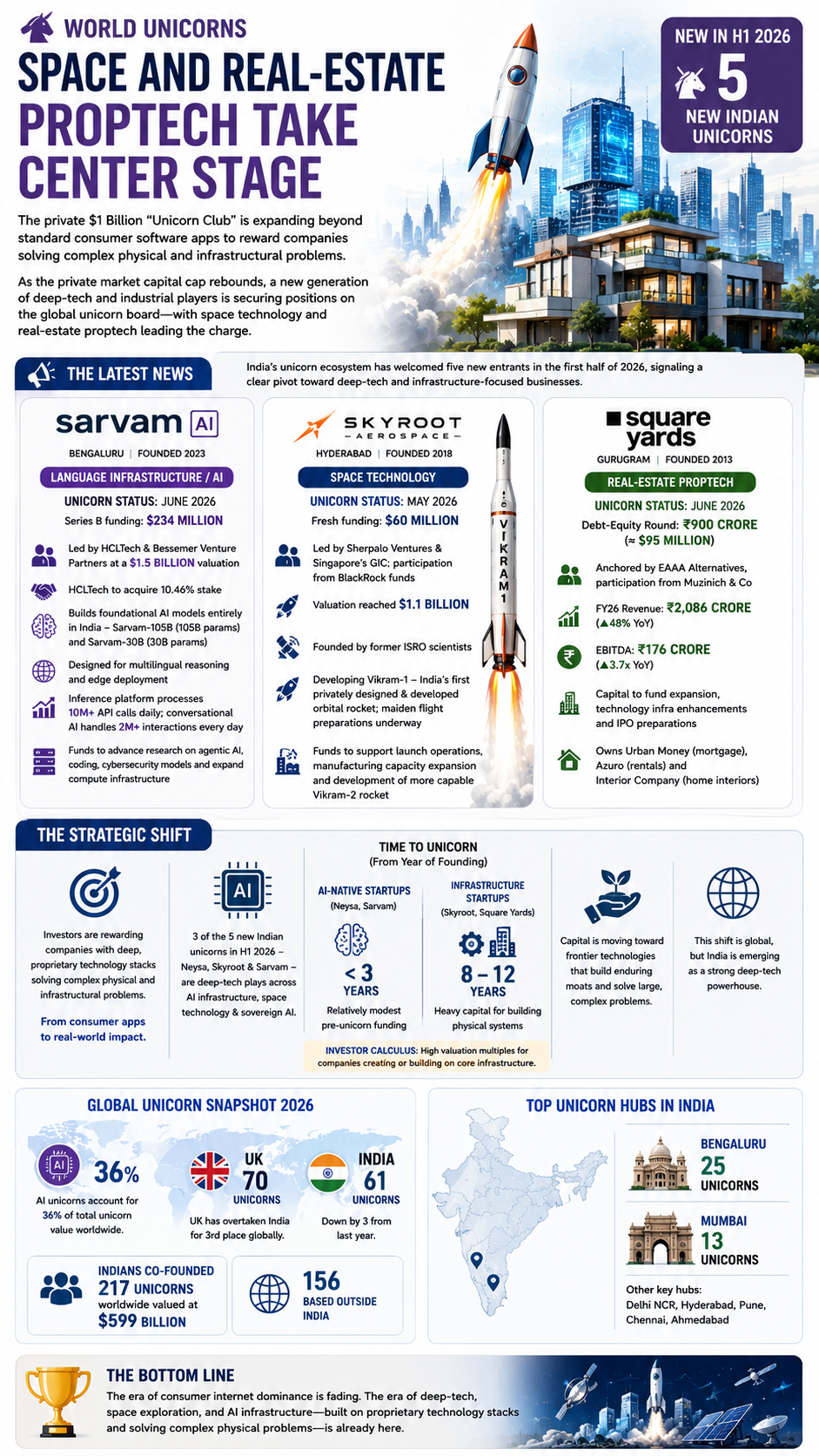
India's unicorn ecosystem has welcomed five new entrants in the first half of 2026, signaling a clear pivot toward deep-tech and infrastructure-focused businesses . The new unicorns include Bengaluru-based language infrastructure builder Sarvam AI, Hyderabad space pioneer Skyroot Aerospace, and real estate technology leader Square Yards .
Square Yards officially crossed the $1 billion threshold following a massive ₹900 crore ($95 million) debt-equity funding round anchored by EAAA Alternatives, with participation from global corporate credit manager Muzinich & Co . The Gurugram-based proptech firm reported FY26 revenue of ₹2,086 crore, marking a 48% year-on-year increase, while EBITDA surged 3.7 times to ₹176 crore . The capital will fund expansion initiatives, technology infrastructure enhancements, and IPO preparations . Beyond its core brokerage business, Square Yards operates mortgage marketplace Urban Money, rental platform Azuro, and home interiors business Interior Company .
Skyroot Aerospace became India's first space-tech unicorn in May 2026 after securing $60 million in fresh funding led by Sherpalo Ventures and Singapore's GIC, with participation from funds managed by BlackRock, pushing its valuation to $1.1 billion . The Hyderabad-based startup, founded in 2018 by former ISRO scientists, is preparing for the maiden flight of Vikram-1—India's first privately designed and developed orbital rocket . The funds will support launch operations, manufacturing capacity expansion, and development of the more capable Vikram-2 rocket .
Sarvam AI achieved unicorn status in June 2026 after raising $234 million in its Series B funding round led by HCLTech and Bessemer Venture Partners, reaching a post-money valuation of $1.5 billion . HCLTech will acquire a 10.46% stake in the Bengaluru-based sovereign AI company . The company develops foundational AI models trained entirely in India, including the 105-billion-parameter Sarvam-105B and the 30-billion-parameter Sarvam-30B, designed for multilingual reasoning and edge deployment . The fresh capital will fund research on next-generation agentic AI, coding, and cybersecurity models while expanding compute infrastructure . Sarvam's inference platform now processes more than 10 million API calls daily, while its conversational AI systems handle over two million interactions every day .
The Strategic Shift
This new wave of unicorns highlights that private investors are strictly rewarding companies with deep, proprietary technology stacks—whether that means launching commercial orbital rockets or automating real-estate market supply chains end-to-end. Three of the five new Indian unicorns this year—Neysa, Skyroot, and Sarvam—are deep-tech plays spanning AI infrastructure, space technology, and sovereign AI, suggesting a fundamental shift away from fintech and consumer internet dominance toward frontier technologies .
The investment pattern is unmistakable: AI-native startups like Neysa and Sarvam achieved unicorn status in under three years with relatively modest pre-unicorn funding, while infrastructure-focused companies like Skyroot and Square Yards took between eight and twelve years to cross the billion-dollar threshold . This reflects a precise investor calculus: where companies build on established infrastructure or create entirely new physical systems, capital moves at high valuation multiples .
Globally, artificial intelligence emerged as the biggest driver of wealth creation, with AI unicorns accounting for 36% of total unicorn value worldwide . The UK has overtaken India for third place globally with 70 unicorns, while India now counts 61 unicorns—down by three from last year—according to the Hurun Global Unicorn Index 2026 . However, Indians have co-founded 217 unicorns worldwide valued at a combined $599 billion, with 156 based outside India . Bengaluru remains India's top unicorn hub with 25 companies, followed by Mumbai with 13 .
The message from the market is clear: the era of consumer internet dominance is fading. The era of deep-tech, space exploration, and AI infrastructure—built on proprietary technology stacks and solving complex physical problems—is already here.

Vishal Sable
B.Tech AD @ shri balaji institute of technology and management
Engineering and tech journalist. I love exploring the impact of emerging technologies on global defense, sovereignty, and everyday life. Always looking for the real story behind the headlines.